

Written by Luis Aburto, Scio's CEO.

Technical debt is often framed as an engineering concern. In practice, it behaves much more like a financial liability that simply does not appear on the balance sheet. It has principal, it accrues interest, and it limits future strategic options. In Software Holding Companies and private equity-backed software businesses, this technical debt financial risk compounds across portfolios and is frequently exposed at the most inconvenient moments, including exits, integrations, and platform shifts.
Leaders who treat technical debt as an explicit, governed liability make clearer trade-offs, protect cash flows, and preserve enterprise value. Leaders who do not often discover the cost during the periods when it matters most.
TABLE OF CONTENTS
Definition: Clarifying Key Terms Early
Before exploring the implications, it is useful to align on terminology using precise, non-financial language.
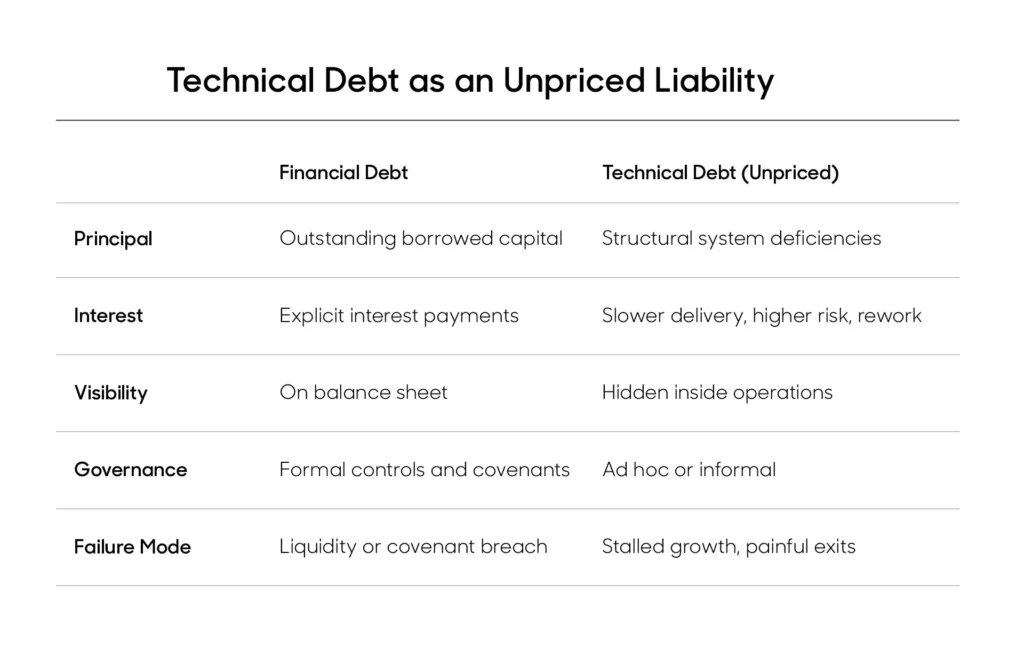
- Technical debt refers to structural compromises in software systems that increase the long-term cost, risk, or effort required to change or operate them. These compromises may involve architecture, code quality, data models, infrastructure, tooling, or integration patterns.
- Principal is the underlying structural deficiency itself. Examples include tightly coupled systems, obsolete frameworks, fragile data models, or undocumented business logic.
- Interest is the ongoing cost of carrying that deficiency. It shows up as slower development, higher defect rates, security exposure, operational risk, or increased maintenance effort.
- Unpriced liability describes a real economic burden that affects cash flow, risk, and valuation but is not explicitly captured on financial statements, dashboards, or governance processes.
This framing matters. Technical debt is not a failure of discipline or talent. It is the result of rational trade-offs made under time, market, or capital constraints. The issue is not that debt exists, but that it is rarely priced, disclosed, or actively managed.
The Problem: Where Technical Debt Actually Hides
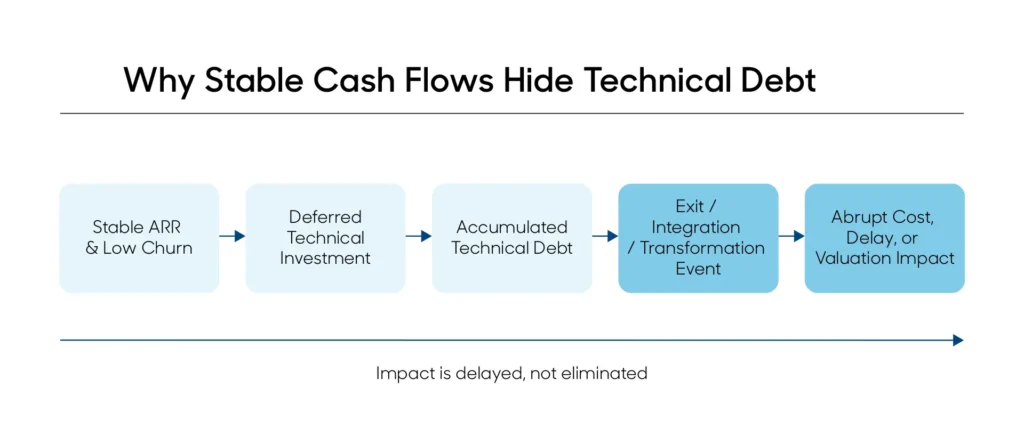
A common executive question is straightforward: if technical debt is such a serious issue, why does it remain invisible for so long? The answer is stability.
Many mid-market software companies operate with predictable recurring revenue, low churn, and strong margins. These are positive indicators financially, but they can also obscure structural fragility. Technical debt rarely causes immediate outages or obvious failures. Instead, it constrains change. As long as customers renew and systems remain operational, the business appears healthy. Over time, however, reinvestment is deferred. Maintenance work crowds out improvement. Core systems remain untouched because modifying them feels risky.
In SHCs and PE-backed environments, this dynamic compounds:
- Each acquisition brings its own technology history and shortcuts.
- PortCos are often optimized for EBITDA rather than reinvestment.
- Architectural inconsistencies accumulate across the portfolio.
The result is a set of businesses that look stable on paper but are increasingly brittle underneath. The debt exists, but it is buried inside steady cash flows and acceptable service levels.
Why This Matters Operationally and Financially
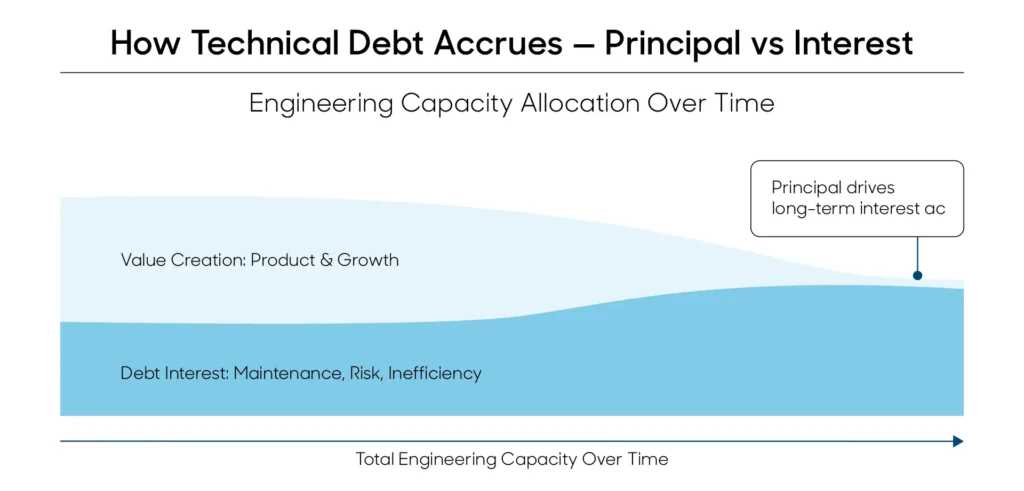
From an operational perspective, technical debt financial risk acts like a tax on execution. Multiple studies show that 20 to 40 percent of engineering effort in mature software organizations is consumed by maintenance and rework rather than new value creation. McKinsey has reported that technical debt can absorb up to 40 percent of the value of IT projects, largely through lost productivity and delays.
Teams experience this as friction: roadmaps slip, changes take longer than expected, and engineers avoid touching critical systems. Over time, innovation slows even when headcount and spend remain flat or increase. Gartner estimates that organizations spend up to 40 percent of their IT budgets servicing technical debt, often without explicitly recognizing it as such. That spend is capital not deployed toward growth, differentiation, or strategic initiatives.
In M&A contexts, the consequences become sharper. Technical debt often surfaces during diligence, integration planning, or exit preparation. Required refactoring, modernization, or security remediation can delay value creation by 12 to 24 months, forcing buyers to reprice risk or adjust integration timelines. In practical terms, unmanaged technical debt:
- Reduces operational agility
- Diverts capital from growth
- Compresses valuation multiples
It behaves like financial debt in every meaningful way, except it lacks accounting discipline.
How This Shows Up in Practice: 3 Realistic Examples
Example 1: The profitable but frozen PortCo
A vertical SaaS company shows strong margins and low churn. Cash flow is reliable. Customers are loyal. Yet every meaningful feature takes months longer than planned. Under the surface, the core platform was built quickly years earlier. Business logic is tightly coupled. Documentation is limited. Engineers avoid core modules because small changes can trigger unexpected consequences.
The company is profitable, but functionally constrained. The cost does not appear on the income statement. It appears in missed opportunities and slow response to market change.
Example 2: The post-acquisition surprise
A private equity firm acquires a mid-market software business with attractive ARR and retention metrics. Diligence focuses on revenue quality, pricing, and sales efficiency. Within months of closing, it becomes clear that the product depends on end-of-life infrastructure and custom integrations that do not scale. Security remediation becomes urgent. Feature launches are delayed. Capital intended for growth is redirected to stabilization.
The investment thesis remains intact, but its timeline, risk profile, and capital needs change materially due to previously unpriced technical debt.
Example 3: The roll-up integration bottleneck
An SHC acquires several software companies in adjacent markets and plans shared services and cross-selling. Nearshore teams are added quickly. Hiring is not the constraint. The constraint is that systems are too brittle to integrate efficiently. Standardization efforts stall. Integration costs rise. The issue is not talent or geography. It is accumulated structural debt across the portfolio.
Recommended Approaches: Managing Debt Without Freezing Innovation
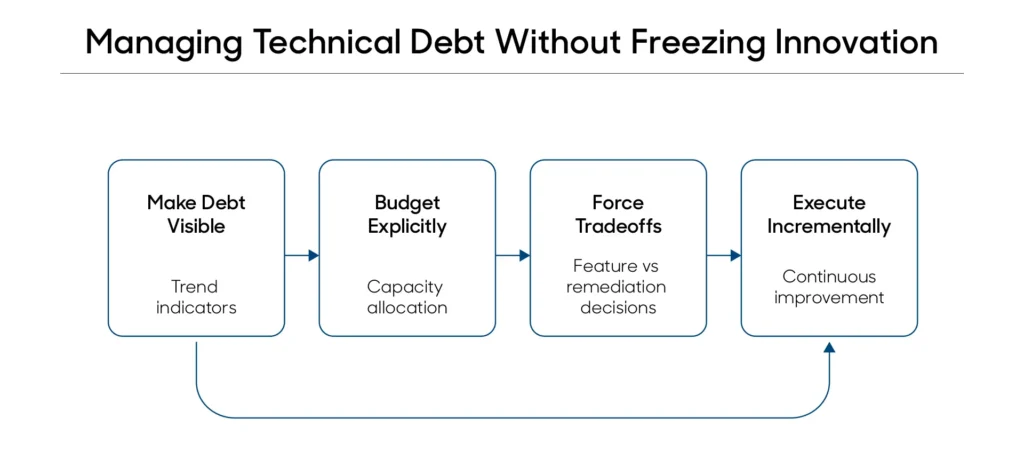
The objective is not to eliminate technical debt. That is neither realistic nor desirable. The objective is to manage it deliberately.
Make the liability visible
Treat technical debt as a standing agenda item. Simple, trend-based indicators are sufficient. Precision matters less than visibility. Separating principal from interest helps focus attention on what truly constrains progress.
Budget explicitly for debt service
High-performing organizations allocate a fixed percentage of engineering capacity to debt service, similar to budgeting for interest payments. Early efforts should prioritize reducing interest through reliability, security, and speed improvements.
Embed trade-offs into governance
Every roadmap reflects trade-offs. Making them explicit improves decision quality. Feature delivery versus remediation should be a conscious, documented choice that is revisited regularly rather than resolved through implicit prioritization.
Use nearshore teams strategically
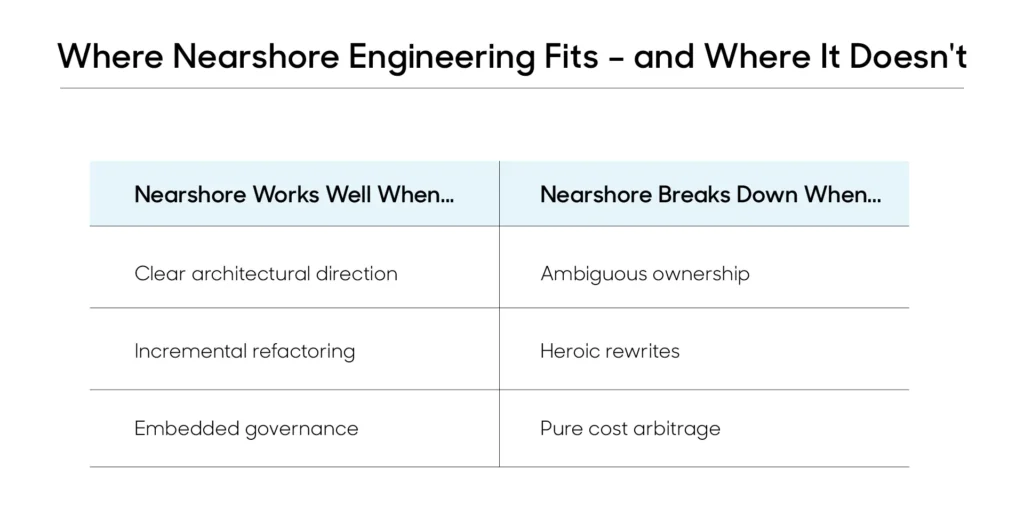
Nearshore engineering can be highly effective for stabilization, incremental refactoring, and platform standardization. Time zone alignment, cost efficiency, and access to skilled engineers make it a strong lever when used correctly. Success depends on clear architectural direction, strong ownership, and mature delivery practices. Not all nearshore partners deliver the same results. Execution quality matters.
Common Pitfalls and How to Avoid Them
| Pitfall | Why It Fails |
| Treating debt as a cleanup project | Often leads to large, risky rewrites. Continuous management is safer and more effective. |
| Assuming stability equals health | Stable uptime does not imply adaptability. Track friction in change, not just availability. |
| Over-optimizing for short-term EBITDA | Deferring reinvestment to hit near-term margins often destroys long-term value. |
| Blaming execution partners | In most cases, debt predates vendors. Fixing system constraints matters more than changing staffing models. |
What This Means for PE-Backed Portfolios
For PE-backed software portfolios the technical debt question is not an engineering concern. It is a value creation concern. The five costs in this article, EBITDA drag, delayed roadmaps, integration bottlenecks, diligence exposure, and constrained capital allocation, directly affect hold period performance and exit outcomes.
The most effective approach is to treat technical debt financial risk as a portfolio-level governance item from day one post-acquisition. A platform health assessment at acquisition, a standing allocation for debt service across PortCos, and a nearshore engineering partner capable of stabilization and incremental refactoring work are the operating components of that governance model.
In complex SHC and private equity environments, partners like Scio support these efforts by providing nearshore engineering teams that integrate into disciplined operating models and help manage technical debt without slowing innovation. For independent software companies the same principle applies at the company level: visible debt, governed trade-offs, and protected capacity for debt service are the practices that separate companies that compound value from those that stall.
Frequently Asked Questions
Is technical debt always a problem?
No. Like financial leverage, it can be rational when used intentionally. A startup that ships quickly to validate a product hypothesis is making a deliberate trade-off, not a mistake. Problems arise when technical debt is unmanaged and invisible, accumulating interest without acknowledgment and limiting strategic options at the moments when flexibility matters most, including exits, acquisitions, and platform transitions.
Can tools alone solve technical debt?
No. Tools help with visibility and measurement, but governance and decision-making are the primary levers. Technical debt is fundamentally a management problem, not a tooling problem. The most effective organizations treat it as a standing agenda item with explicit budget allocation and governed trade-offs, not as something to be solved by switching platforms or adding monitoring dashboards.
Should CFOs be directly involved in technical debt decisions?
Yes. Technical debt directly affects capital allocation, risk, and valuation. CFOs who understand the principal and interest framing can evaluate modernization investments using the same framework they apply to financial debt service: what is the carrying cost, what is the payoff timeline, and what is the risk of deferral. Excluding CFOs from technical debt governance typically results in under-investment and the kind of deferred-maintenance debt that creates valuation surprises during diligence.
How should PE firms think about technical debt during M&A diligence?
As an unpriced liability that affects both the investment thesis and the integration timeline. Technical debt assessment should be a standard component of technology diligence alongside code quality review, security audit, and infrastructure evaluation. The question is not whether technical debt exists but whether its principal is visible, whether its interest is measurable, and whether the remediation cost is correctly priced into the deal structure and the post-acquisition capital plan.
Key Takeaways for Business Leaders
Technical debt behaves like financial debt and should be managed as such. Stable cash flows often hide growing structural risk. The principal and interest framing improves decision quality by making the true cost of deferral visible. Explicit trade-offs outperform heroic fixes.
The five real costs that PE leaders most often miss, EBITDA drag from maintenance overhead, delayed roadmaps, integration bottlenecks at acquisition, diligence exposure at exit, and capital diverted from growth, are all expressions of the same underlying technical debt financial risk. Making that risk visible, governing it deliberately, and allocating capacity for debt service are the practices that protect enterprise value.
In complex SHC and private equity environments, partners like Scio support these efforts by providing nearshore engineering teams that integrate into disciplined operating models and help manage technical debt without slowing innovation. If this is relevant to how your organization is thinking about platform risk, I would be glad to talk through it.
References and Further Reading
- McKinsey and Company, Technology and Digital Research. Research reporting that technical debt can absorb up to 40 percent of the value of IT projects through lost productivity and delivery delays, and that 10 to 15 assets typically drive the majority of technical debt within a portfolio. https://www.mckinsey.com/
- Gartner, IT Technical Debt and Budget Research. Analysis estimating that organizations spend up to 40 percent of their IT budgets servicing technical debt, often without recognizing it as such, representing capital not deployed toward growth or differentiation. https://www.gartner.com/
- Alvarez and Marsal, Software Product and Technology Diligence Practice. M&A advisory practice that evaluates technical debt as an acquisition risk factor, including how unpriced structural deficiencies create valuation uncertainty, integration delays, and remediation cost during deal execution. https://www.alvarezandmarsal.com/
- Deloitte Insights, Technical Debt and Innovation. Research reporting that up to 70 percent of technology leaders identify technical debt as the primary cause of productivity loss and a significant barrier to the innovation capacity that growth theses depend on. https://www.deloitte.com/
- Harvard Business Review, Engineering Debt and Organizational Performance. Research on how deferred platform investment affects business performance, innovation velocity, and the organizational resilience required to execute growth strategies in knowledge-intensive industries. https://hbr.org/
- DORA (DevOps Research and Assessment), State of DevOps Report. Annual research benchmarking the delivery performance practices that distinguish high-performing engineering organizations, including the governance of technical debt as a structural determinant of velocity and reliability. https://dora.dev/publications/
- Scio blog, Platform Modernization Strategy: How to Reduce Risk Without Pausing the Roadmap. Detailed framework for addressing technical debt through slice-based modernization, directly relevant to the remediation approach that PE-backed organizations need during hold periods. https://sciodev.com/blog/platform-modernization-strategy/
- Scio blog, Technical Debt Hidden Cost: 5 Real Risks CTOs Underestimate. Complementary analysis of how technical debt creates hidden operational and business cost beyond engineering metrics, useful for building the internal governance case for technical debt visibility. https://sciodev.com/blog/technical-debt-hidden-cost/