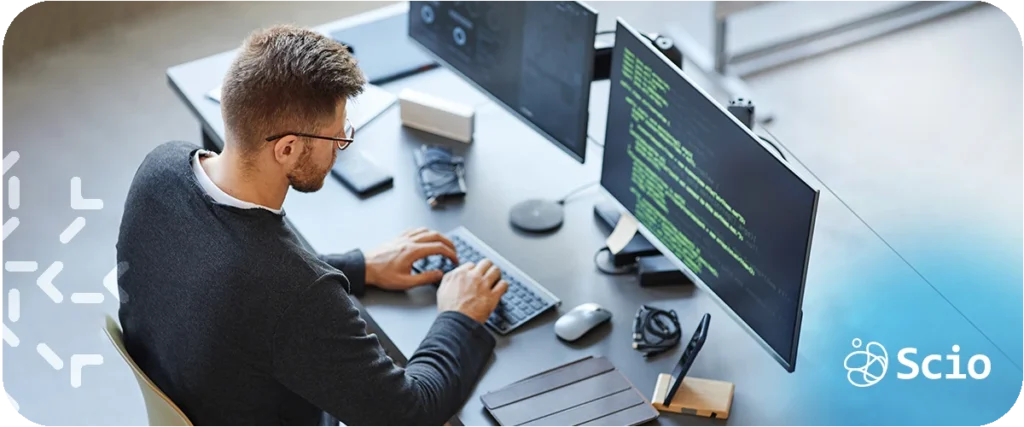
Stereotypes shape how many people think about software development. For decades, the image of the solitary coder, immersed in complex problems and preferring limited interaction, has influenced how the profession is described and sometimes even how teams are built. But does personality really predict engineering performance? Are introverts better programmers than their extraverted peers, or is this stereotype simply outdated?
For engineering leaders and CTOs, this question matters. Building high-performing teams requires more than technical talent. It demands communication, empathy, clarity, and strategic alignment, especially in hybrid and remote environments. This article breaks down five myths about personality and programming, examines current research, and offers a clearer picture of what actually predicts engineering performance.
Table of Contents
Where the Introvert Programmer Stereotype Came From
The idea of profiling people into fixed personality groups is much older than modern psychology. Early frameworks attempted to categorize humans into rigid clusters based on emotion and behavior. Over time, these models evolved into more structured tools like the Myers-Briggs Type Indicator, which remains popular in workplaces despite its limitations.
This assumption was reinforced by early programming environments, which were more isolated and less collaborative. Programming in the 1970s, 1980s, and even 1990s involved long stretches of solo work and tightly siloed roles. Under those conditions, people with introspective working preferences may have appeared more suited to the craft. Today's engineering realities are dramatically different. Modern software development relies on Agile practices, continuous delivery, collective code ownership, and cross-functional collaboration. Engineering has become a team sport, and the stereotype persists mainly because it is simple and culturally reinforced, not because it reflects how teams actually operate.
What Introversion Actually Means
Much of the misunderstanding comes from confusing introversion with social withdrawal. Modern personality research defines introversion and extraversion based on energy orientation, not sociability. Introverts gain energy from reflection and focused thinking. Extraverts gain energy from interaction and external stimulation. Neither trait is inherently better for programming.
Many software engineers who identify as introverted are, in fact, capable communicators who form strong bonds with colleagues and serve as empathetic mentors. They simply prefer depth over frequency in social interactions. The important question is not whether someone leans inward or outward socially. It is whether their cognitive preferences support problem-solving, abstraction, and clear communication, all of which matter for engineering success regardless of personality type.
5 Myths About Personality and Programming
Myth 1: Introverts are inherently better at deep technical work
No credible research supports the claim that introverts are inherently better programmers. High-performing engineers share traits across the cognitive and interpersonal spectrum: strong analytical reasoning, attention to detail, pattern recognition, clear communication, and openness to feedback. These traits exist in any personality type.
Myth 2: Extraverts are too social to focus on complex code
Extraverts can be highly analytical and capable of the sustained focus that complex debugging or architecture work requires. The misconception conflates sociability with an inability to concentrate, which is not supported by how attention and focus actually work across personality types.
Myth 3: The Thinking preference in MBTI means low emotional intelligence
Engineering roles often attract people with a Thinking preference in MBTI terms, who lean toward analytical, logical decision-making. This is not about emotional capacity. It simply reflects a preferred mode of evaluation, and many engineers with strong Thinking preferences are highly attuned to user needs and team dynamics.
Myth 4: Personality type predicts long-term engineering performance
Studies consistently show that problem-solving skills, communication habits, and the ability to collaborate have a much stronger impact on long-term performance than basic personality classification. Hiring based on personality stereotypes limits team diversity and reduces problem-solving range.
Myth 5: Coding is fundamentally a solitary pursuit
Modern software development depends heavily on communication across roles, disciplines, and time zones. Distributed teams, nearshore collaboration, and continuous delivery all demand clear language and reliable alignment. The solitary coder stereotype assumes coding is primarily individual work rather than the collaborative discipline it has become.
Personality Traits and Engineering Reality: A Comparison
| Personality Dimension | Misconception | Reality in Engineering |
| Introversion | Avoids people, prefers isolation | Deep work comes naturally, collaboration remains strong |
| Extraversion | Too social for programming | Thrives in discussion-heavy roles and paired coding |
| Thinking | Emotionally detached | Objective, structured reasoning aids technical decisions |
| Feeling | Not suited for technical work | User empathy strengthens design and product alignment |
What Modern Engineering Really Requires
Software development today extends far beyond writing code. It requires communication across roles, disciplines, and continents. Distributed teams, nearshore collaboration, and continuous delivery demand clear language, shared understanding, and reliable alignment. In this environment, the stereotype of the isolated developer becomes not only incorrect but limiting.
Engineering teams rely on effective async communication, clear documentation, pair programming, cross-functional planning, code reviews with empathetic feedback, and cultural awareness. These skills depend on personality-agnostic traits: discipline, clarity, respect, and the ability to provide context. None of these are exclusive to introverts or extraverts. High-performing teams blend strengths from across the spectrum into a cohesive whole, with some engineers driving deep technical breakthroughs and others excelling at coordination, mentoring, or user empathy.
What This Means for Engineering Leaders

Mid-market software companies
For mid-market software companies hiring decisions that screen for personality type rather than cognitive and communication traits narrow the talent pool unnecessarily. The engineers who actually move a roadmap forward combine technical reasoning with the ability to document clearly, give feedback constructively, and coordinate across a distributed team, regardless of where they fall on the introversion-extraversion spectrum.
Scio's dedicated nearshore engineering teams are built by evaluating exactly these traits: technical reasoning, communication clarity, and collaborative discipline, not personality stereotypes.
PE-backed software portfolios
For PE-backed software portfolios standardizing hiring criteria across PortCos around cognitive and communication traits, rather than informal personality assumptions, produces more consistent team quality across the portfolio and reduces the risk of mismatched hires during rapid scaling periods.
If you want to discuss how Scio evaluates engineering talent for distributed team performance, our team would be glad to talk.
Frequently Asked Questions
Are introverts naturally better programmers?
No. Both introverts and extraverts can excel at programming. Cognitive traits such as analytical thinking, focus, and logical reasoning matter far more than social temperament. The myth persists because it is simple and familiar, not because research supports it.
Does personality predict engineering performance?
Not reliably. Problem-solving skills, communication habits, and the ability to collaborate have a much stronger impact on long-term performance and team success than basic personality types like introversion or extraversion.
Do Agile teams favor introverts or extraverts?
Neither. Agile practices require a balance of deep thinking, often associated with introverts, and interactive communication, often associated with extraverts. Balanced teams that leverage both strengths are consistently more effective than teams skewed toward either personality type.
Is programming still a solitary profession?
No. Modern software development depends heavily on collaboration across different roles, time zones, and disciplines. Success is determined by how well individuals share knowledge and integrate their work into a larger system, not by how much they prefer to work alone.
Should hiring processes screen for introversion or extraversion?
No. Personality type is not a reliable predictor of engineering performance and screening for it narrows the talent pool without improving outcomes. Hiring processes should instead evaluate analytical reasoning, communication clarity, collaborative discipline, and the ability to provide context, traits that exist across the full personality spectrum.
Thinking Programmers, Not Introverted Programmers
The myth of the introverted programmer survives because old narratives are easy to repeat. But modern engineering realities demand a more accurate interpretation. Instead of viewing programmers as introverted, it is more accurate to view them as thinking-oriented, meaning they engage with problems through logic, abstraction, and systems reasoning, traits that do not belong to introverts alone.
Great programmers are not great because they avoid people. They are great because they think well and communicate clearly. Engineering leaders benefit from discarding personality stereotypes altogether and hiring for what actually matters: clarity, curiosity, discipline, reasoning, and adaptability.
If you want to talk through how to evaluate engineering talent on the traits that actually predict performance, our team at Scio would be glad to talk.
References and Further Reading
- Myers and Briggs Foundation, MBTI Overview. Official overview of the Myers-Briggs Type Indicator framework, including its measurement of preferences rather than skill or capability, referenced in this article's discussion of personality dimensions. https://www.myersbriggs.org/
- American Psychological Association, Personality and Job Performance Research. Research on the relationship, or lack thereof, between personality traits and job performance across professional domains, directly relevant to the myths addressed in this article. https://www.apa.org/
- Harvard Business Review, Introverts and Extraverts in the Workplace. Analysis of how introversion and extraversion affect workplace performance, challenging common assumptions about which personality type performs better in technical roles. https://hbr.org/
- Google re:Work, Project Aristotle Team Effectiveness Research. Research identifying the team-level factors, including communication and psychological safety, that predict high performance more reliably than individual personality traits. https://rework.withgoogle.com/
- ACM, Computing Education and Cognitive Skill Research. Academic research on the cognitive skills, including pattern recognition and abstraction, that predict success in computer science independent of personality classification. https://www.acm.org/
- IEEE, Software Engineering and Team Collaboration Standards. Technical standards and research on the collaborative practices required in modern software engineering, supporting the case that programming is a team discipline rather than a solitary pursuit. https://www.ieee.org/
- Scio blog, Emotional Intelligence in Software Engineering: 5 Real Patterns. How emotional intelligence, independent of introversion or extraversion, contributes to engineering team performance and collaboration quality. https://sciodev.com/blog/emotional-intelligence-software-engineering/
- Scio blog, Engineering Team Culture: 5 Proven Collaboration Wins. How team culture and communication practices, not personality composition, determine the collaborative effectiveness this article describes. https://sciodev.com/blog/engineering-team-culture/