
CASE STUDY · HEALTHCARE

Modernizing core technology while product development continued
How Scio and Anthem coordinated parallel engineering efforts, validation, and knowledge transfer.
The business challenge
Modernization needed capacity without taking capacity away from the roadmap.
Anthem needed to renew aging core technology while continuing to improve its product.
Its internal engineering team had ongoing feature commitments, and modernization required focused capacity alongside that work.
The challenge extended beyond migrating the existing application. Improvements developed during the modernization effort also needed to become part of the modernized system.
Three things had to be true at once

Renew core technology
Aging core technology needed to be modernized.

Keep the roadmap moving
Feature commitments stayed with the internal team.

Carry new work forward
Improvements made along the way had to land in the modernized system.
Parallel engineering
Two workstreams. One shared destination.
Anthem’s core team continued developing product improvements while Scio focused on modernization.
This protected capacity for both priorities, but it also created a coordination requirement: functionality evolving in the existing system needed to be accounted for in the modernized application.
Synchronization between the two workstreams became an essential part of preparing the transition.
Product development
Anthem’s internal team continued moving feature work forward while modernization was underway.

Core modernization
Scio provided focused engineering capacity around the technology renewal effort.
Synchronization
Changes introduced during that period needed to be reconciled as the two workstreams moved toward a common transition point.
Validation during modernization
Validate the system while it is changing.
Automated testing supported validation of application functionality throughout the migration.
As the modernized system and ongoing product improvements came together, validation helped the teams assess whether expected behavior was being preserved before the transition.
The system changes
Migration work and product improvements come together.
Automated tests run
Application functionality is validated throughout the migration.
Behavior is confirmed
Teams assess whether expected behavior is preserved before the transition.
Repeated throughout the migration, as the system continued to evolve
The objective was not simply to complete the migration. It was to create confidence that the modernized application still behaved as expected when the workstreams converged.
The transition
Plan the handoff before the workstreams converge.
The engagement included a code freeze that established a controlled point for bringing the latest improvements into the modernized application and completing the handoff.
The freeze was a specific transition stage within a broader effort in which product development had continued alongside modernization.
Knowledge transfer was also part of the handoff, helping Anthem’s team prepare to continue development on the modernized system.
STAGE 01
A defined transition point
The code freeze created a clear moment for reconciling the latest changes and completing the transition.
STAGE 02
Knowledge transfer
The handoff included the context Anthem’s team needed to continue working with the modernized application.
STAGE 03
Continued ownership
The goal was not long-term dependency. Anthem’s engineering team needed to be prepared to move forward after the transition.
The outcome
Core technology changed while product development continued.
Over the 12-month engagement, Anthem renewed its core technology while its internal team continued developing additional functionality.
The engagement brought modernization and product development together through focused capacity, synchronization of evolving functionality, automated validation, a defined transition point, and knowledge transfer.
Months of engagement
Workstreams running in parallel
Controlled transition point
Dedicated capacity
Modernization had focused engineering capacity alongside Anthem’s ongoing product work.
Automated validation
Testing supported validation throughout the migration as the system continued to evolve.
Knowledge transfer
The transition prepared Anthem’s team to continue development on the modernized system.
Before the workstreams converge
The transition needs to be designed, not improvised.
Running modernization alongside active product development creates another engineering challenge: eventually, the two workstreams have to come back together.
That means planning ahead for capacity, synchronization, validation, the transition itself, and what the receiving team needs to own next.
For Anthem, those decisions were part of turning parallel engineering work into a controlled transition.
Capacity
Synchronization
Validation
The transition itself
What the receiving team owns next
Planning something similar
Take the planning questions into your next engineering discussion.
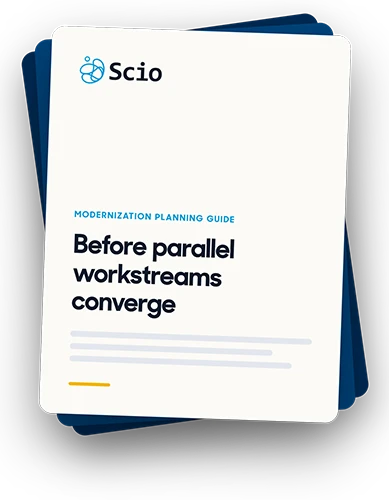
We turned the lessons from this engagement into a short guide for product and engineering leaders planning modernization alongside an active roadmap.
It covers the decisions that need to be thought through before parallel workstreams converge, from capacity and synchronization to validation, transition, and ongoing ownership.
Related solution
Pragmatic application modernization
Modernize what is holding the product back. Leave the rest alone.
Scio helps engineering teams reduce the technical constraints making software harder to change through controlled modernization, without making a full rewrite the default.
Keep critical software and product priorities moving while improving the parts of the application creating the most risk and friction.
Have a similar challenge?
Modernization should not require putting the roadmap on hold.
Tell us what needs to change, what needs to keep moving, and where your team needs focused modernization capacity.