

Most private equity buyers run thorough financial due diligence before closing a software acquisition. They check revenue quality, customer concentration, churn, and EBITDA adjustments. What they rarely examine with the same rigor is the engineering due diligence that determines whether the product can actually support the value creation plan. The result is a pattern that repeats across the industry: a deal closes, the first 100 days begin, and the new CTO discovers that the codebase, the team, or the infrastructure cannot deliver what the investment thesis requires.
This is not a hypothetical problem. Bain's 2025 analysis of 33 software buyouts found that 94% projected significant margin improvement, yet actual margins consistently trailed those projections after five years of ownership. A meaningful share of that gap traces back to engineering realities that were either invisible during diligence or dismissed as fixable post-close. This article maps the five most common engineering gaps that PE buyers overlook, and explains how each one compounds into lost time, missed roadmap targets, and erosion of the returns that justified the deal in the first place.
Table of Contents
Why Financial Due Diligence Falls Short in Software Acquisitions
Financial due diligence answers whether a company is making money. It does not answer whether the product can keep making money under the growth targets a PE buyer sets. That distinction matters because software companies are not static assets. The product must evolve, scale, and adapt to the value creation plan. If the engineering organization cannot deliver those changes, the plan stalls regardless of what the financial model projected.
The standard PE diligence process typically covers revenue quality, customer cohorts, churn analysis, go-to-market efficiency, and legal exposure. Some firms add a commercial technology assessment that reviews the product from the outside: Is it competitive? Does it have a defensible moat? What these assessments miss is the inside: the actual state of the code, the team, the processes, and the infrastructure that will need to deliver on the post-close agenda.
McKinsey's research on PE value creation is explicit about this gap. Firms that conduct operational diligence alongside financial and strategic diligence consistently identify value creation levers, cash flow improvements, and risks that surface-level assessments miss entirely. Engineering is one of the largest cost centers in any software company, often consuming 30% to 50% of total operating expense. Treating it as a black box during diligence is, put plainly, leaving money on the table and risk in the dark.

Five Engineering Due Diligence Gaps PE Buyers Overlook
The five gaps below are not edge cases. They are patterns that repeat across mid-market software acquisitions, typically in companies with 30 to 200 engineers, annual recurring revenue between $10M and $50M, and products that have been in market for five or more years. Each gap has a direct, measurable impact on the value creation timeline.
| Gap | What It Looks Like | Impact on Value Creation | Typical Detection Time |
| Architecture debt | Monolith, tight coupling, no API layer | 6-18 month delay before new features can ship at scale | Month 2-3 post-close |
| Key-person risk | 2-3 engineers own 80% of critical systems | Single departure can halt roadmap for a quarter | Month 1-2 post-close |
| Testing gaps | Low coverage, manual QA, no CI/CD | High change failure rate, slow releases, customer risk | Month 1 post-close |
| Documentation debt | No architecture docs, tribal knowledge only | Onboarding takes 3-6 months, vendor transitions fail | Month 3-6 post-close |
| Capacity mismatch | Team sized for maintenance, not growth | Value creation plan requires 2x capacity the team cannot deliver | Month 1 post-close |
Gap 1: Architecture Scalability and Hidden Technical Debt
Gartner estimates that 40% of the average IT department's budget goes to maintaining technical debt. In mid-market software companies, this ratio is often worse because founding-era architecture was built for early traction, not for the scale a PE growth plan demands. The classic scenario: a monolithic application with tightly coupled components, no API layer, and a database schema that has accumulated years of drift.
Architecture debt is the most expensive gap to remediate post-close. Unlike a pricing change or a sales process improvement, re-architecting a platform takes engineering quarters, not weeks. If the value creation plan depends on launching new product lines, entering adjacent markets, or supporting enterprise clients, architecture limitations can delay those initiatives by 12 to 18 months. That delay directly compresses the hold period and erodes returns.
What to look for pre-close: deployment frequency (elite teams deploy multiple times per day, struggling teams deploy monthly or less), service boundaries (monolith vs. modular), database coupling, and the ratio of new feature work to maintenance work. DORA metrics provide a structured way to assess this without needing source code access.
Gap 2: Key-Person Dependencies and Knowledge Concentration
In companies with 30 to 80 engineers, it is common for two or three people to hold the majority of critical system knowledge. They wrote the original code, they understand the edge cases, and they are the ones who get called at 2 a.m. when something breaks. This concentration is not a cultural failing. It is a natural outcome of fast early growth where documentation and knowledge sharing were lower priority than shipping product.
The risk surfaces when one of those key people leaves. In a PE context, departures are especially likely in the first 12 months post-close as the company navigates new ownership, new operating cadences, and sometimes new leadership. If a critical engineer leaves and takes institutional knowledge with them, the remaining team may need three to six months to recover enough understanding to maintain the system, let alone improve it.
What to look for pre-close: git commit concentration (what percentage of recent commits to critical repositories come from fewer than three developers?), on-call rotation depth, and whether architecture decisions are documented or live only in someone's head.
Gap 3: Testing Infrastructure and Quality Assurance Maturity
Testing maturity is one of the clearest predictors of post-close velocity. A team with strong automated test coverage, continuous integration, and a well-defined release process can ship changes with confidence. A team without these foundations ships slowly, breaks things frequently, and accumulates customer-facing defects that erode NRR and increase support costs.
The 2024 DORA State of DevOps Report found that teams with strong engineering practices maintain delivery performance even during organizational turbulence, including the kind of turbulence that PE ownership typically introduces. Change failure rate and failed deployment recovery time are especially telling: high failure rates and slow recovery mean the engineering organization is fragile. A fragile engineering organization will resist the pace of change a value creation plan requires.
What to look for pre-close: automated test coverage percentage (not vanity metrics, but meaningful coverage of business-critical paths), CI/CD pipeline maturity, release frequency, and change failure rate. These numbers tell you whether the team can absorb the pace of change the deal thesis demands.
Gap 4: Documentation Gaps and Institutional Knowledge Loss
Documentation is the silent gap. It does not announce itself during a management presentation or a product demo. It surfaces when a new engineer joins the team and takes four months to become productive instead of four weeks. It surfaces when the PortCo tries to bring in an external engineering partner and the partner cannot onboard because nobody wrote down how the system works.
For PE-backed companies specifically, documentation debt creates a compounding problem. Operating Partners often plan to bring in outside help, whether consultants, contractors, or nearshore engineering teams, to accelerate specific workstreams. Without adequate documentation of the architecture, data model, deployment process, and business logic, those outside resources spend their first months doing archaeology instead of delivering value.
What to look for pre-close: onboarding time for the last three hires, existence and currency of architecture decision records (ADRs), runbooks for critical systems, and whether the deployment process is documented or exists only as tribal knowledge.
Gap 5: Engineering Capacity vs. Roadmap Ambition
Every PE deal thesis includes a growth plan. That growth plan almost always implies product changes: new features, new integrations, new market segments, platform improvements. The question that diligence rarely asks is whether the current engineering team has the capacity to deliver those changes alongside their existing obligations, which include maintenance, bug fixes, customer support escalations, and keeping the lights on.
The math is often unfavorable. A team of 15 engineers that spends 60% of its time on maintenance and support has the equivalent of 6 full-time engineers available for new work. If the value creation plan requires the output of 15, the plan is already behind on day one. Recognizing this gap pre-close changes the conversation. It shifts the discussion from 'should we grow the team?' to 'how fast can we grow the team without breaking what works, and what is the most effective model to do that?'
What Does a Proper Engineering Due Diligence Process Look Like?
A structured engineering assessment does not require months of work or source code access. It requires the right questions, directed at the right people, with a framework for interpreting the answers. The process typically runs in parallel with financial and commercial diligence and takes two to four weeks.
The assessment should cover five dimensions: architecture and technical debt (current state and remediation cost), team composition and risk (key-person dependencies, hiring pipeline, retention), delivery performance (DORA metrics or equivalent), quality infrastructure (testing, CI/CD, monitoring), and documentation and knowledge management. Each dimension maps to a specific risk factor in the value creation plan.
The output is not a pass/fail grade. It is a calibrated view of engineering risk that feeds directly into deal terms, the 100-day plan, and the first-year operating budget. A PortCo with significant architecture debt is not necessarily a bad investment. It is an investment that requires a realistic remediation timeline and budget, not a value creation plan that assumes the platform is ready for growth on day one.
Some PE firms handle this with internal operating teams. Others engage specialized diligence firms like Crosslake Technologies or West Monroe. A third option that is gaining traction is pairing diligence with an engineering partner who can both assess and hel p execute the remediation plan post-close. That approach has the advantage of continuity: the team that identifies the gaps is the same team that helps close them.
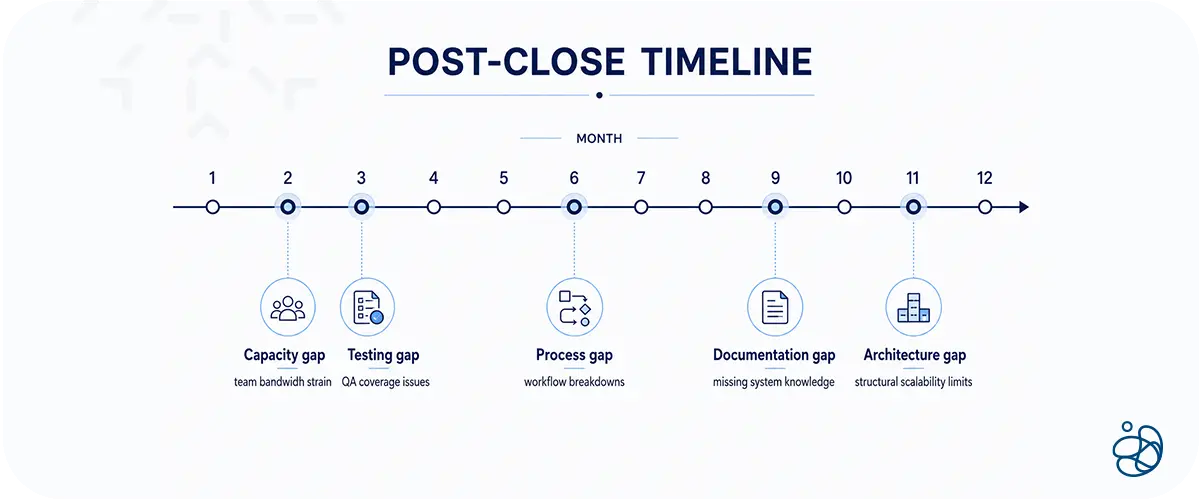
How Do Engineering Gaps Affect Value Creation in the First 12 Months?
The first 12 months after close are when most value creation plans either gain traction or stall. Engineering gaps compound during this period because they interact with the organizational turbulence that PE ownership introduces: new reporting structures, new operating cadences, new KPIs, and sometimes new leadership.
Architecture debt delays the product roadmap. Key-person departures trigger knowledge loss. Testing gaps increase defect rates at the exact moment the company is trying to expand. Documentation debt slows onboarding of new hires or external partners. Capacity mismatches force the team to choose between maintaining the current product and building the future one.
The compounding effect is what makes these gaps so costly. A six-month delay in launching a new product module does not just cost six months. It costs the revenue that module would have generated, the competitive positioning it would have established, and the operational leverage it would have created for the rest of the hold period. Bain's research confirms this pattern: the gap between projected and actual margin improvement in software buyouts is not a forecasting error. It is an execution gap rooted in operational realities that diligence should have surfaced.
What This Means for PE-Backed Software Portfolio Companies
If you are an Operating Partner or a PortCo CTO managing engineering under an investment thesis, these gaps are not abstract. They are the difference between hitting your milestones and explaining to the board why the product roadmap slipped by two quarters.
The engineering organizations inside PE-backed software portfolio companies face a specific set of pressures that make these gaps especially consequential. EBITDA discipline limits how much you can invest in remediation. Hold period timelines create urgency that internal hiring alone cannot match. Post-acquisition integration demands pull engineering attention away from the product. And exit readiness requires the platform to be in a state that passes the next buyer's diligence, which means the technical debt you inherited becomes the technical debt that reduces your exit multiple.
This is where dedicated engineering teams with experience in PE-backed environments become a practical option, not as a replacement for internal talent, but as a parallel capacity that can absorb specific workstreams (modernization, QA buildout, documentation recovery) while the internal team focuses on the product roadmap. The key requirement is that the external partner understands the operating cadence of PE ownership: board reporting cycles, KPI-driven milestones, and the urgency that a defined hold period creates.
Frequently Asked Questions
How long does an engineering due diligence assessment typically take?
A structured assessment takes two to four weeks when run in parallel with financial and commercial diligence. It involves interviews with engineering leadership, review of architecture documentation (where it exists), analysis of delivery metrics, and an evaluation of team composition and risk. The output is a calibrated risk report, not a code audit.
Can you run engineering due diligence without source code access?
Yes. A significant amount of insight comes from delivery metrics (deployment frequency, change failure rate, lead time), team structure analysis (commit concentration, on-call depth), architecture reviews based on documentation and interviews, and evaluation of testing and CI/CD infrastructure. Source code access adds depth but is not a prerequisite for a meaningful assessment.
What DORA metrics should PE buyers ask for during diligence?
The five DORA metrics, deployment frequency, lead time for changes, change failure rate, failed deployment recovery time, and reliability, provide a structured view of engineering health. Deployment frequency and change failure rate are the most immediately actionable for PE diligence because they indicate both velocity and stability. A team that deploys weekly with a low failure rate can absorb change. A team that deploys monthly with a high failure rate cannot.
How much does unaddressed technical debt typically cost a PortCo?
Industry research consistently places the cost of maintaining technical debt at 30% to 40% of total IT budget. For a mid-market software company spending $5M to $10M annually on engineering, that translates to $1.5M to $4M per year consumed by maintenance rather than growth. Over a five-year hold period, unaddressed debt can consume the equivalent of an entire year of engineering capacity that could have been directed toward value creation.
Should we hire a specialized firm for technical due diligence or handle it internally?
It depends on the depth of engineering expertise on your operating team. If you have Operating Partners or internal advisors with hands-on engineering leadership experience, a structured internal assessment can work. If not, specialized firms like Crosslake Technologies, West Monroe, or Bain's Tech Insights Group bring methodology and benchmarks that accelerate the process. A third option is engaging an engineering partner who can both assess pre-close and execute remediation post-close, creating continuity between diligence and action.
What is the most overlooked engineering gap in software acquisitions?
Documentation debt is consistently the most overlooked because it is invisible during management presentations and product demos. It only surfaces when the PortCo tries to onboard new engineers, bring in external partners, or execute a platform migration. Companies that have grown quickly with a small, stable team almost always have significant documentation gaps, and those gaps directly slow every post-close initiative that requires knowledge transfer.
How do engineering gaps affect exit valuation?
Buyers in subsequent transactions are increasingly conducting their own technical diligence. Architecture debt, testing gaps, and key-person risk all reduce buyer confidence and compress multiples. A PortCo that exits with a well-documented, modular architecture, strong delivery metrics, and a team that is not dependent on two or three individuals will command a higher multiple than one that defers remediation throughout the hold period.
The Bottom Line
Engineering due diligence is not an optional add-on to the PE acquisition process. It is the assessment that determines whether the value creation plan is achievable or aspirational. The five gaps outlined here, architecture debt, key-person risk, testing maturity, documentation coverage, and capacity mismatch, are not rare findings. They are the norm in mid-market software acquisitions. What separates successful deals from disappointing ones is whether these gaps were identified pre-close and priced into the plan, or discovered post-close and absorbed as unplanned drag.
The firms that consistently generate top-quartile returns in software PE are the ones that treat engineering as a first-class element of diligence, on equal footing with financials, commercial assessment, and legal review. They staff their operating teams with engineering expertise. They build remediation costs into the deal model. And they line up execution capacity before the deal closes, so the first 100 days are spent building, not discovering what should have been found months earlier.
If your firm is evaluating a software acquisition and you want a clearer picture of engineering risk before you close, a conversation with our team is a good place to start. We work with PE-backed software portfolio companies to assess, stabilize, and scale engineering capacity under the constraints that investment timelines create.
References and Further Reading
- McKinsey & Company. Analysis of how PE firms that conduct operational diligence alongside financial and strategic diligence identify more value creation levers and risks. https://www.mckinsey.com/industries/private-capital/our-insights/bridging-private-equitys-value-creation-gap
- Bain & Company. Proprietary analysis of 33 software buyouts showing that 94% projected margin improvement but actual margins consistently trailed projections. https://www.bain.com/insights/wanted-margin-growth-in-software-investing-global-private-equity-report-2025/
- Bain & Company, Tech Due Diligence. Overview of Bain's technology diligence practice, covering product assessment, competitive positioning, and integration of commercial and technical insights. https://www.bain.com/industry-expertise/private-equity/tech-due-diligence/
- DORA, Accelerate State of DevOps Report 2024. Annual research report on software delivery performance, team practices, and the impact of organizational factors on engineering outcomes. https://dora.dev/research/2024/dora-report/
- DORA, Software Delivery Performance Metrics. Definitive guide to the five DORA metrics for measuring software delivery performance across teams and organizations. https://dora.dev/guides/dora-metrics/
- Gartner. Research hub covering the measurement, prioritization, and remediation of technical debt in software organizations, including the estimate that 40% of IT budget is consumed by debt maintenance. https://www.gartner.com/en/infrastructure-and-it-operations-leaders/topics/technical-debt
- McKinsey & Company. Research on how PE firms can improve exit prospects through value creation planning, operational readiness, and portfolio company preparation. https://www.mckinsey.com/industries/private-capital/our-insights/beating-the-odds-how-private-equity-firms-can-improve-exit-prospects
- Bain & Company. Case study of a rapid tech due diligence engagement where a PE firm evaluated a software target's technology stack within a two-week exclusivity window. https://www.bain.com/client-results/rapid-tech-due-diligence-helped-a-pe-firm-invest-with-confidence/