


Most CTOs I talk to already know where their technical debt lives. They know which modules are brittle, which frameworks are overdue for an upgrade, which parts of the codebase only two senior engineers fully understand. Awareness is not the problem.
The problem is the economics. Addressing debt means pulling capacity away from roadmap work, and in most mid-market software companies, roadmap commitments have names attached to them: a customer who signed a contract, a board that approved a product plan, a sales team that already made promises. Technical debt reduction gets deferred not because leaders do not understand it, but because the math has always been hard to justify.
AI is starting to change that math. Not by making technical debt disappear, but by lowering the cost of specific work that has historically kept modernization from starting at all. I want to be precise about what that means in practice, because the risk of oversimplifying it is real.
TABLE OF CONTENTS
What Technical Debt Actually Costs at Scale
In early growth, technical shortcuts are often reasonable. A young product team validating a market, closing early customers, or responding to changing requirements cannot always make optimal technical decisions. That is not irresponsible. It is the reality of building software under uncertainty.
The problem is what happens when that codebase grows up. The same system now supports more customers, more integrations, more product expectations, and more revenue. What was once "good enough" becomes a constraint. A framework upgrade delayed one quarter becomes a recurring risk. A poorly documented workflow becomes a key-person dependency on two engineers who are already overloaded.
Technical debt charges interest on every change. I think of it in five categories that I have seen play out consistently across the companies we work with at Scio:
- Delivery interest: features take longer because the system is difficult to change.
- Quality interest: fragile areas produce more defects and regression risk.
- Knowledge interest: only a few people understand important workflows, creating concentration risk.
- Opportunity cost: engineers maintain fragile systems instead of enabling product growth.
- Financial drag: rework, incidents, support effort, and slower delivery reduce the return on engineering investment.
The right economic question is not "How much technical debt do we have?" It is "Which debt is charging the highest interest, and which parts of that debt are now cheaper to reduce with AI support?" That reframe is what I want to focus on here.
How AI Shifts the Economics
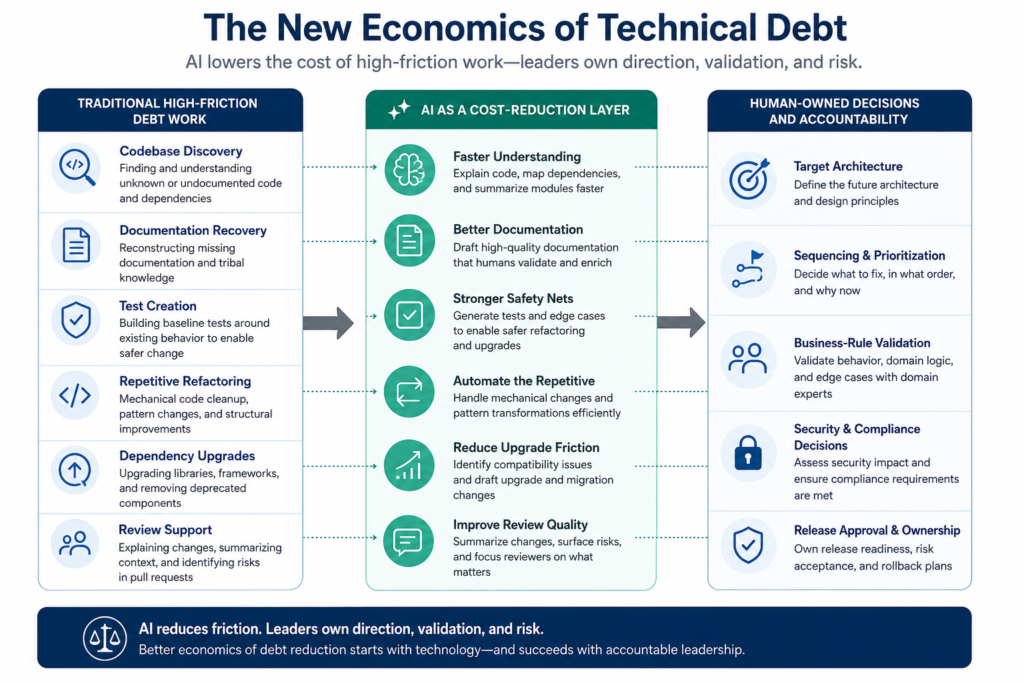
AI technical debt reduction works by lowering the cost of specific activities that have historically been the most expensive and least glamorous part of modernization: understanding what is actually there before changing it.
McKinsey has reported that generative AI can meaningfully reduce time spent on documentation tasks and speed refactoring, particularly when work is structured and repetitive. Sonar's developer research identifies documentation, test coverage, debugging, and refactoring as the areas where AI can have a positive impact on technical debt. These findings align with what I see in practice.
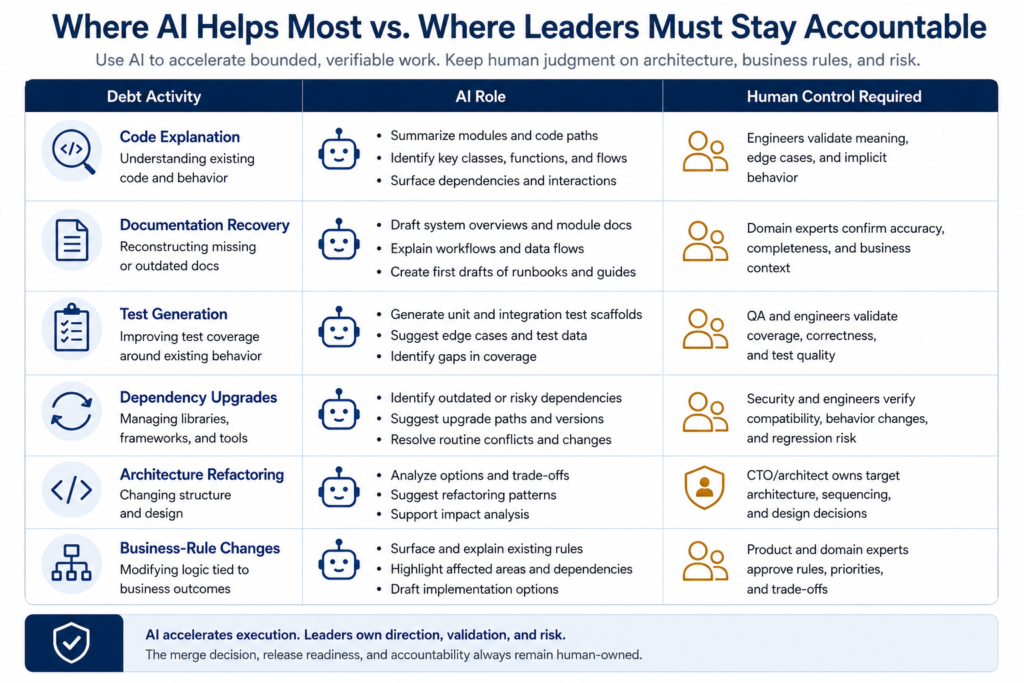
The sweet spot for AI is bounded, verifiable work. It can help teams explain unfamiliar code, summarize modules, and identify dependencies. It can draft documentation that engineers and domain experts then validate. It can generate baseline tests around existing behavior, which is often the prerequisite for safer refactoring. It can support dependency upgrades, framework migrations, deprecated API replacement, and repetitive transformations where the source and target patterns are clear.
What AI cannot do: decide what the platform should become, determine which business rules must be preserved, or define the modernization sequence that best supports the company's roadmap. Those decisions still require senior engineering judgment. The economic shift is real, but it is more narrow than most vendor narratives suggest.
Why Debt Persists Even When Leaders Know It Exists
I want to address this directly because I hear it often. Leaders know the debt is there. They know it is slowing delivery. And they still defer it, sprint after sprint. There are structural reasons for that.
The first is that modernization competes with roadmap work, and roadmap commitments are visible in ways that platform health is not. A customer waiting for a feature shows up in a customer success call. Technical debt shows up as slower estimates and higher incident rates, which are easier to absorb quietly than to explain to a board.
The second is that the first phase of modernization is the least glamorous and most expensive. Before changing a legacy system, teams need to understand it. That means code archaeology, dependency mapping, documentation recovery, test repair, and business-rule validation. This is where AI can help the most, but it is also where teams most often underestimate the effort.
The third is weak test coverage. Many teams know what they want to refactor but cannot prove that behavior will remain stable afterward. Without tests, every change feels like a production incident waiting to happen. That fear is rational, and it is one of the most common reasons modernization stalls.
Forrester has argued that technical debt includes a broader portfolio of deferred technical investment, including knowledge gaps, unsupported technologies, system inflexibility, and redundant systems. I agree with that framing. The narrower view of technical debt as "bad code" misses the organizational and architectural dimensions that are often the most expensive to carry.
What AI-Assisted Work Looks Like in Practice
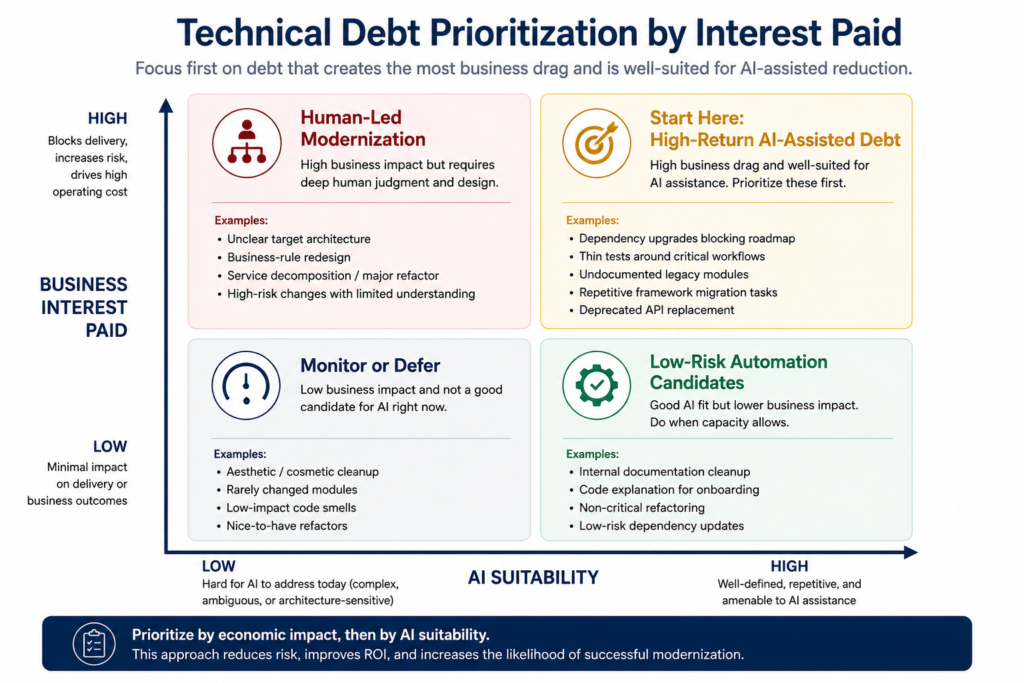
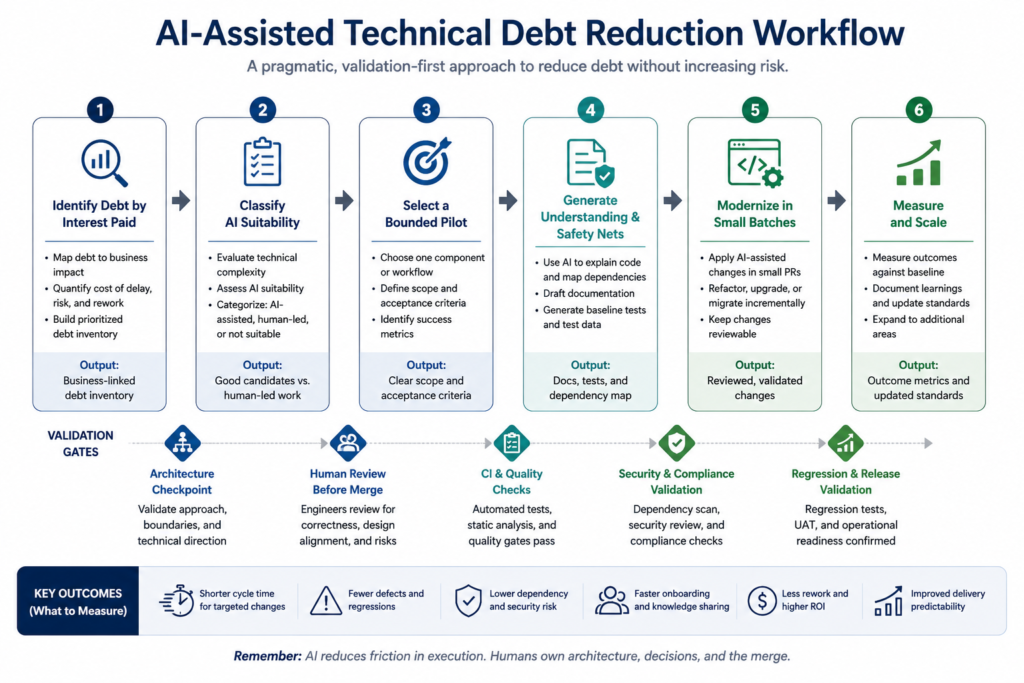
A practical workflow starts with a debt inventory based on interest paid. Which debt repeatedly slows delivery? Which blocks upgrades? Which increases incident exposure? Which concentrates knowledge in too few people? That prioritization should be driven by business drag, not engineering frustration.
The next step is matching work to the right level of AI involvement. This is where I see the most mistakes. Teams either avoid AI entirely, which is conservative but leaves real efficiency gains on the table, or they use AI as a bulk code generator, which creates a verification burden that can exceed the original problem.
The goal of a disciplined AI technical debt reduction program is to reduce the cost of the work that enables modernization, not to automate the modernization decisions themselves.
AI Suitability: What to Use AI For and What to Keep Human
| Good AI candidates | Human-led with AI support | Poor AI-first candidates |
| Documentation recovery | Architecture refactoring | Ambiguous product behavior |
| Code explanation and summarization | Service decomposition | Unclear target architecture |
| Dependency mapping | Business-rule validation | High-risk changes without tests |
| Test generation around existing behavior | Migration sequencing | Security, billing, compliance workflows |
| Repetitive refactoring with clear patterns | Release planning | Customer-specific logic without expert review |
| Framework upgrades, deprecated API replacement | Architecture review and validation | Changes where no domain expert is available |
The key constraint I always come back to: AI is most useful when it makes disciplined engineering work cheaper. It becomes a risk when it substitutes for deciding what the system should become.
What Risks to Watch
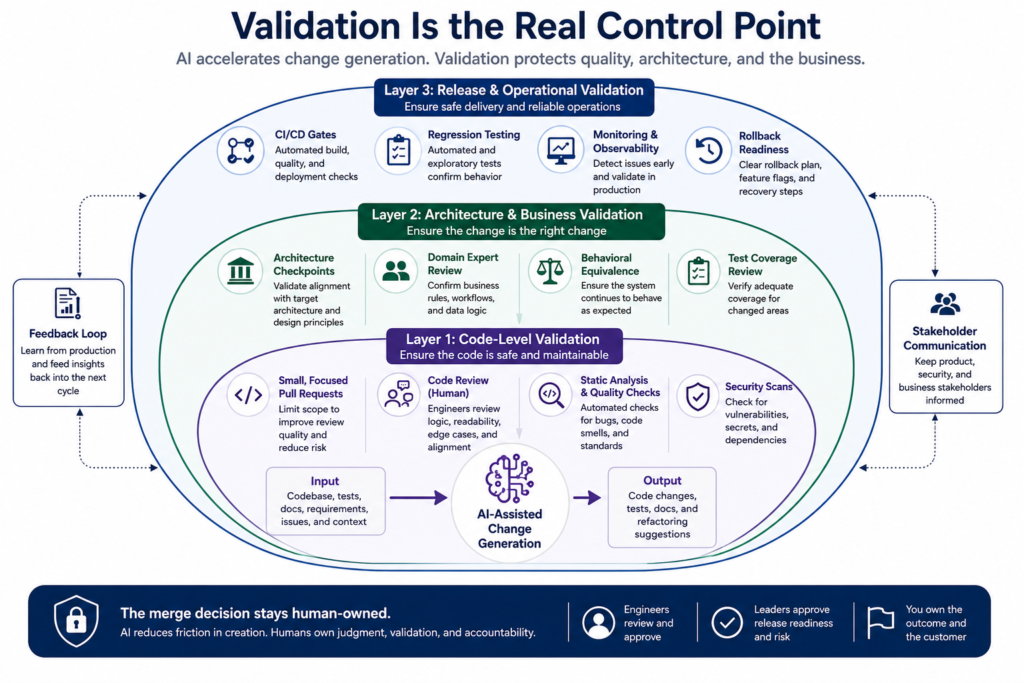
Plausible code is not the same as correct code. AI-generated output can look clean and still miss an edge case, preserve the wrong abstraction, or introduce a security issue. I think this is the most important thing to hold onto when evaluating AI modernization tools, because the surface of the output is not a reliable signal of its correctness.
Superficial cleanup is a related risk. A team can remove visible complexity while creating deeper maintainability problems. Recent research warns that AI-generated changes can introduce code smells, correctness issues, and redundancy that are harder to detect than the original debt.
Architecture drift is the third risk I see most often. When teams accept AI-generated changes without architecture review, the system can become less coherent over time. Local improvements weaken the larger design without anyone noticing until the damage is significant.
DORA's 2024 research on generative AI in software delivery makes a point I find important: individual productivity gains do not automatically translate into system-level delivery outcomes. Faster local work does not improve throughput or stability if teams are creating larger changes, weaker feedback loops, or more review burden. The bottleneck shifts from writing code to verifying whether generated changes are safe and coherent.
Finally: be skeptical of vendor case studies. Many AI modernization examples come from enterprise environments or vendor-led programs. They are useful signals, but mid-market companies should validate the approach in their own codebase before scaling.
How to Start: A Sequenced Approach
- Reframe debt as economic drag. Ask where the company is paying interest every sprint. Slow roadmap delivery, release instability, rework, extended onboarding, knowledge concentration. That is your debt inventory.
- Identify AI-suitable debt. Start with bounded, testable work: documentation recovery, dependency upgrades, test generation, repetitive modernization. Leave architecture decisions, business-rule validation, and compliance-sensitive changes to humans.
- Choose one pilot. One module, repository, service, or upgrade. Define what "done" means before using AI. Create a validation-first workflow: baseline tests, small pull requests, architecture checkpoints, human review, CI checks, release monitoring.
- Measure in business terms. Reduced rework, shorter cycle time, fewer regressions, better onboarding, lower dependency risk. Lines changed and files migrated are incomplete metrics.
- Scale only after learning. Document what worked. Update coding standards. Train teams on approved use cases. Expand only when review and validation capacity can keep up with generation speed.
What This Looks Like Across Three Scenarios
Scenario 1: The deferred framework upgrade
A mid-market SaaS company has delayed a major framework upgrade for three years. The system still works, but every feature touching that area takes longer. The original engineers are gone, documentation is thin, and test coverage is incomplete. The useful move is not asking AI to complete the upgrade. The team uses AI to summarize modules, identify deprecated dependencies, draft documentation, and generate baseline tests around critical workflows. Senior engineers then separate the mechanical changes from the design-sensitive ones. The upgrade becomes scoped and fundable rather than vague and risky.
Scenario 2: The roadmap tax hidden in a legacy module
A product team keeps missing estimates because a pricing or permissions module is hard to change. Product leaders see slow delivery. Engineering leaders know the issue is concentrated debt. AI helps explain code paths, summarize business rules, identify frequently changed areas, and generate tests around high-risk paths. Product and engineering then validate which behaviors are essential and which are accidental complexity. The modernization effort gets tied directly to roadmap predictability, which makes it fundable at the executive level.
Scenario 3: The strategic initiative blocked by platform constraints
A company wants to launch a new integration, an AI-enabled feature, or an enterprise workflow. The current architecture makes the initiative slow and risky. AI supports dependency mapping, documentation recovery, test scaffolding, and repetitive refactoring. Senior engineering leaders still own the target architecture, sequencing, and release plan. The result is a clearer path to the strategic initiative without pretending that AI can make the hard trade-offs.
What This Means for Engineering Leaders
CTOs and VPs of Engineering at mid-market software companies
For mid-market software companies the most common mistake I see is treating AI modernization as a binary choice: either ignore it or run it as a background automation project. Neither works. The right framing is to identify specific modernization work that AI can make cheaper and safer to start, then run a disciplined pilot with explicit acceptance criteria and human review at every step.
A nearshore engineering team that already operates within a mature technical review model can add meaningful capacity for this kind of work, particularly for documentation recovery, test generation, and bounded refactoring that would otherwise compete directly with roadmap delivery. The constraint is always the same: the partner needs to integrate into your architecture standards and delivery rhythm, not operate as a separate AI experiment.
Operating Partners at PE-backed software portfolios
For PE-backed software portfolios technical debt is a value creation and exit readiness issue. A PortCo that carries significant debt in its most actively changed modules will see that debt show up as delivery predictability problems, recurring incidents, and diligence findings. AI-assisted modernization can accelerate debt reduction in bounded, high-drag areas without requiring a large permanent headcount increase, which is particularly relevant for companies where the hold period timeline limits how much can be built organizationally.
The practical sequence I recommend for PortCos is to start with a debt inventory tied to the value creation plan, pilot AI-assisted work in the highest-drag area, and measure outcomes in business terms before expanding. That sequence produces evidence the Operating Partner and board can evaluate, which is more durable than a modernization narrative that depends on vendor case studies. If you want to walk through how this applies to a specific portfolio company, I would be glad to talk.
Frequently Asked Questions
What is AI technical debt reduction and what makes it different from traditional modernization?
AI technical debt reduction uses AI tools to lower the cost of the discovery, documentation, testing, and repetitive transformation work that has historically made modernization too expensive to start. What makes it different from traditional modernization is that AI can compress the front-end work, understanding what is there before changing it, which has always been the most time-consuming and least fundable part of a debt reduction program. What has not changed is that architecture decisions, business-rule validation, migration sequencing, and release planning still require senior engineering judgment.
Which types of technical debt are best suited for AI-assisted reduction?
The best candidates are bounded, testable, and repetitive: documentation recovery, code explanation and summarization, dependency mapping, baseline test generation around existing behavior, repetitive refactoring with clear patterns, framework upgrades, and deprecated API replacement. The worst candidates are debt in areas where the target architecture is unclear, business rules are poorly understood, no domain expert is available, or the changes affect security, billing, compliance, or customer-specific logic without expert oversight.
What is the biggest risk when using AI for technical debt work?
The biggest risk is treating plausible code as correct code. AI-generated output can look clean and still miss an edge case, preserve the wrong abstraction, or introduce a security issue. The second risk is that faster code generation shifts the bottleneck to review and validation, and if review capacity cannot keep up with generation speed, teams create new hidden debt rather than reducing the existing kind. DORA's 2024 research on generative AI confirmed that individual productivity gains do not automatically translate into better system-level delivery outcomes when feedback loops and batch sizes are not managed carefully.
How should a mid-market CTO start an AI-assisted debt reduction program?
Start with the economics, not the tools. Identify the debt that is charging the highest business interest: which modules are slowing roadmap delivery, blocking upgrades, generating recurring incidents, or concentrating knowledge in too few people. Then find the AI-suitable subset of that debt, typically documentation recovery, test generation, and repetitive refactoring, and run one bounded pilot with explicit acceptance criteria and human review at every step. Measure in business terms: reduced rework, shorter cycle time, fewer regressions, better onboarding. Scale only after that pilot produces documented evidence of what works in your specific codebase.
Where I Stand on This
AI does not eliminate technical debt. I want to be clear about that because the marketing narrative around AI and modernization often implies it does. What AI can do is lower the cost of specific modernization work that has previously been too expensive to justify starting. That is a meaningful shift, but it is narrower than it often gets presented.
The companies that will benefit most from this shift are the ones that approach it with the same discipline they would apply to any engineering investment: clear acceptance criteria, strong review practices, architecture ownership, and measurement tied to business outcomes rather than activity. Faster code generation makes technical judgment more important, not less. The decisions about what the platform should become, which business rules must be preserved, and which modernization sequence best supports the roadmap still belong to engineering leaders.
At Scio, we support mid-market software companies and PE-backed portfolios that need to reduce technical debt without pausing roadmap delivery. We work within the client's architecture, delivery rhythm, and quality standards because we know that the value of modernization is not the code generated. It is the engineering leverage created. If this is a conversation worth having for your organization, I would be glad to start it.
References and Further Reading
- McKinsey and Company, The AI Revolution in Software Development. Research reporting that generative AI can meaningfully reduce time spent on documentation tasks and accelerate refactoring, particularly when work is structured and repetitive. https://www.mckinsey.com/capabilities/tech-and-ai/our-insights/the-ai-revolution-in-software-development
- Sonar, State of Code Developer Survey Report. Developer research identifying documentation, test coverage, debugging, and refactoring as the areas where AI tools have the most positive impact on technical debt. https://www.sonarsource.com/state-of-code-developer-survey-report.pdf
- Forrester, What Technical Debt Means to IT Professionals. Forrester research arguing that technical debt includes a broader portfolio of deferred technical investment than code quality alone, including knowledge gaps, unsupported technologies, system inflexibility, and redundant systems. https://www.forrester.com/blogs/what-technical-debt-means-to-it-professionals/
- DORA, 2024 State of DevOps Report. Research finding that while AI adoption increased individual productivity and job satisfaction, it also had negative effects on delivery stability and throughput when batch sizes, feedback loops, and review practices were not managed carefully. https://dora.dev/research/2024/dora-report/
- Scio blog, Technical Debt Prioritization: 5 Proven Roadmap Fixes. Complementary framework for prioritizing technical debt by business impact rather than engineering preference, directly relevant to the debt inventory approach described in this article. https://sciodev.com/blog/technical-debt-prioritization/
- Scio blog, Technical Debt Financial Risk: How to Make the Business Case. Analysis of the financial dimensions of technical debt, including how to build an investment case for debt reduction that connects to roadmap predictability and business outcomes. https://sciodev.com/blog/technical-debt-financial-risk/
- Scio blog, Legacy System Modernization: 8 Approaches for CTOs. Broader analysis of modernization methods beyond AI-assisted work, covering when to stabilize, refactor, replatform, modularize, or replace components of a legacy platform. https://sciodev.com/blog/legacy-system-modernization/