A software company hiring specialized skills in DevOps, QA automation, data engineering, or cloud architecture usually discovers the gap the hard way: a release depends on one senior engineer, regression testing keeps expanding, or a cloud bill grows faster than anyone can explain. Posting a requisition rarely closes that gap fast. Specialized capability on demand, an accountable lead and small embedded team, gets there in weeks instead of the roughly ten months a full hire-and-onboard cycle actually takes.
This is not a case against hiring. It is a case for recognizing when a capability gap, not a headcount shortage, is the real constraint, and for treating specialized capability on demand as a legitimate first move rather than a stopgap.
TABLE OF CONTENTS
Capacity Problem or Capability Problem?
"We have more backlog than engineers" and "several teams depend on a technical domain nobody formally owns" sound similar from a distance, but they call for opposite responses. Adding generalist developers helps the first problem and can quietly make the second one worse by adding more variation, more coordination overhead, and more technical debt to a domain nobody is accountable for.
There is no universal engineer-count threshold where this shift happens. The more reliable signal is operational: several product squads have formed, infrastructure and data are shared across them, release dependencies cross team boundaries, and no single leader owns the system connecting those teams. Google's 2024 DORA research similarly finds internal development platforms more common in larger, more complex organizations, without treating any specific headcount as a hard line.
Four Capability Gaps That Surface as Teams Scale
These four domains are where mid-market software companies most consistently discover that competent generalist engineers were never the same thing as a domain owner. Each one can look fine on a resource plan while quietly consuming senior attention that should be going toward the roadmap instead.
DevOps and Platform Engineering: CI/CD Ownership Vacuum
When deployment pipelines and environments are maintained informally, provisioning runs on tickets and tribal knowledge, observability differs service by service, and senior developers end up as de facto incident and release gatekeepers. The cost shows up as longer lead time, lower release frequency, and rising cloud waste, since nobody owns the platform's roadmap or reliability targets as a real product.
QA Automation: Test-Coverage Stagnation
Without an owner for test strategy, regression stays manual or UI-heavy, automation stays fragmented and flaky, and testing happens late instead of continuously. Capgemini and OpenText's 2024 World Quality Report found that a lack of comprehensive test-automation strategy was a barrier for 57 percent of respondents and legacy systems for 64 percent, even as generative AI adoption in QA accelerated.
Data Engineering: Ad-Hoc Pipelines and Hidden Debt
When application engineers and analysts build pipelines without a data-engineering owner, transformations get duplicated, jobs fail silently, and nobody can say with confidence what a given metric actually means anymore. dbt Labs' 2024 survey found that 57 percent of data practitioners cited poor data quality as a major challenge, up from 41 percent in 2022, and close to half cited ambiguous data ownership as a root cause.
Cloud Architecture: Single-Person Bottlenecks
When cloud knowledge concentrates in one architect, product squads pick services and deployment patterns independently, and architecture review happens after implementation instead of before it. Flexera's 2025 State of the Cloud survey found that 84 percent of respondents named cloud spend management their leading challenge, with budgets already exceeding limits by 17 percent and spend expected to climb another 28 percent.
Software Company Hiring Specialized Skills: Why So Slow?
The honest answer is that this is not competing against a slow process. It is competing against a genuinely long one, and the real comparison point is time-to-productivity, not time-to-signed-offer, since a vacancy can be technically filled while the capability gap stays operationally open.
A 10-Month Hire-and-Onboard Cycle, Not 6
The Linux Foundation's 2024 State of Tech Talent Report, based on a global survey of technical hiring managers, found average technical hiring took 5.4 months, with SRE and platform roles averaging 6.0 months and DevOps, cloud architecture, and data-management roles each averaging 5.8 months. Average onboarding to normal productivity added another 4.8 months, for a combined 10.2-month hire-and-onboard cycle, up from 7.6 months the year before.
Skill Gaps Are Persistent, Not a Short-Term Anomaly
Skillsoft's 2024 survey of more than 5,100 IT professionals found 65 percent of IT decision-makers reported team skill gaps, and 56 percent expected those gaps to persist for one to two years. Respondents connected unresolved gaps directly to employee stress, longer project timelines, and a reduced ability to meet business objectives, which is a very different picture than a temporary recruiting delay.
What On-Demand Specialized Capability Actually Looks Like
Specialized capability on demand is an embedded, outcome-owned engineering function: a senior lead with implementation capacity who closes a defined capability gap, integrates into the existing engineering organization, and leaves durable systems and documentation behind rather than personal knowledge that walks out the door.
Capability-Led, Not Resume-Led
The engagement starts from delivery risk and target outcomes, not headcount. A named senior specialist owns the domain's architecture, backlog, and standards, with enough implementation capacity on the team to turn decisions into shipped systems, not just recommendations.
Fast Ramp-Up Backed by Real Integration
The speed advantage only holds if the specialist actually joins the existing workflow: shared planning and refinement, participation in architecture review and engineering ceremonies, and access to the same repositories, CI/CD feedback, and documentation as the internal team, not a separate backlog running in parallel.
Built-In Knowledge Transfer and Exit Planning
A real engagement leaves behind artifacts that outlast it: golden paths and reusable CI/CD templates for platform work, a risk-based test strategy and automation architecture for QA, data contracts and lineage documentation for data engineering, or reference architectures and decision records for cloud. Those artifacts are what separate a capability engagement from generic staffing that closes tickets without changing how the organization solves the next instance of the same problem.
How Do You Evaluate a Specialized Capability Partner?
Not every specialized-capability offer is built the same way, and the difference usually shows up in how precisely a partner can answer a small set of pointed questions, before a contract, not after the first disappointing sprint.
Depth of Domain Expertise, Not Just Availability
Ask a platform lead how they measured developer adoption on a comparable engagement, ask a QA lead how they reduced flakiness rather than just which framework they use, and ask a cloud architect to walk through a real cost-versus-reliability tradeoff they made. Production experience in the exact domain is what the Linux Foundation's research flags as the hardest thing to verify, with 37 percent of organizations reporting difficulty confirming claimed technical skills.
Alignment With Your Tooling, Process, and Decision Rights
Set an explicit RACI before work starts: the client retains accountability for product strategy and final architecture authority, the capability lead owns domain design and execution, and product squads stay responsible for their own application behavior as consulted users of the new capability, not bystanders.
Success Metrics Tied to Outcomes, Not Hours
Agree on the same measures DORA recommends for the underlying domain, deployment frequency and lead time for platform work, critical-path automation coverage for QA, pipeline uptime and data freshness for data engineering, before the engagement starts, so success is judged on delivery and reliability outcomes rather than utilization.
What This Means for Independent Software Companies
For independent software companies past the point where a single engineering group covers everything informally, this gap is rarely visible as a line item. It shows up as a senior engineer who has quietly become the release manager, the QA analyst, and the data troubleshooter all at once, with a full product roadmap still sitting on their plate underneath it.
Scio's own analysis of hybrid engineering models covers this exact pattern: pairing in-house ownership of product vision and architecture with nearshore specialists who bring depth in DevOps, data engineering, or QA automation on demand, integrated as dedicated team members rather than a separate vendor track.
Frequently Asked Questions
What differentiates on-demand specialized capability from staff augmentation?
Staff augmentation adds hands to client-defined tasks. Specialized capability on demand adds accountable ownership: a named lead responsible for the domain's standards, roadmap, and measured outcomes, not just ticket throughput.
How quickly can specialists begin adding value?
Ramp-up is typically measured in weeks rather than the roughly ten-month hire-and-onboard cycle the Linux Foundation's 2024 research reports for comparable technical roles, though real adoption and organizational change still take longer than initial access to systems.
Can we retain architectural ownership while using on-demand experts?
Yes, and it should be explicit from day one. The client keeps final architecture authority and product strategy; the capability lead owns domain design, standards, and execution within that boundary.
How do we ensure continuity after the engagement ends?
Continuity depends on contractual knowledge transfer: client-owned repositories and cloud accounts, documented runbooks and architecture decision records, and an explicit plan to operate, transfer, or reduce the capability once it stabilizes.
Is on-demand specialized capability cheaper than a permanent hire?
Not necessarily on an hourly basis. Its advantage is shortening exposure to the capability gap and matching capacity to the actual need, not a lower headline rate, so the business case should be framed around risk and time, not cost alone.
The Bottom Line
A software company hiring specialized skills is not choosing between a fast option and a slow one. It is choosing between an open-ended gap that persists for the better part of a year and a bounded engagement that establishes ownership in weeks and can be scaled, transferred, or reduced once the domain stabilizes.
The gap does not announce itself as a staffing shortfall. It shows up as a senior engineer stretched across four roles, a release that depends on one person's memory, or a cloud bill nobody can fully explain. If your team is weighing whether a specific domain needs an owner now or can wait for the next hiring cycle, our team at Scio would be glad to help you think it through.
Skillsoft. 2024 IT Skills and Salary survey of more than 5,100 IT professionals on the persistence and business impact of skill gaps. https://www.skillsoft.com/resources
Google Cloud / DORA. 2024 State of DevOps research on internal development platforms and their prevalence in larger, more complex organizations. https://cloud.google.com/devops/state-of-devops
U.S. Bureau of Labor Statistics. May 2024 occupational wage data for software developers, QA analysts, data scientists, and network architects. https://www.bls.gov/oes/current/oes_nat.htm
The staff augmentation vs dedicated teams debate shows up in every conversation about scaling engineering at mid-market software companies. And almost every time, the comparison is reduced to the same two variables: hourly rate and time to fill a seat. That framing misses the point entirely. The real question is not how fast you can add a developer or what the rate card looks like. The real question is which model allows your engineering organization to deliver more, retain knowledge, and operate as a cohesive unit under the pressure of a growth plan.
Most mid-market CTOs have worked with both models at some point. Staff augmentation through providers like BairesDev or Toptal, where individual contractors are placed into your team and you manage them directly. Dedicated teams through partners that assign a stable group of engineers to your product on a long-term basis. And yet, the decision between the two is often made based on procurement criteria rather than engineering criteria. This article breaks down three factors that change the decision when you evaluate them honestly, and it explains when each model genuinely makes sense.
TABLE OF CONTENTS
Why the Staff Augmentation vs Dedicated Teams Decision Gets Oversimplified
The oversimplification starts with how the decision is framed. Procurement teams evaluate engineering capacity the same way they evaluate any vendor: cost per unit, contract flexibility, and speed of delivery. Those are legitimate criteria, but they describe the transaction, not the outcome. They answer the question 'How much does it cost to fill this seat?' without asking 'What happens to my engineering organization six months after the seat is filled?'
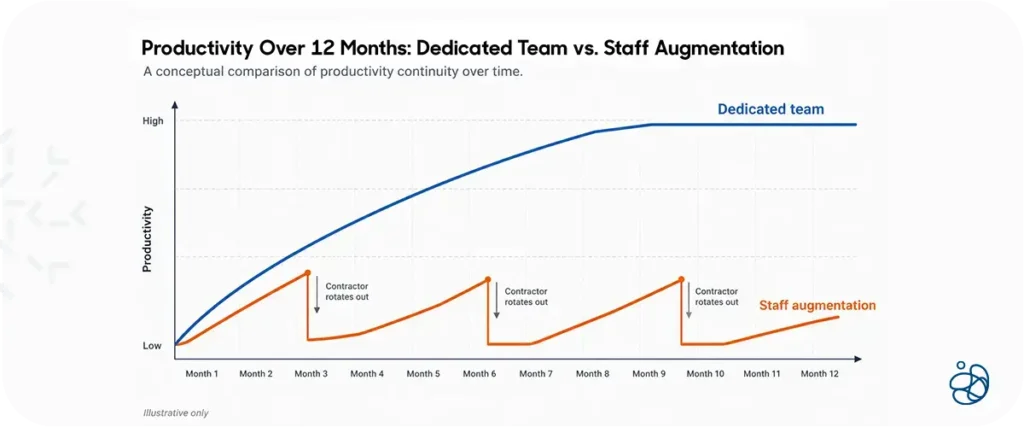
The second problem is that the industry itself blurs the lines. Many providers describe their offering as 'dedicated teams' when the actual delivery model is closer to staff augmentation with a different label. The individuals rotate, the provider manages bench and availability rather than product outcomes, and the relationship is structured around hours delivered rather than capabilities built. If the engineers working on your product change every four to six months, you do not have a dedicated team. You have staff augmentation with a longer contract.
The third and most consequential problem is that the factors that matter most for engineering outcomes, specifically ownership, knowledge retention, and integration depth, are invisible in a rate card comparison. They only become visible after you have been working with a partner for six months or more, which is exactly when switching costs make it expensive to change direction. The right time to evaluate these factors is before you sign, not after you discover their absence.
Three Factors That Change the Staff Augmentation vs Dedicated Teams Decision
These three factors are not theoretical preferences. They are structural differences in how each model affects your engineering velocity, knowledge base, and team cohesion over time. Each one compounds: a small advantage in month one becomes a significant advantage by month six, and a critical one by month twelve.
Dimension
Staff Augmentation
Dedicated Team
Why It Matters
Ownership model
You manage the individual. Provider manages availability.
Team lead owns delivery outcomes. Shared accountability.
Determines who is responsible when things go wrong.
Knowledge retention
Knowledge lives in your team. If the contractor leaves, it leaves too.
Knowledge stays in the team. Transitions are managed internally.
Protects roadmap continuity and reduces ramp-up cycles.
Integration depth
Individual joins your rituals. Cultural alignment varies.
Team integrates at process level. Shared standards and cadence.
Affects communication overhead and defect rates.
Ramp-up time
Fast initial placement. Slow productivity ramp per person.
Slower initial setup. Faster sustained delivery after ramp.
Higher visible cost per hour. Lower total cost of delivery over 12+ months.
Total cost of engineering output, not cost per hour.
Factor 1: Ownership and Accountability
In a staff augmentation model, the provider is accountable for placing a qualified individual in your team. After that, accountability transfers to you. You manage the person's work, you integrate them into your processes, you handle performance issues, and you absorb the cost when someone does not work out. The provider's obligation is to replace the individual, not to ensure the work gets done.
In a dedicated team model, the partner shares accountability for delivery outcomes. A team lead on the partner side participates in sprint planning, contributes to architecture decisions, and takes ownership of specific modules or workstreams. When something goes wrong, the conversation is between two engineering leaders who share context, not between a procurement manager and a staffing coordinator.
This difference becomes critical when your company is under pressure to deliver. Growth plans, board milestones, product launches, and customer commitments do not pause while you onboard a replacement for a contractor who did not work out. A partner that shares ownership of outcomes has skin in the game. A provider that sells hours does not.
Factor 2: Knowledge Retention and Team Continuity
Knowledge retention is the factor most CTOs underestimate until they experience it. In a staff augmentation model, the contractor learns your codebase, your business logic, your deployment process, and your edge cases. That knowledge lives in their head. When they leave, and turnover in staff augmentation is structurally high because the model incentivizes the provider to rotate talent toward new engagements, the knowledge leaves with them. The next contractor starts from scratch.
The 2024 DORA State of DevOps Report found that team stability is one of the strongest predictors of software delivery performance. Teams with stable membership consistently outperform teams with high turnover across all five DORA metrics: deployment frequency, lead time, change failure rate, failed deployment recovery time, and reliability. This finding is not surprising, but it does quantify what most CTOs know intuitively: rotating people through a codebase destroys velocity.
A dedicated team model addresses this structurally. The team is assigned to your product for the long term. When an individual transition occurs (and they do occur in any model), the partner manages the knowledge transfer internally. The incoming engineer is onboarded by teammates who already understand your system, not by your internal team. That difference saves weeks of ramp-up per transition and protects your roadmap continuity.
Factor 3: Integration Depth and Cultural Alignment
Integration depth is the degree to which external engineers operate as part of your engineering organization rather than alongside it. In a staff augmentation model, integration depends entirely on how well your internal team absorbs the new person. Some contractors integrate beautifully. Others remain on the periphery, contributing code but never fully understanding the product, the customer, or the 'why' behind the technical decisions.
In a dedicated team model, integration happens at the team level, not the individual level. The team adopts your coding standards, participates in your code reviews, uses your tools, and aligns with your sprint cadence. Over time, the dedicated team develops product intuition, which is the understanding of what the customer needs, what the architecture can support, and what trade-offs are worth making. That product intuition is impossible to develop in a three-month engagement and extremely difficult to develop when individuals rotate.
The practical impact shows up in communication overhead and defect rates. Teams that are deeply integrated produce fewer misunderstandings, fewer rework cycles, and fewer defects that reach production. For a mid-market software company that ships to paying customers, every defect that reaches production has a cost: support tickets, customer confidence erosion, and engineering time diverted from the roadmap.
When Does Staff Augmentation Actually Make Sense?
Staff augmentation is not inherently inferior. It is the right model in specific situations, and dismissing it entirely would be dishonest. Here are the scenarios where it genuinely works well.
Short-term, well-defined projects with clear scope. If you need three React developers for a four-month project that has a fixed spec and a clear end date, staff augmentation is efficient. You are not building long-term capability. You are renting capacity for a bounded task. The knowledge retention risk is low because the scope is contained.
Skill-specific gaps that your team can manage. If your team needs a DevOps engineer to set up a CI/CD pipeline and your existing team lead can manage the work, a single augmented resource makes sense. The management overhead is low because the work is defined and the expertise is specific.
Exploratory or experimental work. If you are prototyping a new feature direction and you want to test a technology without committing internal resources, bringing in a specialist on a short-term basis lets you explore without overhead.
The pattern across these scenarios is clear: staff augmentation works when the engagement is short, the scope is defined, and the knowledge created does not need to persist beyond the project. When any of those conditions is false, the dedicated team model produces better outcomes over time.
What Should CTOs Evaluate When Choosing a Dedicated Team Partner?
If you decide that a dedicated team is the right model, the next challenge is distinguishing genuine dedicated team partners from staff augmentation providers using different branding. These five questions will reveal the difference quickly.
What is your average team tenure on a single client product? If the answer is less than 12 months, the provider is rotating talent. Genuine dedicated teams maintain core membership for two years or more.
How do you handle transitions when a team member leaves? The right answer involves an internal knowledge transfer process managed by the partner, not by your team. If their answer is 'we will find a replacement,' that is staff augmentation.
Who is accountable for delivery outcomes? If the answer points only to the individual developers, that is staff augmentation with a team label. A real partner has a team lead or delivery manager who shares accountability for sprint commitments, quality, and velocity.
How does your team integrate with our engineering processes? Look for specifics: code review participation, architecture decision involvement, shared tooling, aligned sprint cadence. Vague answers about 'flexibility' and 'adapting to your needs' usually mean they do not have a structured integration process.
Can I talk to a CTO at a company similar to mine who has worked with you for more than a year? This is the single most revealing question. Providers that genuinely operate a dedicated team model have long-term clients who will vouch for the experience. Providers that rotate talent have a harder time producing these references.
What This Means for Independent Mid-Market Software Companies
For independent mid-market software companies with 30 to 200 engineers, the staff augmentation vs dedicated teams decision carries specific weight. Your engineering team is large enough to have specialization but small enough that every person's contribution is visible. Adding the wrong model does not just waste budget. It disrupts team dynamics, creates management overhead, and can actually slow you down.
The math works differently at mid-market scale than it does at enterprise scale. An enterprise company with 500 engineers can absorb 20 augmented contractors without significant cultural disruption. A company with 50 engineers that brings in 10 contractors has fundamentally changed the composition of its team. If those 10 people rotate every six months, the company spends more time onboarding than building.
Mid-market CTOs who need to scale engineering without losing team cohesion should evaluate partners that offer dedicated engineering teams designed for long-term integration. The criteria outlined above, especially team tenure, transition management, and shared accountability, are the filters that separate partners who understand mid-market engineering from those who are simply selling seats.
There is also a timing dimension. If your company is approaching a funding round, an acquisition, or a major product launch, the knowledge continuity that a dedicated team provides becomes even more valuable. Investors and acquirers evaluate engineering team stability. A team composed of long-tenured dedicated engineers tells a different story than a team with a rotating roster of contractors.
Frequently Asked Questions
Is a dedicated team more expensive than staff augmentation?
The hourly rate for a dedicated team is typically 10% to 20% higher than staff augmentation because it includes team coordination, knowledge management, and transition planning. However, the total cost of delivery over 12 months is usually lower because you avoid repeated ramp-up cycles, reduce management overhead, and eliminate the productivity loss caused by turnover. The right comparison is cost per feature delivered, not cost per hour billed.
How long does it take for a dedicated team to reach full productivity?
A well-structured dedicated team typically reaches 70% to 80% productivity within the first four to six weeks, and full productivity by month three. This is slower than placing an individual contractor, but the productivity is sustained. Staff augmentation reaches initial productivity faster per individual, but the cycle resets every time a contractor rotates out.
Can I start with staff augmentation and switch to a dedicated team later?
Yes, but the transition has a cost. The augmented individuals may not stay when the model changes, and the new dedicated team needs its own ramp-up period. Starting with the model you intend to use long-term avoids paying for two ramp-up cycles.
What size engineering team benefits most from a dedicated team model?
Companies with 30 to 200 engineers see the most impact from dedicated teams. Below 30, the integration overhead of any external model can be disproportionate. Above 200, the organization is typically large enough to absorb augmented resources without significant disruption. The mid-market range is where team cohesion, knowledge retention, and cultural alignment matter most.
How do I measure whether my dedicated team is performing well?
The same way you measure your internal team. DORA metrics (deployment frequency, lead time, change failure rate, recovery time) are the industry standard for delivery performance. Additionally, track team tenure, sprint commitment accuracy, and the ratio of new feature work to rework. A dedicated team that delivers consistently on sprint commitments with low rework is performing well.
What happens if I am not satisfied with a dedicated team member?
A good dedicated team partner manages this proactively. The team lead identifies performance issues early, provides coaching, and initiates transitions when needed. Because the partner maintains bench depth and shared product knowledge within the team, replacing an individual does not reset the entire team's understanding of your product. This is structurally different from staff augmentation, where replacing a contractor means starting the onboarding process from zero.
The Bottom Line
The staff augmentation vs dedicated teams decision is not a procurement decision. It is an engineering decision that affects your team's velocity, your product's quality, and your company's ability to deliver on its growth plan. The three factors that most CTOs overlook, ownership, knowledge retention, and integration depth, are precisely the factors that determine whether external engineering capacity accelerates your roadmap or creates drag.
Staff augmentation has its place: short-term, well-scoped projects where knowledge persistence is not required. But for mid-market software companies that need sustained engineering capacity over 12 months or more, the dedicated team model produces better outcomes by every measure that matters. The key is choosing a partner that actually operates this model, not one that labels staff augmentation with a different name.
DORA, Accelerate State of DevOps Report 2024. Annual research on software delivery performance, including findings on team stability as a predictor of delivery outcomes across all five DORA metrics. https://dora.dev/research/2024/dora-report/
DORA, Software Delivery Performance Metrics. Guide to the five DORA metrics for measuring engineering team performance: deployment frequency, lead time, change failure rate, recovery time, and reliability. https://dora.dev/guides/dora-metrics/
Stack Overflow, Developer Survey 2024. Annual survey of 65,000+ developers covering technology trends, work preferences, and team dynamics that inform engineering team design decisions. https://survey.stackoverflow.co/2024/
Building an in-house development team has long been considered the safest route for companies that want full control over their product roadmap. For many mid-sized US tech organizations, the instinct is to hire internally, keep talent close, and rely on the idea that internal teams ensure predictable delivery. But in today's market, where margins are tight and hiring cycles are long, that instinct needs to be tested against a more complete picture.
Salary is only the visible portion of the investment. The true cost of in-house development extends well beyond the offer letter. This article breaks down what that full cost looks like and how to use it to make better team design decisions.
TABLE OF CONTENTS
Hidden Cost 1: The Employer Tax Layer
For most companies, the total cost of employing a single developer can reach between 1.5 and 2 times the base salary once supporting costs are included. Compensation is the line item every engineering leader expects. What often goes overlooked is how many additional expenses surround that salary.
Employer taxes form the first layer. Contributions such as Social Security, Medicare, unemployment insurance, and state-level payroll taxes consistently raise the real cost of each engineering hire. These mandatory obligations are built into the employment structure and must be considered in long-term workforce planning.
The next layer is the benefits package. Competitive engineering roles typically include medical, dental, and vision insurance, retirement contributions and matching programs, parental leave policies, paid time off, and wellness initiatives. A strong benefits package is no longer a differentiator. It is the baseline expectation for retaining engineering talent in the US market. According to the Bureau of Labor Statistics, benefits account for approximately 30 percent of total employer compensation costs for private-sector workers.
Hidden Cost 2: Recruitment and Hiring Cycles
Engineering hiring cycles tend to last longer than most corporate roles and carry costs that compound quickly.
Premium job postings on specialized technical platforms
Recruitment agency fees, often 15 to 25 percent of first-year salary
Internal recruiter time across multiple hiring rounds
Interview panels and technical evaluations requiring senior engineer time
Time invested by engineering managers in assessments and debriefs
Each unfilled role also creates productivity drag. Existing engineers absorb additional responsibilities while the role is open. Senior engineers who participate in interviewing lose focused engineering time. For mid-market companies, where senior engineers are already stretched across multiple priorities, this opportunity cost is real and recurring.
Research from the Society for Human Resource Management estimates the average cost-per-hire at over $4,700 per employee, with technical roles running significantly higher due to longer search cycles and specialized evaluation requirements.
Hidden Cost 3: Training and Continuous Upskilling
Engineering organizations must invest in continuous training to remain aligned with evolving technologies, frameworks, and infrastructure practices. Without consistent upskilling, technical debt accumulates and team performance declines. These investments include technical conferences and industry events, professional courses and certification programs, internal knowledge-transfer initiatives, and learning platforms and developer tools.
What makes this cost particularly relevant for in-house teams is that it is non-recoverable. When a trained engineer leaves, the investment in that engineer's development leaves with them. In contrast, nearshore engineering partners typically absorb training investment as part of their operating model, providing trained engineers without the client bearing the upskilling cost directly.
Hidden Cost 4: Turnover and Compounding Instability
Even well-managed engineering organizations face turnover. Every departure carries measurable financial and operational impact that compounds over time.
Immediate productivity loss
When a developer leaves, productivity slows almost immediately. Responsibilities must be redistributed, roadmaps stretch, and deadlines shift as teams adapt to reduced capacity. Even after a replacement is hired, onboarding and ramp-up periods introduce additional delays. New engineers typically require several months to reach full productivity, especially in complex systems with legacy codebases, limited documentation, or deep domain-specific business logic.
Loss of institutional knowledge
Internal knowledge is often the most valuable asset lost during turnover. Engineers who have worked on a product for years carry deep understanding of architectural decisions, business logic, and historical technical trade-offs. When these engineers leave, organizations experience knowledge gaps in system architecture, incomplete or outdated documentation, slower development velocity, growth in technical debt, and increased pressure on remaining team members.
This is one of the most significant drivers of the true cost of in-house development, and it rarely appears in initial budget planning. For a closer look at how technical debt compounds these costs over time, see Why Technical Debt Rarely Wins the Roadmap.
Hidden Cost 5: Developer Engagement and Productivity Drag
Beyond financial considerations, internal engineering performance often depends on something less visible: developer engagement. A technically strong team that is emotionally disconnected will struggle to deliver consistent, innovative work. When developers lose interest, feel undervalued, or lack meaningful challenges, productivity declines gradually.
One of the most common contributors to disengagement is monotony. Engineers repeatedly assigned to maintenance work or repetitive tasks often experience declining motivation. Organizations counter this by introducing variety in daily work, rotating responsibilities, introducing new technologies, and including developers in architectural discussions. Without deliberate attention to engagement, the productivity drag remains invisible on financial statements but visible in delivery timelines and turnover rates.
Evaluating whether to scale engineering capacity in-house or through a nearshore partner is about choosing an operating model aligned with your roadmap, delivery pace, and long-term talent strategy.
Factor
In-House Teams
Nearshore Teams
Time-to-hire
45 to 90+ days average
2 to 4 weeks with the right partner
Total cost per engineer
1.5x to 2x base salary including taxes and benefits
Predictable monthly rate; no benefits overhead
Turnover cost
High; every departure restarts hiring cycle
Managed and absorbed by the partner
Scalability
Slow; constrained by hiring timelines
Fast; flexible to roadmap changes
Institutional knowledge
Accumulates internally over time
Preserved through stable team structures
Training and upskilling
Client absorbs full cost
Partner absorbs as part of operating model
Management overhead
Full ownership by internal leaders
Shared responsibility with partner
Nearshore development does not replace internal engineering teams. Many mid-sized technology companies adopt hybrid models that combine the advantages of both. Core product ownership remains in-house while nearshore teams extend delivery capacity and bring specialized skills when needed. For a detailed comparison of engagement models, see Dedicated Agile Teams vs. Staff Augmentation: What's Best for Growing Tech Companies.
What This Means for Mid-Market and PE-Backed Companies
Mid-market software companies
For mid-market software companies scaling past 50 to 150 engineers, the true cost of in-house development becomes most visible in hiring velocity and turnover. The team is large enough to have real staffing complexity but often too stretched to absorb the operational cost of each departure and rehire cycle.
The most effective response is not choosing between in-house and nearshore, but designing a team architecture that reduces exposure to the five hidden costs outlined above. A dedicated nearshore engineering team operating within your workflow provides predictable capacity without the full hidden cost structure of in-house hiring. Staff augmentation extends that flexibility further for teams with variable demand across the roadmap.
PE-backed software portfolios
For PE-backed organizations managing multiple software assets, the true cost of in-house development appears as a portfolio-level pattern: compounding turnover costs, inconsistent hiring timelines across portfolio companies, and technical debt that accumulates faster than internal teams can address it. Standardizing around a nearshore engineering partner creates more predictable engineering economics across the portfolio, directly supporting EBITDA targets and exit timeline planning.
What is the biggest hidden cost of in-house development?
Turnover, consistently. Every departure restarts the recruitment cycle, creates productivity drag during the gap, requires onboarding investment for the replacement, and results in institutional knowledge loss that is never fully recovered. The financial cost of replacing a senior engineer typically ranges from 50 to 200 percent of annual salary when all direct and indirect costs are included.
When does nearshore development make more sense than in-house hiring?
When time-to-hire pressure is affecting roadmap delivery, when the hidden cost structure of in-house hiring exceeds the predictable cost of a nearshore partner, when the team needs flexibility to scale up or down based on roadmap changes, or when the engineering work requires skills that are scarce or expensive in the local market. For most mid-market software companies operating with variable roadmap demand, the answer is that nearshore often complements rather than replaces in-house hiring.
How do nearshore teams maintain alignment across different time zones?
Time zone alignment is one of the primary advantages of nearshore over offshore development. Nearshore teams in Latin America operating with US-based companies typically share 4 to 8 hours of working overlap per day. That overlap is sufficient for synchronous standups, architecture discussions, code reviews, and incident response. For a detailed analysis of how this affects delivery performance, see Time Zone Alignment Still Matters: 5 Real Delivery Wins.
Is a hybrid engineering model effective for mid-market companies?
Yes, and it is the most common model for mid-market software companies that have grown past 50 engineers. Core product ownership and architectural decisions remain in-house, while nearshore teams extend delivery capacity for feature development, legacy modernization, or roadmap acceleration. This structure preserves institutional knowledge while reducing exposure to the hidden costs of in-house hiring for all incremental capacity needs.
How do I calculate the true cost of an in-house developer?
Start with base salary and add employer taxes (typically 7 to 10 percent), benefits (15 to 30 percent of salary), recruitment cost (amortized over average tenure), training and upskilling, and a turnover provision based on your historical attrition rate. For most US-based engineering roles, the total comes to 1.5 to 2 times base salary per year before accounting for productivity drag during open positions or ramp-up periods for new hires.
What is the financial impact of engineering turnover?
The direct cost of replacing an engineer includes recruitment fees, interview time, onboarding, and the productivity gap during transition. Indirect costs include knowledge loss, rework from incomplete context transfer, and the morale impact on remaining team members. Research consistently places total replacement cost at 50 to 200 percent of annual salary for technical roles, depending on seniority and specialization.
Choosing the Right Development Strategy
The true cost of in-house development is not an argument against building internal engineering teams. It is an argument for building them with a complete understanding of what they actually cost and what alternatives exist for the portions of that cost that can be managed differently.
In-house teams provide depth, culture, and institutional knowledge that external partners cannot fully replicate. The question is not whether to have internal engineers. It is which parts of your engineering capacity are best served by internal hiring, and which are better served by a well-integrated nearshore partner operating within your workflow.
If you want to run that analysis for your specific team structure, our team at Scio works with CTOs and engineering leaders to design engineering organizations that optimize for delivery, cost, and long-term sustainability.
References and Further Reading
Bureau of Labor Statistics, "Employer Costs for Employee Compensation" — Quarterly data on the full cost breakdown of US private-sector employment, including wages, taxes, and benefits by industry and occupation. bls.gov
SHRM, "Employee Benefits Survey" and "Cost-Per-Hire" Research — Society for Human Resource Management data on recruitment costs, benefits spending, and the total cost of talent acquisition for technical roles. shrm.org
LinkedIn, "Future of Recruiting Report" — Data on engineering hiring timelines, cost-per-hire trends, and the competitive dynamics affecting technical talent acquisition in the US market. linkedin.com
Gallup, "State of the Global Workplace Report" — Research on the productivity and financial impact of employee engagement, including the measurable cost of disengagement in knowledge work environments. gallup.com
McKinsey & Company, "Winning in the Talent Market" — Analysis of engineering talent strategy, total cost of employment, and the operating model decisions that affect long-term development capacity. mckinsey.com
Stack Overflow Developer Survey 2024 — Developer compensation benchmarks, career preferences, and the factors that influence retention decisions among software engineers. survey.stackoverflow.co
DORA (DevOps Research and Assessment), "State of DevOps Report" — How team stability, turnover rates, and engineering culture affect delivery performance metrics including cycle time and change failure rate. dora.dev
Scio blog, "Dedicated Agile Teams vs. Staff Augmentation: What's Best for Growing Tech Companies" — Practical comparison of engagement models for organizations choosing between in-house scaling and nearshore partnership. sciodev.com
Scio blog, "Scaling Engineering Teams with a Hybrid Model: In-House and Outsourced" — How mid-market companies design engineering organizations that combine in-house depth with nearshore flexibility. sciodev.com
The U.S. software industry faces one of the toughest talent gaps in its history. The Bureau of Labor Statistics projects a shortage of more than 1.2 million software developers by 2026. For engineering leaders trying to keep product roadmaps moving, this gap creates real and immediate operational risk.
When headcount is frozen, recruiting cycles drag for months, and talent competition pushes salaries into unsustainable ranges, CTOs begin looking for alternatives. Hiring freelance developers becomes one of the first options considered: flexible cost, rapid onboarding, and access to specialized skills on demand. On paper, it feels like a practical solution. But the day-to-day reality is more complicated.
TABLE OF CONTENTS
The 5 Real Risks Behind Freelance Hiring
Risk 1: Quality and consistency are unpredictable
Freelance talent varies widely. You might find a senior engineer who can ship a feature independently, or you might find someone who oversells their capabilities and requires constant oversight. Evaluating true seniority is difficult because freelancers work outside the context of peer review, long-term team collaboration, and consistent delivery frameworks. Even skilled freelancers often work on multiple clients at once, creating uneven output and unpredictable planning. For teams maintaining large systems, inconsistent quality introduces fragility that often surfaces months later when the freelancer is no longer available to fix it.
Risk 2: Communication and collaboration gaps slow delivery
Modern software engineering depends on shared context, cross-functional collaboration, and fast feedback loops. Freelancers are external to team culture, communication norms, and shared knowledge. They may not understand why a decision was made, how a system evolved, or which stakeholders need visibility. Without integrated collaboration, even talented freelancers can unintentionally create rework or technical debt through misinterpreted requirements.
Risk 3: Management overhead falls on senior engineers
Managing multiple freelancers requires significant oversight: task assignment, context sharing, code review, progress tracking, and quality control. That overhead typically falls on senior engineers, engineering managers, or the CTO. The time spent coordinating freelancers is time not spent improving architecture, supporting stakeholders, or planning next-quarter initiatives. Freelancers also tend to operate in a task-based rather than product-based structure, completing what they are assigned but rarely engaging deeply with long-term strategy.
Risk 4: Intellectual property and security exposure
Freelancers often work from personal devices, unmanaged networks, and non-standardized security practices. Without enterprise-level controls, companies take on meaningful risk: unsecured endpoints, informal access patterns, improper credential storage, lack of audit trails, and potential code reuse across clients. Formal partners have institutional safeguards including controlled access, compliance frameworks, encryption standards, and formal documentation. This difference matters especially for companies in regulated industries or those handling user data or proprietary algorithms.
Risk 5: Loss of continuity when engagement ends
Freelancers leave. When they exit, so does their context: why certain decisions were made, what trade-offs were chosen, where technical shortcuts were taken, and how specific modules interact. When internal teams inherit this code without guidance, delivery slows down, bugs become harder to diagnose, and features become harder to extend. Continuity and accountability are structural weaknesses in the freelance model that cannot be solved by clear documentation alone.
When Freelancers Do Work Well
Despite the risks, freelancers can be valuable in specific scenarios:
Short-term, highly specialized needs: Quick UI fixes, landing pages, one-time DevOps scripts, proof-of-concept experiments, or small API integrations that are self-contained and low-risk.
Band-aid support during peak workloads: Isolated features or temporary pressure relief when the work assigned is not architecture-dependent, not tied to long-term roadmap ownership, and not part of sensitive systems.
Early-stage startups validating quickly: Seed-stage teams where speed outweighs long-term maintainability and where the understanding is explicit that the code will need to be rebuilt as the product scales.
Creative or non-core engineering tasks: Design, UX, marketing automation, or research prototypes that require specialized skills but not deep system integration.
The key is knowing where they fit strategically without assuming they solve every staffing gap.
When Freelancers Create Long-Term Problems
The issues caused by freelancers often surface months after the initial engagement. Common long-term problems include:
Fragmented architecture from multiple engineers applying different patterns, tooling, and naming conventions without consistent governance
Reduced team cohesion when freelancers skip sprint ceremonies, architecture discussions, retrospectives, and long-term planning
Delivery risk when a freelancer misses a deadline or disappears during a production issue with no service-level commitment or continuity insurance
Knowledge gaps that surface as slow debugging, hard-to-extend features, and dangerous dependencies on undocumented decisions
Nearshore Teams as a Stronger Alternative
For growing engineering organizations, nearshore teams offer a stronger balance of flexibility, quality, cost, and control. They minimize many of the risks associated with freelancing while maintaining the agility companies need.
Real-time collaboration and cultural alignment: Nearshore teams in Latin America work within U.S.-compatible time zones, reducing the async delay that compounds with every sprint, code review, and production incident.
Higher accountability and predictability: Unlike freelancers, nearshore teams operate inside structured processes with secure infrastructure, defined responsibilities, continuous delivery practices, QA and testing, and knowledge retention.
Talent quality and continuity: Engineers are part of a stable company environment with lower turnover, stronger delivery habits, and preserved institutional knowledge.
Cost structure that supports scale: U.S. senior engineers at $150 to $250 per hour; nearshore senior engineers at $60 to $100 per hour; with significantly better alignment, communication, and continuity than low-cost offshore alternatives.
Freelancers vs. Nearshore vs. In-House: A Direct Comparison
Model
Stability
Cost
Communication
Continuity
Freelancers
Low
Moderate
Variable
Low
Nearshore Teams
High
Moderate
Excellent
High
In-House (U.S.)
Very High
Very High
Excellent
Very High
What This Means for Engineering Leaders
Mid-market software companies
For mid-market software companies the freelance model often looks attractive at the start of a capacity problem and becomes expensive to unwind. The hidden costs, rework, fragmented architecture, management overhead, and continuity gaps, typically emerge after the engagement, when the internal team is absorbing the consequences. Leaders who structure capacity decisions around the 5 real risks in this article avoid the most common and most expensive mistakes.
A dedicated nearshore engineering team provides the structured delivery, knowledge continuity, and cultural alignment that the freelance model structurally cannot.
PE-backed software portfolios
For PE-backed software portfolios the freelance model aggregates risk across PortCos. Fragmented codebases, undocumented decisions, and continuity gaps compound the technical debt problem that already affects hold-period execution. Nearshore teams with clear governance, knowledge retention, and delivery accountability reduce the technical debt accumulation that erodes platform value.
If you are navigating a capacity gap and want to discuss how to structure it for long-term delivery reliability rather than short-term convenience, our team at Scio would be glad to help.
Frequently Asked Questions
When is it safe to hire freelance developers?
Hiring freelance developers is appropriate for isolated tasks, small prototypes, or non-core work with limited long-term impact on your architecture: quick UI fixes, one-off DevOps scripts, proof-of-concept experiments, or temporary peak-workload relief. They work well when the work is self-contained, low-risk, and independent of deep system knowledge. They create problems when used for core systems, long-term product ownership, or work that requires architectural context and continuity.
Are nearshore engineering teams more expensive than freelancers?
Nearshore teams typically cost more per engagement than the cheapest freelance options, but significantly less than U.S. in-house roles. The relevant comparison includes the full cost of freelance: rework, management overhead, context loss, and the architectural fragmentation that accumulates over multiple engagements. When these hidden costs are factored in, nearshore teams with structured delivery and knowledge continuity typically produce better total cost of ownership for any work that extends beyond a single, isolated task.
How fast can a nearshore engineering team start delivering?
Scio teams typically ramp within days or weeks depending on the specific skill set and project scope. Unlike recruitment, which can take months, structured nearshore onboarding processes ensure a fast and effective start. The initial investment in knowledge transfer and context sharing during onboarding pays compounding dividends as the team develops the institutional knowledge that makes future delivery faster and more reliable.
What makes nearshore teams stronger than freelance alternatives for core systems?
Continuity, structured delivery, and accountability. Nearshore teams provide knowledge retention when engineers change, service-level commitments when incidents occur, and governance frameworks that prevent the architectural fragmentation and security exposure that freelance models accumulate. For systems where mistakes are expensive and continuity matters, the structural differences between a managed nearshore team and individual freelancers are more important than the apparent cost difference.
How do you evaluate whether a capacity gap requires a freelancer or a nearshore team?
Start with three questions: Is this work isolated and self-contained, or does it require architectural context and continuity? Is the risk of knowledge loss acceptable when the engagement ends? And does this work touch systems where quality control, security practices, and delivery accountability matter? If the answers suggest ongoing integration, architectural dependency, or production-level risk, a nearshore team with structured delivery and knowledge retention is the appropriate model. If the work is genuinely isolated and temporary, a freelancer may be sufficient.
Freelancers Are a Tool, Not a Strategy
Freelancers serve immediate needs, but they rarely support long-term engineering health. When used within the right boundaries, they save time and offer tactical flexibility. When misused, they create operational drag, rework, and the hidden costs that surface months later.
The challenge for CTOs is balancing the agility hiring freelance developers offers with the stability their engineering organization requires. The five real risks in this article are not arguments against all external talent. They are a framework for deciding which type of external talent matches which type of engineering need.
Scio provides engineering teams that behave like a natural extension of your in-house developers, with the continuity, accountability, and delivery reliability that individual freelancers cannot match. If you want to discuss how to structure your capacity model, our team would be glad to help.
References and Further Reading
Bureau of Labor Statistics, Software Developer Workforce Projections. U.S. government projections on the software developer talent shortage, providing context for the capacity pressure that leads engineering leaders to consider freelance alternatives. https://www.bls.gov/ooh/computer-and-information-technology/software-developers.aspx
DORA (DevOps Research and Assessment), State of DevOps Report. Research on how team structure, knowledge continuity, and delivery accountability affect software delivery performance, directly relevant to the continuity and governance differences between freelance and structured nearshore models. https://dora.dev/publications/
NIST, Cybersecurity Framework for Vendor and Contractor Management. U.S. government guidance on managing security risks in contractor and vendor relationships, including the access control, audit trail, and compliance standards that freelance models often cannot meet. https://www.nist.gov/cyberframework
Harvard Business Review, Outsourcing and Organizational Performance. Research on how different outsourcing models affect organizational performance, knowledge retention, and the long-term delivery capabilities that engineering organizations depend on. https://hbr.org/
McKinsey Global Institute, Talent and Future of Work Research. Analysis of how engineering talent strategies, including freelance, nearshore, and in-house models, affect delivery performance, innovation capacity, and organizational resilience. https://www.mckinsey.com/
Scio blog, In-House vs Nearshore Software Development: 5 Real Trade-offs. Direct comparison of in-house and nearshore development models with specific relevance to the staffing decision framework for engineering leaders choosing between flexibility and stability. https://sciodev.com/blog/in-house-vs-nearshore-software-development/
Scio blog, Offshore Outsourcing Risks: 5 Real Problems CTOs Underestimate. Analysis of how offshore and loosely-managed external development creates the continuity, communication, and quality risks that well-structured nearshore models are designed to avoid. https://sciodev.com/blog/offshore-outsourcing-risks/
Scio blog, Moving from Offshore to Nearshore: 5 Proven Execution Wins. How engineering leaders navigate the transition from fragmented external development models to structured nearshore partnerships with higher continuity and delivery accountability. https://sciodev.com/blog/moving-from-offshore-to-nearshore/
The hybrid engineering model, where in-house and outsourced developers work together as a single, integrated unit, is quietly becoming the preferred path for companies that want to grow fast without losing their footing. It is not a trend born from cost pressure alone. It is the result of a deeper realization in tech leadership circles: scaling sustainably requires both control and flexibility, both depth and reach.
For mid-size and enterprise technology firms, especially across innovation hubs like Austin and Dallas, the hybrid engineering team offers a practical balance between structure and agility. It keeps product ownership and architecture close to home while giving engineering organizations access to specialized skills and scalable capacity beyond their local talent pool.
TABLE OF CONTENTS
What Is a Hybrid Engineering Team?
At its essence, The hybrid approach combines the strengths of internal teams with those of external ones. Your in-house engineers bring domain expertise, product vision, and architectural continuity. The outsourced or nearshore team brings flexibility, specialized skills, and scalable capacity on demand.
Unlike traditional outsourcing, which often feels transactional and distant, the hybrid approach treats the external team as a natural extension of your core engineering organization. The external engineers adopt your standards, join your workflows, and align with your roadmap. The model thrives when ownership is shared, collaboration happens daily, and standards are unified across the board. As Forrester notes in its analysis of modern outsourcing, the field has evolved toward integrated, long-term collaboration models where success depends on alignment and shared outcomes, not just contract compliance.
5 Benefits of the In-house + Nearshore Model
Benefit 1: Scale without overhead
Hiring senior engineers in-house can take 4 to 6 months and cost up to 2.5x the base salary when factoring recruitment, benefits, and retention incentives. By leveraging nearshore pods, companies gain capacity within weeks, with shared governance that avoids the rigidity of traditional vendor contracts.
Benefit 2: Access to specialized talent on demand
In a world of emerging frameworks and niche technologies, no internal team can master every stack. This model provides targeted access to skills like MLOps, React Native, or automated testing on demand, without the overhead of maintaining those capabilities permanently in-house.
Benefit 3: Maintain strategic control
Unlike full outsourcing, the core in-house team retains architectural decision-making and long-term product ownership. The outsourced team focuses on execution excellence under the same Agile cadence and standards, so the product vision never leaves the building.
Benefit 4: Cultural and time zone alignment
Nearshore collaboration, particularly in U.S.-Latin America partnerships, adds real-time communication, cultural proximity, and shared work ethics that amplify collaboration. This is something often missing in offshore setups where time zone gaps create the async delays that erode sprint velocity and trust simultaneously.
Benefit 5: Faster ramp-up and lower execution risk
A nearshore pod that joins your existing sprint cadence, uses your tools, and follows your definition of done can be productive within two to four weeks of starting. That ramp-up speed, combined with the continuity of in-house leadership, produces a delivery model that is faster to scale and lower risk to unwind than either a pure internal team or a traditional outsourcing arrangement.
Hybrid vs. In-house vs. Outsourced: A Direct Comparison
Criteria
In-house
Outsourced
Hybrid
Cost
High fixed overhead
Lower, but variable quality
Optimized balance of cost and quality
Flexibility
Limited scalability
High flexibility, low integration
Scalable with operational cohesion
Control
Full control
Minimal control
Shared governance with visibility
Speed
Slower ramp-up
Fast start, slower coordination
Fast, with sustained rhythm
When a Hybrid Model Makes Sense (and When It Does Not)
The hybrid model works best for organizations that need agility without losing control. It fits when the backlog is growing faster than your internal hiring pipeline, when specialized skills are becoming bottlenecks, when you are running multiple parallel projects, or when you need to reduce execution risk while expanding throughput.
That said, hybrid models are not a solution for every situation. They tend to struggle in environments where tight security or heavy compliance dominates, such as defense systems or core banking platforms. They can also underperform when teams lack maturity in process definition or communication. When hybrid models fail, it is rarely a technical issue. It is a leadership one. Treating hybrid collaboration as a structural partnership rather than a budget shortcut is what determines whether the model scales smoothly or collapses under its own complexity.
How to Structure and Architect the Team
Successful hybrid models start with clarity on who owns what and how everyone stays connected.
In-house core: product managers, tech leads, and key architects responsible for strategic direction and core systems.
Nearshore pods: engineers working within the same sprint cadence, responsible for delivery of specific modules or features.
Bridging roles: lead connectors or engineering managers who ensure alignment between internal and external contributors.
Use unified workflows: shared repositories, code reviews, and CI/CD pipelines. Daily syncs, sprint boards, and joint retrospectives build trust and rhythm. Include nearshore engineers in company meetings and recognition channels to create a shared identity that outlasts any individual contract.
Risk Mitigation and Governance
Every model carries operational risks, but good governance neutralizes most of them early. Common risks include divergent standards from inconsistent coding practices, loss of visibility into external workflows, and dependency on a single vendor or region.
Use measurable SLAs for delivery speed, code quality, and response time.
Run regular technical audits and cross-team reviews to surface integration issues early.
Create an exit plan that includes knowledge transfer and documentation to ensure continuity regardless of how the relationship evolves.
Metrics and KPIs to Measure Success
Metric
What It Indicates
Ideal Trend
Lead time / cycle time
Efficiency of delivery
Decreasing
Defect density
Code quality
Stable or lower
Throughput
Feature velocity
Increasing
Ramp-up time
Onboarding efficiency
Decreasing
Retention and turnover
Cultural integration
Improving
ROI / cost vs value
Financial efficiency
Optimized
What This Means for Engineering Leaders
Mid-market software companies
For this model addresses the two most common scaling problems simultaneously: the backlog that grows faster than the hiring pipeline, and the specialization gaps that appear when a product roadmap expands into new technical territory. Leaders who start with a focused nearshore pod on a bounded workstream, validate the model, then expand based on delivery evidence, build a scaling capability that compounds over time rather than introducing new coordination risk.mid-market software companies
Scio builds hybrid teams that operate as seamless extensions of our clients' engineering culture, teams that are not just skilled but easy to work with. Our dedicated team model is designed for exactly this integration pattern.
PE-backed software portfolios
For PE-backed software portfolios the hybrid model enables operating partners to deploy consistent engineering capacity across PortCos without building a permanent internal team for each one. Portfolio companies that adopt the model early in the hold period gain the delivery flexibility to execute the value creation plan without being constrained by local hiring timelines or the overhead of traditional staffing firms.
How do you maintain alignment across internal and nearshore teams in a hybrid model?
Through shared rituals, unified tooling, and explicit governance. The specific tools matter less than the consistency: standups, retrospectives, and transparent metrics run across both teams using the same board, the same definition of done, and the same sprint cadence. When both sides operate inside one process rather than two parallel ones, alignment is a byproduct of the daily work rather than something that needs to be managed separately.
What is the ideal ratio of in-house to nearshore engineers in a hybrid team?
Most successful setups range between 60/40 and 70/30 in-house to nearshore. This balance ensures strategic control and core institutional knowledge stay in-house while the nearshore team provides the flexibility and specialization the model depends on. The right ratio shifts over time as the roadmap evolves, and the best hybrid arrangements allow that ratio to flex without requiring a new contract negotiation every time.
How do you protect intellectual property in a hybrid engineering model?
Through strong NDAs, clear IP clauses, restricted access policies, and enforceable SLAs. Nearshore regions like Latin America operating under USMCA provide legal frameworks that align closely with U.S. IP standards, which reduces the enforceability risk that some offshore jurisdictions carry. Equally important is operational practice: code repositories, access controls, and offboarding processes that ensure knowledge and assets stay with the client organization regardless of changes in the vendor relationship.
How long does it take to integrate a nearshore pod into an existing team?
Typically between two and four weeks for full operational integration, including access setup, codebase onboarding, and active participation in sprints. The pace depends on how well the internal team has documented their standards and how clearly the nearshore pod's initial scope is defined. Teams that start with a bounded, well-documented workstream for the first pod almost always achieve faster integration than those that bring the external team into ambiguous or undefined scope.
When does a hybrid model fail?
Almost always for leadership reasons rather than technical ones. The most common failure patterns are treating the nearshore team as a budget shortcut rather than a structural partnership, creating parallel processes that diverge over time rather than unified workflows, and failing to extend culture and recognition to the external team. When the nearshore engineers feel like vendors rather than colleagues, the engagement-level behaviors that make the model work, proactive communication, ownership of outcomes, honest feedback, disappear.
Scaling Smart With a Hybrid Mindset
This is not a compromise between in-house quality and outsourcing cost. It is a modern operating model for software organizations that want both control and velocity. By combining the stability of an internal team with the elasticity of nearshore partners, CTOs can build engineering systems that scale sustainably and stay resilient through change.
The key is not just to outsource. It is to integrate. Companies that treat hybrid collaboration as a design challenge, not a staffing shortcut, end up with stronger architectures, healthier teams, and faster products. If you are interested in exploring what a hybrid model could look like for your organization, our team at Scio would be glad to talk.
References and Further Reading
Forrester, Technology Outsourcing Is Dead: Long Live Technology Outsourcing. Forrester analysis showing that modern outsourcing is evolving toward integrated, long-term collaboration models where success depends on alignment and shared outcomes rather than contract compliance. https://www.forrester.com/
McKinsey and Company, Engineering Talent and Capacity Research. Analysis of how hybrid team models address the tension between speed-to-productivity and local hiring constraints in technology organizations scaling their engineering capacity. https://www.mckinsey.com/
DORA Research Program, State of DevOps Report. Research on the delivery practices, including shared tooling, unified definition of done, and joint retrospectives, that distinguish high-performing distributed teams from low-performing ones. https://dora.dev/publications/
Harvard Business Review, Outsourcing and Organizational Design Research. Research on how the structural design of hybrid outsourcing arrangements affects delivery quality, cultural integration, and long-term relationship performance. https://hbr.org/
Scio blog, Dedicated Teams: How Scio Builds Them. Overview of how Scio structures dedicated nearshore engineering teams as seamless extensions of client engineering organizations, directly relevant to the hybrid team model described in this article. https://sciodev.com/services/dedicated-teams/
Scio blog, In-House vs Nearshore Software Development: 5 Real Trade-offs. Complementary analysis of the specific trade-offs between in-house and nearshore engineering, supporting the decision framework for when a hybrid model makes strategic sense. https://sciodev.com/blog/in-house-vs-nearshore-software-development/
Today's business world is more technology-dependent than ever, and staying competitive often requires staying ahead of the latest shifts in the technical landscape. For smaller IT departments, this creates a specific set of pressures: limited headcount, growing backlog, rising security demands, and users expecting the same responsiveness they would from a much larger team.
The small IT department challenges described in this article are not solved by working harder or hiring faster. They are solved by making deliberate choices about where internal bandwidth goes and when external capacity genuinely helps. Having the right development partner can greatly relieve the stress of tackling complex tasks without enough resources, bringing outside expertise and additional bandwidth to the table to handle any project efficiently and cost-effectively.
TABLE OF CONTENTS
The Reality of Running a Small IT Department
Smaller teams have a more difficult time responding quickly to software and hardware malfunctions, making it hard to keep tech running at an optimal level. Protecting sensitive data stored digitally often requires more resources than a small IT staff possesses. Managing user demands takes further coordination from team members who are already stretched. Keeping up with advancements in technology is a challenge when the budget does not support frequent upgrades.
Deloitte's 2024 Tech Trends report reinforces how quickly technology landscapes evolve, finding that even well-structured IT teams struggle to keep pace with emerging tools, rising security demands, and new expectations from the business. This makes adaptability, and the ability to collaborate effectively with external expertise, more important than ever for teams operating with limited internal bandwidth.
5 Ways to Stay Ahead When Resources Are Limited
Way 1: Build deep knowledge of the systems you own
The most valuable thing a small IT team can do is know its own systems better than anyone else. When you have a thorough understanding of the information systems in use, industry trends, and how different aspects of the IT domain fit together, you can make better decisions faster, with less wasted effort. Knowledge of your own environment is what makes external help effective when you bring it in.
Way 2: Build relationships with other departments early
A small IT team that understands how various business areas work together can apply technology more precisely to meet organizational objectives. Those relationships also change how incidents are managed: when stakeholders trust the IT team and understand how it works, crisis communication is faster and more productive. Building cross-functional relationships before a crisis is significantly easier than trying to establish them during one.
Way 3: Manage crises with structure, not improvisation
When a difficult situation arises, whether a sudden malware attack, unexpected hardware failure, or a platform migration, approach it with focus rather than improvisation. Bring in all involved stakeholders early to assess the short-term and long-term impact. Find ways to streamline using technology already available internally. Maintain consistent communication so all parties stay current on what is happening and what the plan is. The teams that handle crises well are usually the ones that prepared the structure for communication and escalation before the crisis occurred.
Way 4: Automate the repetitive before it consumes the skilled
Many of the tasks that consume disproportionate time in small IT departments, such as routine monitoring, scheduled maintenance, and standard user provisioning, can be partially automated. Directing automation at the most repetitive workstreams frees the team's limited skilled hours for the work that genuinely requires judgment: security decision-making, architectural choices, and the kind of incident response that depends on knowing the specific system well.
Way 5: Use an external partner for what exceeds internal capacity
Even the best IT departments are sometimes outclassed by the size of the task. Bringing in the right nearshore partner for complex projects, security work, or capacity surges is not a sign of weakness. It is the most realistic path to outcomes when the alternative is asking a small team to do more than it can sustainably absorb. The value of external help scales directly with how clear you are about what internal bandwidth is genuinely available.
Common Challenges and How to Address Them
Challenge
Impact on the Team
What Helps Overcome It
Limited internal bandwidth
Delays, context switching, growing backlog
Support from a high-performing external engineering team
Continuous learning and collaboration with experienced peers
Unexpected incidents
Stress, downtime, operational disruption
Clear processes, communication, and shared responsibilities
Complex projects with tight timelines
Reduced quality, missed expectations
Senior engineering capacity and structured planning
When to Bring In an External Development Partner
There are clear signals that indicate when the scope of small IT department challenges has exceeded what internal teams can address alone. The backlog is growing faster than internal capacity can absorb it. A project requires specialized skills the team does not have and cannot acquire quickly enough. An incident requires simultaneous response and continued delivery that one team cannot provide. Security work demands the kind of depth and focus that a stretched team can only partially commit to.
In all of these situations, the question is not whether to bring in external help, but what kind of external help actually fits the need. A partner who understands your environment, communicates in your time zone, and can step into your existing processes without creating new coordination overhead is fundamentally different from a vendor who requires you to adapt to their model.
What to Look for in the Right Engineering Partner
When evaluating an external development partner for a small IT department, there are specific criteria that determine whether the engagement will genuinely reduce your burden or simply add a new one.
Time zone alignment. Real-time communication with your team rather than async delays that slow incident response and decision cycles.
Proven experience with companies your size. Partners who have worked with mid-sized companies understand the constraints and communication rhythms that enterprise-scale vendors often lack.
Strong security protocols. An external partner who handles your systems needs to meet the same security standards as your internal team, including background checks, access controls, and incident response procedures.
Flexibility to adapt quickly. Your roadmap and priorities will shift. A partner who can adjust without requiring a contract renegotiation every time is significantly more valuable than one who only works within rigid scope boundaries.
Long-term service orientation. Working with clients similar in size and offering consistent service over time rather than project-by-project engagement reduces the onboarding overhead that makes external help feel more burdensome than it should.
What This Means for Engineering Leaders
Mid-market software companies
For mid-market software companies the small IT department challenges in this article are most acute at the intersection of growth and constraint: the company is large enough that IT failures affect real customers and real revenue, but lean enough that the team cannot absorb a major incident and continue normal delivery simultaneously. Leaders who build the external partner relationship before the crisis hits get a significantly better outcome when the crisis occurs than those who are evaluating vendors while the system is down.
Scio provides dedicated nearshore engineering teams that integrate into existing IT operations, adding specialized capacity where it is most needed without requiring the internal team to manage a separate vendor workflow.
PE-backed software portfolios
For PE-backed software portfolios PortCo IT departments often face a concentrated version of these challenges immediately after acquisition, when platform expectations from the acquirer exceed the existing team's capacity while the integration work is still ongoing. Establishing an external engineering partner early in the hold period, before capacity pressure peaks, protects both delivery continuity and team stability during the most demanding phase of the engagement.
If you want to discuss what a high-performing nearshore engineering partnership could look like for your IT organization, our team would be glad to talk.
Frequently Asked Questions
What are the most common small IT department challenges in mid-market companies?
The most consistently recurring challenges are limited bandwidth that creates a growing backlog, skill gaps that emerge as technology evolves faster than the team can upskill, difficulty responding to unexpected incidents while maintaining normal delivery, and the pressure to keep security and compliance standards current with resources that were sized for a smaller threat environment. These challenges compound each other: bandwidth limitations prevent training, which deepens skill gaps, which slows incident response.
When should a small IT team consider bringing in an external development partner?
When the alternative is asking the internal team to absorb work that genuinely exceeds their sustainable capacity. Clear signals include a backlog growing faster than the team can address it, a project requiring skills the team does not have and cannot quickly develop, security work demanding focused depth the stretched team cannot commit, or an incident requiring simultaneous response and continued delivery that a single team cannot provide.
How do external development partners help during a technology crisis?
A good partner brings specialized skills, faster execution, and additional resources to stabilize critical systems quickly. This allows the internal IT team to focus on the problem diagnosis and stakeholder communication it knows best, while the partner executes the necessary technical solutions in parallel. The most effective partnerships are those where the scope and communication protocols were established before the crisis, not during it.
What should IT leaders look for when choosing a nearshore development partner?
Time zone alignment, proven experience with mid-sized companies, strong security practices, and flexibility to adapt quickly are the most decision-relevant criteria. Factors like consistent long-term service orientation and cultural compatibility also determine whether the partnership will sustain over time or create new coordination overhead that offsets its value.
How can small IT teams stay prepared for unexpected incidents or rapid technology changes?
Through a combination of documentation, infrastructure health reviews, and established external relationships. Maintaining thorough runbooks, reviewing infrastructure health regularly, staying informed about emerging tools, and creating crisis communication protocols before they are needed all reduce response time and decision quality during an incident. Having an external partner already familiar with your environment gives you effective surge capacity precisely when internal bandwidth is most constrained.
The IT Department as a Strategic Asset
IT departments are essential to the success of practically every modern business, and they have to exhibit a combination of expertise, agility, and cross-functional collaboration to handle any challenge that comes their way. The most effective teams are not the ones that never face resource constraints. They are the ones that make deliberate choices about where internal bandwidth goes and build the external relationships that let them respond effectively when the task exceeds what they can absorb alone.
If you are exploring ways to expand your development capacity with a partner that prioritizes alignment, communication, and long-term collaboration, our team at Scio would be glad to talk.
References and Further Reading
Deloitte, 2024 Tech Trends Report. Annual analysis of the technology landscape shifts that organizations must navigate, including the pace of change that makes adaptability and external collaboration increasingly important for lean IT teams. https://www2.deloitte.com/us/en/insights/focus/tech-trends.html
Gartner, IT Outsourcing Vendor Selection Research. Research on the criteria organizations should use to evaluate technology vendors, including security, flexibility, and service orientation criteria directly relevant to this article's partner evaluation section. https://www.gartner.com/
NIST, Supply Chain Risk Management Framework. U.S. government framework for assessing the security and compliance requirements for external technology partners, relevant to this article's discussion of what security protocols to require from a nearshore partner. https://csrc.nist.gov/projects/risk-management/about-rmf
Project Management Institute, Crisis Communication and Incident Response Standards. Standards and guidance on establishing communication protocols and escalation procedures before incidents occur, directly relevant to the structured crisis management approach in this article. https://www.pmi.org/
McKinsey and Company, IT Talent and Outsourcing Research. Analysis of how mid-market companies address bandwidth and skill gaps through external engineering partnerships, supporting the strategic outsourcing decision framework in this article. https://www.mckinsey.com/
Scio blog, Outsourcing Body Shop: 5 Real Risks Before You Sign. Complementary analysis of how to distinguish between body shop outsourcing arrangements and genuine engineering partnerships when evaluating external capacity options. https://sciodev.com/blog/outsourcing-body-shop/
Scio blog, Vibe Coding Security Risks: 5 Real Threats CTOs Must Know. How rapid technology adoption without security review creates the same kind of exposure this article addresses in the context of small IT department capacity constraints. https://sciodev.com/blog/vibe-coding-security-risks/