
Written by Luis Aburto, Scio's CEO.

For software holding companies and mid-market software businesses, platform modernization is often discussed too late and in the wrong language. A sound platform modernization strategy does not begin with architecture preferences. It begins with business risk. By the time technical debt conversations reach the board, the real question is not whether to modernize but how.
The practical question is not whether the platform has technical debt. Most mature software platforms do. The better question is whether platform health is starting to constrain the growth plan. McKinsey research indicates that technical debt can consume between 10 and 20 percent of IT budgets that would otherwise fund new capabilities. The wrong response is usually a large rewrite that competes with the roadmap and delays visible value. A better response is to modernize in slices: identify the workflows where platform risk is already affecting operations, revenue, or execution confidence, then improve them one at a time.
Table of Contents
A Few Definitions Before Discussing Modernization
Before discussing application modernization as a business issue, it is useful to clarify a few terms.
- Platform health is the ability of a software platform to support reliable operations, timely product delivery, maintainable systems, scalable growth, secure infrastructure, and predictable cost to serve.
- Technical debt is the accumulated cost of past technology decisions, shortcuts, outdated components, weak documentation, or deferred maintenance that makes future change slower, riskier, or more expensive. Not all technical debt is equally harmful. What matters is whether it is creating visible business risk or consuming meaningful capacity.
- Modernization is the targeted improvement of systems, architecture, workflows, data flows, infrastructure, or engineering practices to reduce risk and improve business performance. It does not automatically mean replacing everything, rebuilding from scratch, or adopting new technology for its own sake.
- Modernize in slices means improving one bounded workflow, module, service, integration, or customer journey at a time. The existing system remains operational while selected slices are stabilized, replaced, or improved based on where risk is highest and business value is clearest.
A modernization program should not be a vague effort to clean up the platform. It should be a focused effort to reduce specific risks that are already affecting the business or could affect the next phase of growth.
When Does Technical Debt Become a Business Problem?
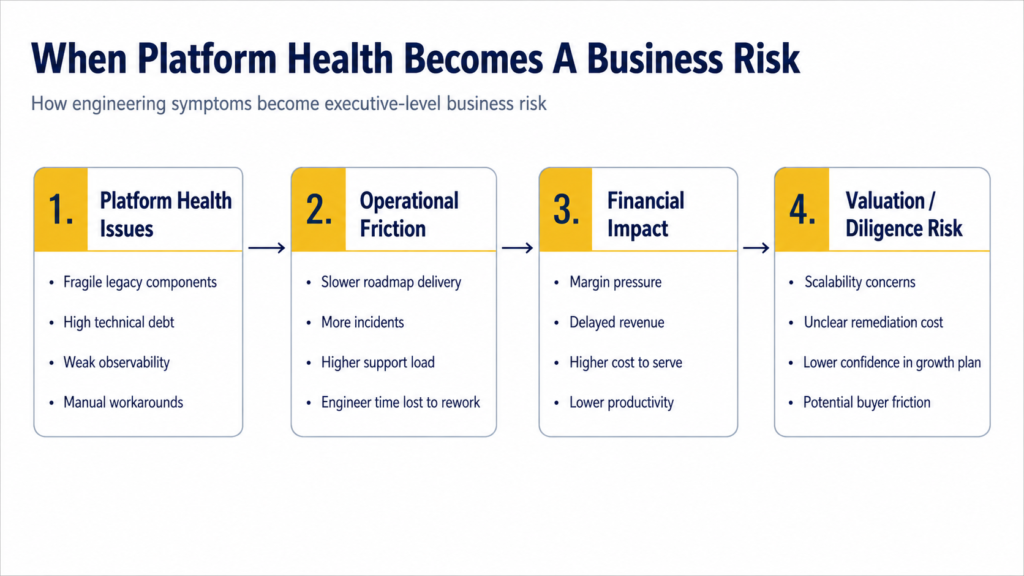
Technical debt becomes a business problem when it starts interfering with the company's ability to execute its growth plan.
For the CTO, the symptoms may look like fragile architecture, regression risk, slow release cycles, aging dependencies, or weak observability. For the CEO, they show up as missed commitments, delayed customer promises, slower product expansion, or a growing gap between strategic ambition and delivery capacity. For the CFO, they appear as margin leakage, unplanned engineering work, higher support cost, lower productivity, and uncertain future investment needs. For the Operating Partner, they become execution risk against the value-creation plan.
This is especially relevant for software holding companies and PE-backed software businesses. In these environments, the platform is expected to support a defined growth thesis. That thesis may include an acquisition integration, a new product expansion, a geographic move, or an exit. If the platform cannot support those moves, modernization is no longer an engineering preference. It becomes a risk-reduction priority.
Alvarez and Marsal describes technical debt as a significant M&A risk, noting that outdated applications, poor system architecture, and weak code quality can create valuation challenges, operational risk, and remediation costs that affect deal confidence. The issue is not that every technical flaw immediately reduces valuation. The issue is that visible platform risk makes the growth story harder to believe.
Why Does Platform Health Matter to EBITDA, Growth, and Valuation?
Weak platform health rarely appears as a single line item on the P&L. Instead, it shows up as accumulated friction across the business.
Operationally, it slows roadmap delivery. Medium-sized changes take longer because teams must understand fragile dependencies, test manually, and work around undocumented behavior. Releases become more cautious, fewer things ship on time, and customer commitments erode. Financially, the impact can be significant. Deloitte has reported that up to 70 percent of technology leaders view technical debt as a hindrance to innovation and the number one cause of productivity loss. For a PortCo, that lost capacity matters. If one-third of engineering time is consumed by debt-related maintenance, the company is effectively funding a shadow cost center that competes with roadmap execution.
That can affect the business in several ways:
- Delayed revenue: Product features, integrations, and customer commitments ship later.
- Higher cost to serve: Support, customer success, and engineering spend more time resolving avoidable issues.
- Weaker retention: Reliability problems and slow improvements can damage customer confidence.
- Lower productivity: Engineering capacity is consumed by rework, defects, and manual intervention.
- Higher future investment needs: Buyers, boards, or investors may assume future remediation cost.
For investors and holding companies, the issue also affects underwriting. Alvarez and Marsal's software product and technology diligence practice evaluates whether the product, technology, and organization can support the target's planned growth. When the answer is uncertain, it can create EBITDA impairment exposure. Platform risk can affect valuation not because every buyer applies the same technical debt discount, but because platform uncertainty weakens confidence in the growth forecast.
What Usually Causes Platform Health to Deteriorate?
Most platform health problems are not caused by one bad decision. They usually come from repeated, rational decisions made under pressure.
Common root causes include:
- Roadmap pressure without repayment discipline. Product teams ship features quarter after quarter while cleanup, test automation, documentation, and dependency upgrades are deferred.
- Temporary fixes that became permanent. Manual scripts, one-off customer exceptions, hardcoded rules, fragile integrations, and support-driven workarounds slowly become part of the operating model.
- Debt concentrated in critical assets. McKinsey has observed that technical debt is not evenly distributed. A set of 10 to 15 assets often drives the majority of the debt in an enterprise, and severity is not always obvious from the outside.
- Weak observability. Teams cannot quickly see what is failing, where performance is degrading, or which release caused a problem.
- Outdated components. Legacy frameworks, unsupported versions, old infrastructure, and unpatched dependencies create security, reliability, and hiring risks.
- Poor data integrity. Billing, usage, entitlements, customer health, and operational reporting may depend on inconsistent data. That creates manual reconciliation and can become a diligence concern.
- Knowledge concentration. A few senior engineers understand the risky parts of the system. When they are overloaded or leave, the platform becomes harder to change safely.
The pattern is familiar: the business pushes for speed, engineering absorbs complexity, and the real cost appears later as reduced agility, reduced reliability, or reduced confidence.
How Does a Platform Modernization Strategy Work in Practice?
The most effective modernization programs are workflow-centered, not technology-centered. The question is not "Should we move to a new architecture, new version, or new language?" The better question is: which business-critical workflows are creating the most risk, cost, or drag?
Typical workflows to evaluate include:
- Product delivery and release: CI/CD pipelines, automated testing, code review, deployment frequency, rollback, and change failure rate.
- Customer onboarding and provisioning: Account setup, tenant configuration, integrations, data migration, and implementation handoffs.
- Billing, entitlements, and usage metering: Subscription rules, usage tracking, pricing logic, invoicing, and customer permissions.
- Authentication and access: Identity, roles, permissions, admin controls, and customer access.
- Reporting and analytics: Customer-facing reports, internal dashboards, product usage data, finance metrics, and data pipelines.
- Core transaction workflow: Claims processing, order management, scheduling, payments, document processing, or any workflow directly tied to customer value delivery.
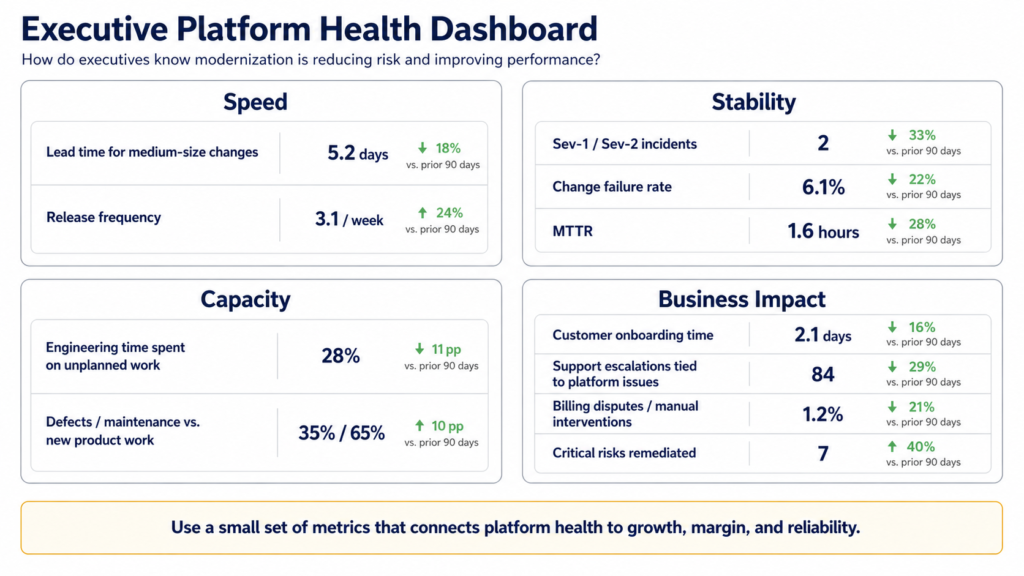
DORA's software delivery metrics offer a practical measurement language for these efforts. DORA tracks throughput through change lead time, deployment frequency, and failed deployment recovery time. It tracks stability through change failure rate and recovery time. These metrics connect engineering health to operational performance. They help leaders see whether modernization is actually improving speed, stability, and execution capacity.
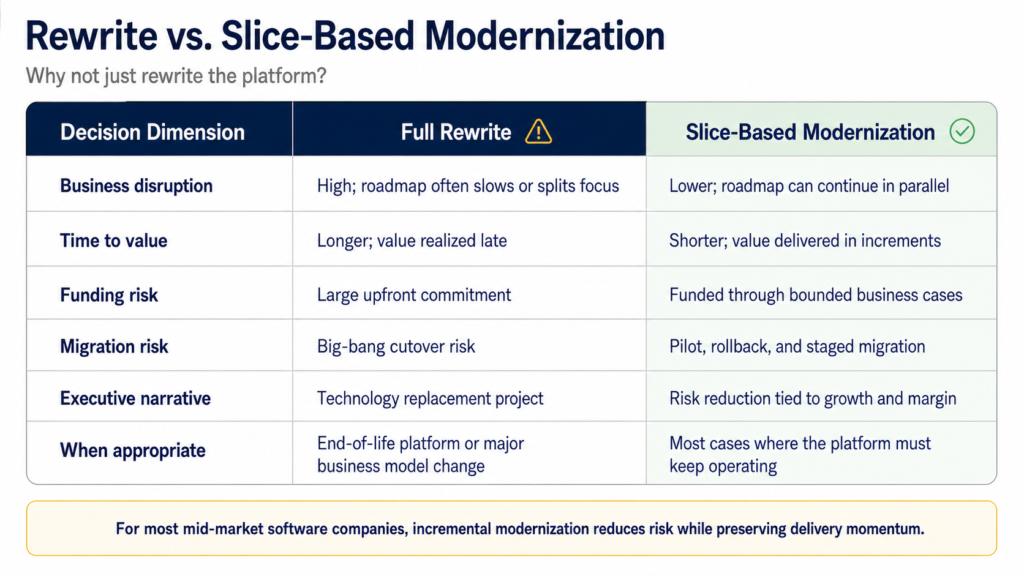
Slice-Based Modernization vs. Full Platform Rewrite
| Dimension | Modernize in Slices | Full Platform Rewrite |
| Delivery continuity | Roadmap continues during modernization | Roadmap often paused or severely constrained |
| Time to business value | Visible improvement per slice, weeks to months | Value delayed until late in project |
| Risk profile | Bounded and reversible at each slice | High: two platforms in parallel, divided attention |
| Capacity required | Can be run alongside roadmap with defined allocation | Requires significant dedicated engineering capacity |
| When appropriate | Most cases: platform is workable but accumulating risk | Platform near end-of-life, fundamental business model change |
What Should Leaders Watch Out For Before Funding Modernization?
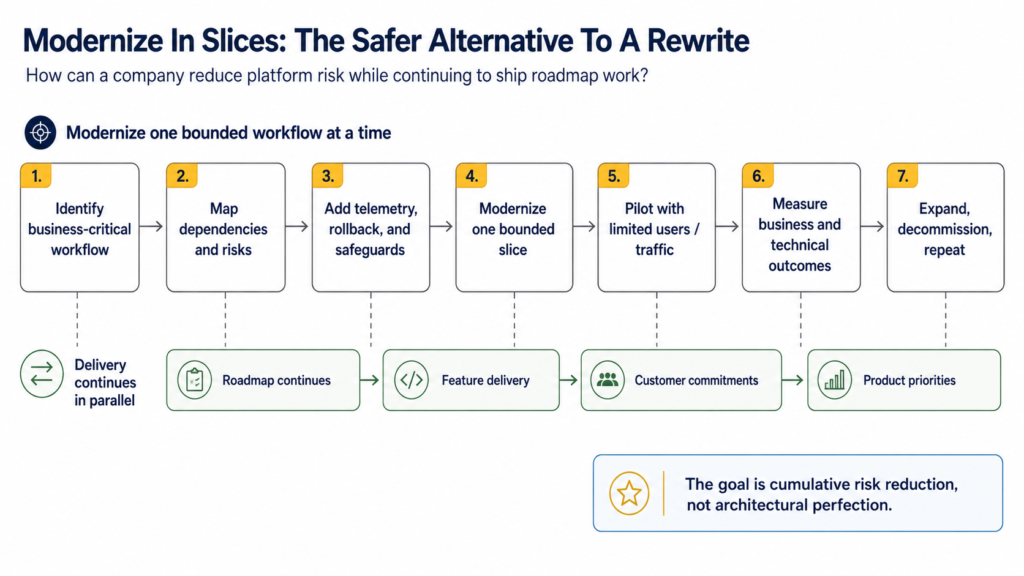
The main risk is confusing modernization with a rewrite. A rewrite feels clean. It promises a fresh start. But it often creates a second platform, divides attention, and delays value until late in the project. For mid-market companies, that is dangerous because the business still needs to ship, support customers, and close deals while the rewrite is underway.
AWS describes this risk clearly in its guidance on the strangler fig pattern. A big-bang migration introduces transformation risk and business disruption. While refactoring is underway, adding new features to the old system is difficult, which means the company is paying to maintain two platforms and receiving value from neither at full capacity.
Other constraints matter as well:
- Data migration may be harder than expected.
- Hidden dependencies may not be fully understood.
- Internal teams may lack available capacity.
- Product incentives may favor new features over platform improvement.
- Finance may reject modernization unless the business case is clear.
- Security or compliance issues may require faster remediation than a slice-based plan allows.
External engineering capacity can help, especially when internal teams are already stretched. Nearshore software engineering can be a strong model for this type of work because it can provide time-zone-aligned, technically senior capacity without requiring a long hiring process. The caveat is important: not all nearshore partners are suited for modernization work. Modernization requires disciplined engineering, product context, architectural judgment, and the ability to operate effectively within an existing system.
Realistic Examples of Modernizing in Slices
Example 1: Billing and entitlements
A mid-market SaaS company has recurring billing disputes because pricing rules, permissions, and usage tracking are spread across old code, spreadsheets, and manual support processes. A full rewrite would be excessive. A slice-based approach would start with one product line or customer segment. The team could create a cleaner entitlement layer, add reconciliation reporting, migrate the highest-risk accounts, and retire the legacy path once the new one is proven.
Business outcome: fewer billing disputes, less revenue leakage, lower support burden, and better finance confidence.
Example 2: Customer onboarding
A PortCo's growth plan depends on faster customer onboarding, but each new customer requires manual setup, custom scripts, and engineering intervention. The company selects the most common onboarding path, automates tenant setup, standardizes configuration, improves integration templates, and tracks onboarding cycle time. Once that path improves, the next most common path becomes the new slice.
Business outcome: faster time-to-value, reduced services burden, more scalable growth, and a better early customer experience.
Example 3: Reliability around a core workflow
A platform has frequent incidents in a high-value transaction workflow. The team knows the architecture is fragile, but the company cannot afford to pause roadmap delivery. Instead of rewriting the platform, the team defines service-level objectives, improves logging and monitoring, isolates one fragile dependency, introduces safer routing, and migrates a small portion of traffic to validate the improved path.
Business outcome: fewer severe incidents, faster recovery, less engineering time lost to firefighting, and a more credible growth plan.
These examples share a common pattern: the modernization effort is bounded, measurable, and tied to a business workflow. That is what makes it fundable, executable, and defensible to leadership and investors.
How to Modernize Without Pausing the Roadmap
A practical modernization program starts with value protection. Leaders should ask: where is platform health already creating visible business risk?
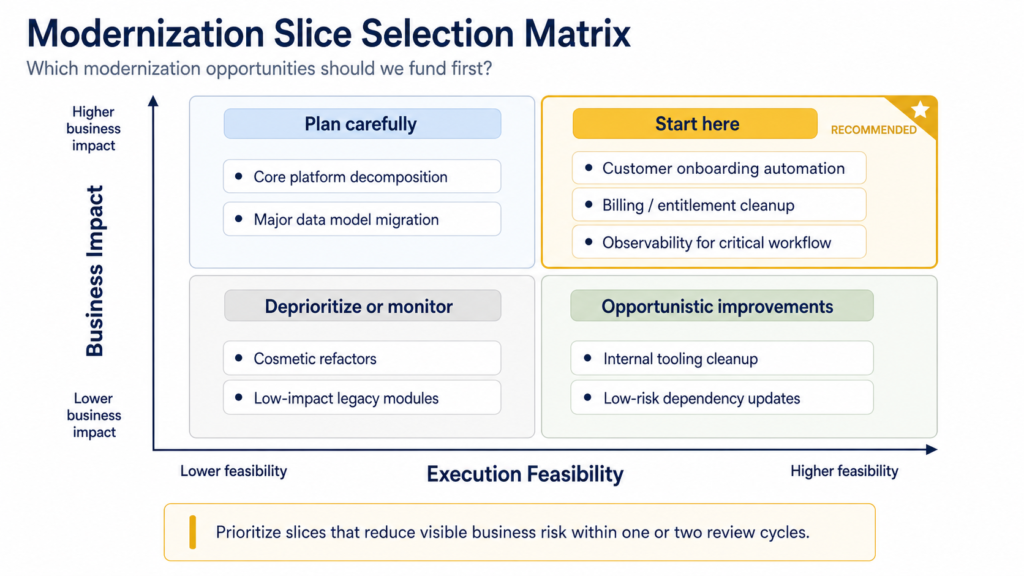
The best starting points are usually workflows with clear leadership relevance:
- Customer-facing reliability issues
- Slow roadmap delivery
- High support load
- Revenue leakage
- Manual operations that constrain scale
- Scalability constraints limiting growth
- Security exposure
- Diligence-sensitive platform gaps
From there, leaders should protect capacity. Modernization cannot depend on "extra time." It needs a defined allocation, preferably tied to roadmap work. For example, if a new pricing initiative requires changes to billing and entitlements, the company can modernize that slice while delivering the commercial initiative. This turns modernization from a separate workstream into a shared benefit.
The program should also include a small executive dashboard. Useful metrics may include lead time for change, release frequency, severe incidents, recovery time, change failure rate, engineering time spent on unplanned work, onboarding cycle time, billing disputes, support escalations, and critical risks remediated. Run the work quarterly. Review the platform risk register. Reallocate capacity. Decommission old components when safe. Modernization should become an operating rhythm, not a one-time rescue program.
When Slice-Based Modernization Is Not Enough
Slice-based modernization is not always the answer. If the core platform is near end-of-life, unsupported, insecure, or impossible to staff, incremental improvements may only delay a larger replacement. If the business model is changing fundamentally and the platform cannot support it incrementally, a more significant rebuild may be required.
If there is a severe security or compliance exposure, immediate remediation may be required. Some risks cannot wait for a gradual migration path. Slice-based modernization also fails when leadership refuses to protect capacity. It is less risky than a rewrite, but it is still real work. If modernization is expected to happen only after roadmap work is complete, it will not happen.
The approach works best when leaders are willing to make platform health visible, tie modernization to business outcomes, and sustain the effort over multiple quarters.
The 5 Most Common Platform Modernization Mistakes
The first mistake is starting with architecture instead of business risk. If the modernization case sounds like "engineering wants cleaner code," it will lose to roadmap pressure. The better case is tied to a specific business outcome: reducing support burden, improving revenue reliability, or enabling the next customer segment.
The second mistake is treating all technical debt equally. A cosmetic refactor is not the same as a billing defect that creates revenue leakage. A low-traffic legacy module is not the same as an unstable core workflow. Risk prioritization is the most important step in modernization planning.
The third mistake is adding new systems without retiring old ones. This increases complexity instead of reducing it. Every modernization slice should include decommissioning criteria. If the old path is not retired when the new one is proven, the company is maintaining two systems instead of one.
The fourth mistake is ignoring operating practices. Code improvements will not produce enough value if release management, testing, incident response, documentation, and ownership remain weak. Technical improvement and process improvement need to move together.
The fifth mistake is underestimating capacity. Internal teams may already be responsible for roadmap delivery, support, incidents, and customer escalations. A strong engineering partner can provide focused modernization capacity that allows internal teams to maintain roadmap momentum without absorbing the full modernization effort on top of their existing load.
What This Means for PE-Backed Portfolios and Mid-Market Software Companies
PE-backed software portfolios and software holding companies
For software holding companies and PE-backed portfolios, platform modernization is directly connected to value creation. The growth thesis may depend on integrating an acquisition, expanding into a new vertical, or preparing for an exit. Each of those moves requires a platform that can be changed predictably, scaled reliably, and described confidently during diligence. A disciplined modernization program tied to the value creation plan, with measurable business outcomes and a quarterly operating rhythm, is a meaningful part of the investment thesis execution.
For operating partners managing multiple portfolio companies, the PE-backed software portfolio context also shapes how engineering capacity is structured. Modernization work often requires bringing in additional capacity without disrupting the internal team. Dedicated nearshore engineering teams can provide the time-zone-aligned, technically senior support needed to run modernization in slices alongside the roadmap.
Mid-market software companies
For mid-market software companies, the challenge is balancing modernization against a roadmap that already consumes most of the available engineering capacity. The practical entry point is identifying one or two workflows where platform risk is already creating visible cost: a billing process that generates support escalations, an onboarding flow that requires manual engineering intervention, or a release process that generates frequent incidents. Improving one of those workflows produces measurable business value, demonstrates the model, and creates the case for a sustained program.
Independent software companies at this stage often find that the hardest part of modernization is not the technical work. It is building organizational alignment around the business case. Framing platform health as a value-protection program rather than a technical cleanup effort is the first step toward that alignment.
Frequently Asked Questions
Should we stop roadmap work to modernize the platform?
Usually no. In most mid-market software companies, stopping the roadmap to modernize creates more risk than it removes. The safer approach is to modernize selected slices while roadmap work continues, using defined capacity allocation and tying modernization slices to commercial initiatives where possible. The only cases where a more significant pause may be justified are severe security or compliance exposures, or platforms that are truly near end-of-life and cannot safely continue operating.
How much capacity should we allocate to platform modernization?
There is no universal percentage. Start with the business risk. If platform issues are delaying revenue, increasing support cost, or creating diligence exposure, the capacity case is already visible. A practical starting point is 15 to 20 percent of engineering capacity, tied to the highest-priority workflow rather than distributed across a broad backlog. That allocation should be protected, reviewed quarterly, and connected to specific business outcomes so it remains defensible when roadmap pressure increases.
Is a full platform rewrite ever the right approach?
Yes. A rewrite or major replacement may be appropriate when the platform is near end-of-life, the business model is changing fundamentally, or the security and compliance exposure cannot be resolved incrementally. What matters is that the decision is made for business reasons, not technical elegance. A rewrite should have a clear business case, a realistic capacity plan, and a defined transition that keeps the existing platform operational for customers while the new one is validated.
How should CFOs evaluate the business case for platform modernization?
CFOs should look beyond engineering cost. The business case should include cost to serve, incident burden, support escalations, delayed revenue, customer risk, and the estimated remediation cost that a future buyer or investor might apply during diligence. Platform modernization is not primarily an engineering investment. It is a margin improvement program, a reliability improvement program, and a risk reduction program. When presented in those terms, with measurable outcomes tied to specific workflows, it competes more effectively for capital allocation.
Key Takeaways for Business Leaders
Technical debt becomes material when it constrains growth, reliability, margin, customer trust, or diligence confidence. At that point, it is no longer a technical problem. It belongs on the leadership agenda.
Modernization should be framed as value protection, not technical cleanup. Full rewrites often create more risk than they remove, especially when the business must keep shipping. The practical pattern is a disciplined platform modernization strategy built around slices, starting with business-critical workflows where risk is already visible and measurable. Progress should be tracked with operational and financial metrics, not only engineering activity.
Scio helps software holding companies, PE-backed software companies, and mid-market software organizations add disciplined nearshore engineering capacity to reduce platform risk while continuing to support the roadmap. If this is relevant to where your organization is right now, I would be glad to talk it through.
References and Further Reading
- Alvarez and Marsal, Software Product and Technology Diligence Practice. M&A advisory practice evaluating platform health as an investment risk factor, including how technical debt creates valuation uncertainty and operational risk during acquisition diligence. alvarezandmarsal.com
- McKinsey and Company, Technology and Digital Research. Research on technical debt distribution in enterprise software, including the finding that 10 to 15 assets typically drive the majority of technical debt and the EBITDA impact of deferred platform investment. mckinsey.com
- Deloitte Insights, Technical Debt and Innovation Research. Research reporting that up to 70 percent of technology leaders identify technical debt as the primary cause of productivity loss and a significant barrier to innovation capacity. deloitte.com
- DORA (DevOps Research and Assessment), State of DevOps Report. Annual research defining software delivery performance metrics including change lead time, deployment frequency, change failure rate, and recovery time as the measurement language for platform modernization outcomes. dora.dev
- AWS, Strangler Fig Pattern and Migration Guidance. Architectural guidance on incremental migration patterns, including the strangler fig approach that underpins slice-based modernization and the documented risks of big-bang rewrite migrations. docs.aws.amazon.com
- Gartner, Technical Debt and Software Platform Management Research. Analysis of how technical debt accumulates in enterprise software portfolios, the business impact on delivery capacity and EBITDA, and the governance practices that support sustainable platform investment. gartner.com
- Harvard Business Review, Engineering Leadership and Organizational Performance. Research on how platform health, engineering investment decisions, and technical risk management affect long-term business performance and growth capacity. hbr.org
- NIST, Cybersecurity Framework and Software Security Guidance. U.S. government framework for software security risk assessment, relevant to the security and compliance modernization scenarios where slice-based approaches must be accelerated. nist.gov
- Scio blog, Technical Debt Hidden Cost: 5 Real Risks CTOs Underestimate. Detailed breakdown of how technical debt creates hidden business cost beyond engineering metrics, directly relevant to building the business case for platform modernization. sciodev.com