In PE-backed portfolio companies, inherited legacy platforms often buckle under operational strain within the first few months of ownership. The instinct to launch a modernization project immediately, to prove value creation fast, is understandable, but it is usually the wrong first move. This guide covers the actual application support vs modernization strategy decision: why robust application support, stabilizing code, fixing critical defects, and streamlining maintenance, should precede any pragmatic modernization roadmap.
The evidence here draws on KPMG's 2025 technology M&A research, PagerDuty and New Relic's incident economics data, Bain and PwC's carve-out and TSA research, and DORA's delivery performance findings. All of it points the same direction: stabilize the platform first, then modernize with a clear fact base, not the reverse.
Jumping directly into modernization is risky for PE-backed portfolio companies that inherit fragile, undocumented systems. New owners typically discover platform instability and unresolved technical debt in the earliest weeks post-acquisition, and strategic urgency can push a team into refactoring before anyone has mapped what is actually load-bearing.
Fragility Exposed in Due Diligence and Early Operations
Legacy fragility often stays hidden until post-close integration is underway. KPMG's private enterprise research found that flaws in foundational IT systems disrupt private companies' workflows on a weekly basis, and that private-sector respondents were more likely than public-sector peers to experience this. Only 30 percent of KPMG's 2025 M&A survey respondents rated tech debt as highly important pre-deal, even though 70 percent linked unresolved tech debt to operational disruption and 60 percent to cyber risk.
The Disruption Risk of Big-Bang Rewrites on Live Platforms
A wholesale rewrite on a live platform tends to expose exactly the instability it was meant to fix. Bain warns that post-acquisition environments, carve-outs especially, are prone to Day 1 operational failures when dependencies are not fully mapped and controlled beforehand. PwC's research on TSA exits notes that a typical exit requires more than 1,500 interdependent design decisions, which is precisely why a rushed modernization effort can backfire while the platform is still entangled with seller systems.
Application Support vs Modernization Strategy: The Case
For most PE-backed PortCos, application support is the real first step in modernization strategy, not a delay before it. Stabilizing first restores platform health, reduces risk, and builds a credible baseline the modernization business case can actually stand on.
Reducing Operational Risk to Protect EBITDA and Exit Timelines
Fragile platforms mean frequent incidents, long recovery times, and rising operational cost. PagerDuty's 2024 research found the average production incident takes 175 minutes to resolve at an estimated $4,537 per minute, close to $794,000 per incident, with organizations reporting roughly 25 high-priority incidents a year, near $20 million annually. Robust application support cuts incident frequency quickly, which is a direct EBITDA lever and a direct exit-readiness lever.
Reclaiming Capacity and Clarifying Technical Debt Prioritization
KPMG's 2025 research found legacy-system issues can consume up to 40 percent of engineering capacity, capacity that would otherwise fund modernization and value creation work. Stabilization reclaims that capacity and gives the team room to document dependencies, assess technical debt honestly, and prioritize modernization where the ROI is actually highest.
What Real Application Support Includes for PE PortCos
Effective application support goes well past break-fix. Done properly, it hardens the platform for operational continuity and clear governance, which is exactly the foundation a later modernization program needs to stand on rather than a temporary patch applied under pressure.
24/7 Incident Management, SLA-Driven Response, and Root-Cause Fixes
Best-in-class support means round-the-clock incident triage, real root-cause analysis, and attention to dependencies rather than surface symptoms. New Relic's 2024 research found full-stack observability was associated with 79 percent less downtime and roughly 48 percent lower hourly outage costs than fragmented tooling, a direct measure of what disciplined support actually buys.
Maintenance Burden Reduction and Governance Tightening
High-quality documentation and unified runbooks are what make support onboarding fast instead of tribal. DORA's 2023 research links strong documentation to 25 percent higher team performance and faster code review to roughly 50 percent better software delivery performance. That combination is what reduces key-person risk and builds the operating foundation modernization eventually depends on.
How Do You Move From Support to Modernization?
Stabilization is not the end state, it is the disciplined precursor that makes modernization fundable and low-risk instead of speculative. Once support onboarding is complete, the roadmap shifts from guesswork to a data-driven sequence built on real dependency maps and real incident history, not assumptions.
Building a Data-Driven Modernization Roadmap on a Stable Foundation
With service inventory, dependency mapping, and health baselines in place, teams can make grounded decisions about which applications to replatform, refactor, replace, or retire, based on risk, cost, and business impact, rather than guessing at what the platform can absorb.
Iterative Modernization vs. Big-Bang Rewrite: A Low-Risk Framework
Prioritizing iterative, metric-driven modernization over a single large rewrite keeps capacity available for ongoing post-acquisition integration work. Organizations that choose iterative upgrades consistently report lower downtime, fewer budget overruns, and more predictable outcomes than teams that attempt a single large-scale replacement.
The table below frames the full sequence for a PE audience.
Sequence Element
What It Is Really Doing
Why It Matters for EBITDA and Exit
Application support stabilization
Establishes service inventory, dependency mapping, observability, incident response, and safe change controls.
Reduces downtime cost, protects revenue, and creates a measurable platform health baseline.
Controlled TSA and separation planning
Clarifies what stays, what exits, and what must be rebuilt for standalone operation.
Avoids one-time-cost overruns and business interruption during integration.
Pragmatic application modernization
Selectively replatforms, refactors, replaces, or retires applications once risk is visible.
Converts modernization from speculative spend into a defensible value creation plan.
Case Study: Stabilization That Enabled Modernization
Before: A mid-market PE portfolio company inherited a core transaction processing system with chronic outages and spiraling support costs immediately post-close. In the first 90 days, average incident resolution time exceeded three hours, and the projected financial impact from outages threatened to destabilize forecasted EBITDA while teams struggled with undocumented processes and heavy dependence on a small group of engineers.
After: A stabilization-first approach instituted 24/7 incident response, unified observability, and improved documentation. Incident frequency dropped 60 percent within four months, the engineering team reclaimed roughly 35 percent of its capacity, and board confidence increased with better forecasting and risk controls. Only after this did targeted modernization begin, delivering on the original value creation plan.
How Do You Decide: Support or Modernization First?
For PortCo CTOs and Operating Partners, the sequencing decision should be governed by readiness criteria and metrics, not urgency alone. The checklist and metrics below turn that judgment call into something defensible to a board.
Stabilization Criteria Checklist for PortCo CTOs and Operating Partners
Incidents are trending down over a three-month window.
24/7 incident response is in place and SLAs are consistently met.
All high-severity technical debt is documented.
Platform dependencies are mapped and cross-documented.
Board and management agree on the platform health metrics being tracked.
Key Metrics to Track Before Launching Modernization
Mean time to detect and mean time to resolve for production incidents.
Downtime cost per incident.
Percentage of engineering capacity spent on maintenance.
Change failure rate across releases.
Platform health and documentation completeness status.
What This Means for Operating Partners and PortCo CTOs
For Operating Partners Managing the Portfolio
Across a portfolio, the stabilization-before-modernization sequence is what keeps a single fragile PortCo from becoming a cross-portfolio credibility problem. Bain's research on PE-backed software portfolios ties average holding periods drifting toward seven years directly to the cost of any company that spends its first year firefighting instead of executing the value creation plan.
For PortCo CTOs Managing the Technical Side
For a CTO who inherited the platform rather than built it, the stabilization phase is the highest-leverage work available in the first two quarters: it is what turns an unfamiliar, undocumented system into a platform the CTO can actually make defensible modernization decisions about. Dedicated nearshore engineering teams are a practical way to add that stabilization capacity without pulling focus from whatever the internal team is already carrying.
Frequently Asked Questions
Why can't we start modernization immediately after acquisition?
Modernization on an unstable platform often backfires, increasing outages and completion risk instead of reducing it. Stabilizing first protects operational continuity and builds the credible baseline that a modernization business case actually needs to stand on.
How long does a stabilization engagement typically last?
Most PE-backed stabilization engagements run three to six months before modernization begins, enough time to baseline metrics, fix critical defects, and document the dependencies that were previously undocumented.
What KPIs demonstrate that we're ready to modernize?
The clearest signals are a consistent downward trend in incidents, an improving mean time to resolve, documented platform dependencies, and a minimum viable level of observability across the core system.
Can application support teams transition into modernization pods?
Yes. The same engineers who deliver application support often transition directly into modernization workstreams, carrying platform familiarity and incident context that would otherwise take a new team months to rebuild.
How does stabilization impact EBITDA and exit readiness?
Reducing operational incidents and reclaiming engineering capacity protects margin, supports more credible forecasts, and produces a more attractive platform story for a future buyer or the next funding round.
Does stabilization delay the value creation plan?
Done well, it accelerates the plan rather than delaying it, since it removes the diversionary firefighting workload that would otherwise compete with modernization capacity for the rest of the hold period.
The Bottom Line
For PE-backed portfolio leadership, the pull to modernize immediately after acquisition is understandable, but it is usually the wrong sequence. Application support vs modernization strategy is not really a choice between the two. It is a sequencing decision, and the evidence consistently favors stabilizing first.
Proactive application support positions the platform for a modernization program that actually succeeds, while protecting operational integrity and exit value along the way. If your team is weighing this exact sequencing question for a portfolio company, our team at Scio would be glad to talk through where your platform actually stands.
DORA (DevOps Research and Assessment). Research linking documentation quality and code review speed to software delivery performance. https://dora.dev/research/2024/dora-report/
Incremental legacy modernization in SaaS platforms lets mid-market software companies reduce technical debt and brittle architecture in critical modules without disrupting production. This guide outlines a risk-reduced framework to refactor legacy code iteratively, preserve delivery velocity, and enable the business to keep shipping while the platform improves underneath it.
TABLE OF CONTENTS
Why SaaS Legacy Systems Accumulate Debt and Why It Matters Now
Most mid-market SaaS codebases did not become legacy systems through bad decisions. They became legacy systems through good decisions: shipping fast to validate the product, meeting customer deadlines, and choosing the simplest path through a complex problem under time pressure. The problem is that those decisions accumulate. What was acceptable scaffolding at Year 2 is brittle architecture at Year 6, when the product is larger, the team is bigger, and the customers have more complex expectations.
The hidden cost of technical debt in SaaS
Technical debt in a SaaS system charges interest on every change. Stack Overflow's 2024 developer survey found that 62.4 percent of professional developers named the amount of technical debt as their top workplace frustration, ahead of build-stack and deployment-stack complexity. Sonar's 2026 developer survey found that 41 percent named managing technical debt as a primary source of toil, and 32 percent named debugging legacy or poorly documented code.
In practice, this shows up as slower feature estimates, recurring incident work, fragile deployments, and painful onboarding. New engineers spend time reconstructing system behavior that should be in documentation. Senior engineers are pulled from roadmap work into maintenance and firefighting. The product can still ship, but each release costs more engineering effort than the last.
How brittle architecture slows roadmap velocity
Brittle architecture is a specific kind of technical debt: coupling that makes isolated change difficult. A shared database that multiple services write to directly. Authentication logic scattered across layers. A build pipeline that has never been documented because the engineer who built it is now gone. Cross-cutting concerns that touch every new feature, making every change broader and riskier than it needs to be.
AWS's modernization guidance describes the effect precisely: in a tightly coupled system, changes require broader retesting, cycle time worsens, and maintenance load rises. The consequence for a mid-market SaaS team is that the roadmap slows not because engineers are unproductive but because the architecture forces each change to carry unnecessary risk. The team is doing more work per feature than the feature itself requires.
Why Full Rewrites Fail in Legacy Modernization SaaS Projects
The appeal of a full rewrite is understandable. Start clean. Make the right architectural decisions this time. No legacy constraints. In practice, full rewrites in mid-market SaaS environments fail at a high rate, for reasons that are predictable in advance.
Operational disruption and resource drain
A full rewrite requires the team to maintain two codebases simultaneously: the production system that customers depend on and the new system being built. That split destroys leverage. The team cannot ship roadmap features on the legacy system because every change creates a conflict with the in-progress rewrite. And the new system takes longer than estimated because the team is also still supporting production.
TierPoint's 2025 mid-sized business technology survey found that 97 percent of respondents felt the impact of IT skill shortages, with 64 percent saying the impact would be major to severe. For a mid-market SaaS team, that means a full rewrite is being attempted with a team that is already stretched. The talent required to build the new system while stabilizing the old one is rarely available at the same time.
How big-bang approaches escalate project risk
Both Microsoft and AWS have made this point explicitly in their current modernization guidance. AWS warns that a single-cutover rewrite or refactor is a "huge undertaking and a big risk," introducing transformation risk while making it difficult or impossible to add features during the transition. Microsoft's migration guidance notes that full rewrites are difficult and risky for most production applications, especially when legacy decisions, dependency chains, and cross-cutting concerns have accumulated over time.
The failure mode is well-documented: the rewrite takes longer than planned, customers notice the feature freeze, key engineers burn out, and the team eventually ships a version-one rebuild of a system that was already version six. The architectural improvements are real, but the cost and timeline damage often exceed the original budget by a significant margin.
A Pragmatic Incremental Modernization Framework
The alternative is not to accept the legacy system forever. It is to modernize one meaningful seam at a time, using patterns that preserve production stability while the platform improves underneath it. The following framework reflects what AWS, Microsoft, and Azure each recommend for production SaaS systems that cannot pause for a full rewrite.
Phase
Focus
Key Activity
Risk Gate
Assessment
Map current state
DORA baseline, module inventory, incident history
Seam boundaries documented
Target selection
Identify first module
Business-impact and risk scoring, domain-driven design
Test coverage baseline exists
Façade and build
Strangler Fig execution
Proxy layer, anti-corruption adapter, new service slice
Behavior parity verified in staging
Observability
Instrument both paths
OpenTelemetry, feature flags, alerting on new path
Full-stack visibility on old and new
Progressive cutover
Shift traffic incrementally
Canary rollout, rollback path tested, data consistency checked
Rollback confirmed under 15 minutes
Retirement
Remove temporary structures
Adapter, flag, and sync job retirement on a fixed schedule
No backward dependencies remain
Select the right module to start
The first module should be chosen by intersection of business pain and seam clarity, not by technical ambition. The right candidate is a module where the cost of the current architecture is measurable (slow releases, recurring incidents, team frustration with every change) and where the boundary between that module and the rest of the system is clear enough to support a façade or proxy layer without restructuring everything around it.
AWS recommends using domain-driven design and event storming to identify service boundaries before carving a monolith. The warning is important: premature decomposition in the wrong place is expensive. Decomposing a domain that is genuinely unclear at the boundary creates a distributed monolith with all the complexity of microservices and none of the decoupling benefit.
Apply Strangler Fig and anti-corruption patterns
The Strangler Fig pattern, documented in both Azure and AWS modernization guidance, works by placing a façade in front of the legacy system and routing new requests to a new implementation while the legacy system continues to handle existing traffic. The old system is not replaced in one step; it is incrementally strangled as the new implementation takes over one surface at a time.
Where the new service needs to communicate with legacy subsystems that use different data models or protocols, an anti-corruption layer translates between old semantics and new. Azure's modernization documentation notes that this layer adds latency and a new service to manage, which is a real cost. It should be treated as temporary infrastructure with a defined retirement date, not as a permanent integration layer.
Instrument before you refactor
Test coverage before behavioral change is the single most reliable predictor of modernization confidence. Microsoft's current migration guidance recommends focusing coverage on API boundaries, serialization, database access, and authentication before starting any refactoring. Those are exactly the seams most likely to produce silent regressions when behavior is rebuilt.
Observability investment belongs at the same moment. New Relic's 2024 observability research found that organizations with full-stack observability experience 79 percent less annual downtime and 48 percent lower outage cost per hour. For a SaaS team running old and new paths simultaneously during a transition, that visibility is not optional: it is the mechanism that makes safe cutover possible.
How to Execute Risk-Reduced Modernization in Practice
Conduct a modernization readiness assessment
Before any code changes, establish the baseline the team will measure improvement against. This means collecting current DORA metrics: change lead time, deployment frequency, change failure rate, and time to restore service. It also means mapping the legacy module inventory by business impact: which modules slow the roadmap most, which generate the most incident volume, and which have the lowest test coverage relative to how frequently they change.
Sonatype's 2024 software supply chain report found that some critical vulnerabilities took more than 500 days to remediate, and that component publication vastly outpaced software bill of materials publication across the industry. For a SaaS modernization program, the readiness assessment should include an explicit dependency audit: open-source components with known vulnerabilities, unsupported libraries, and dependencies that block version upgrades are modernization blockers that become visible only when a team looks deliberately.
Prioritize with a technical debt scoring model
Not all technical debt is equally expensive to carry. The most useful prioritization model combines two axes: the business cost of the current debt (release slowdown, incident frequency, customer impact) and the remediation cost (estimated engineering effort, test coverage required before safe change). High business cost and relatively lower remediation cost is the right starting point. High business cost and high remediation cost is the case for a phased approach with multiple sprints.
Sonar's 2026 developer survey found that 17 percent of developers named broken or outdated dependencies as a major source of toil. Dependencies are often the highest-leverage starting point because upgrading them is bounded work that generates measurable security and stability benefit without requiring architectural redesign.
Design iterative refactoring sprints with explicit exit gates
Each sprint in a modernization program should have a defined exit gate: what behavior must be verified, what test coverage must exist, what rollback path must be confirmed, and what observability must be active before the sprint is considered complete. Without exit gates, modernization sprints drift. Work that was supposed to take three weeks takes eight because the definition of done was never precise.
LaunchDarkly's documentation describes feature flags as the mechanism that decouples deployment from release, enabling canary rollouts and rapid disablement if behavior degrades. For an iterative modernization program, flags are the operational control that makes progressive cutover safe: the new path can be deployed, tested, and validated before any customer traffic shifts to it.
Track progress with DORA-aligned modernization metrics
The metrics that matter are not lines refactored or modules completed. They are the same delivery metrics DORA uses to measure engineering organizational performance: change lead time trending down, deployment frequency trending up, change failure rate staying low or improving, and time to restore service improving or holding stable. Secondary metrics for a modernization program include test coverage trend for the modules being worked, open vulnerability count, and dependency age.
The single most common cause of modernization setbacks is changing behavior in a module that does not have sufficient test coverage to detect a regression. Microsoft's guidance is explicit: focus test investment on API boundaries, serialization, database access, and authentication before starting architectural changes. These are the seams that produce silent regressions when rebuilt.
Sonar's 2026 survey found that 53 percent of developers reported AI improved their test coverage. That is a meaningful efficiency gain for teams that are building baseline test coverage as part of a modernization program: AI-assisted test generation can reduce the cost of establishing coverage on a poorly-tested legacy module. The same survey found that 96 percent of developers do not fully trust AI-generated code to be functionally correct, which means human review of AI-generated tests is still required.
Avoid scope creep with modular boundaries
Modernization scope expands when the first module boundary is drawn loosely. A "billing module refactor" becomes a "billing and subscription refactor" becomes a "billing, subscription, and entitlement refactor," and six months later the team is doing a big-bang rewrite of the commercial layer with a different name. Modular boundaries need to be documented and enforced as a governance decision, not left to the team to interpret sprint by sprint.
GitLab's 2024 developer survey found that 64 percent of respondents wanted to consolidate their toolchain, and that 42 percent of AI-using developers were already using six to ten tools in the development process. Toolchain sprawl during a modernization program creates context switching overhead that compounds the existing technical debt burden. Where possible, modernization sprints should standardize on a defined set of tools rather than introducing new ones.
Plan the retirement of temporary structures
Every adapter, feature flag, anti-corruption layer, and sync job created during a modernization program is temporary by design. If it is not retired on a defined schedule, it becomes permanent technical debt. Azure's modernization guidance notes that the anti-corruption layer adds latency and a new service to manage; that cost is acceptable as a bridge but not as a permanent fixture.
Retirement gates should be built into the program plan before modernization starts: the condition under which each temporary structure will be removed, the engineer responsible for that retirement, and the sprint in which it is scheduled. Without this, modernization programs produce cleaner primary code and a new layer of transitional scaffolding that nobody owns.
Illustrative Scenario: Billing Module Refactoring
The following is a composite scenario drawn from common patterns in mid-market SaaS modernization. It is not attributed to a specific client.
Starting conditions
A mid-market SaaS company with approximately 60 engineers had accumulated significant technical debt in its billing and subscription module over four years of accelerated growth. Deployment to the billing module required a full integration test suite run taking over two hours, every release touched billing regardless of whether billing logic changed, and three recurring incidents per quarter could be traced directly to the module. Feature estimates for anything touching pricing or entitlements were consistently three times longer than estimates for comparable work elsewhere in the system.
Approach
The team ran a modernization readiness assessment before writing any code. The assessment identified the billing module as the highest business-cost, most bounded candidate: revenue impact of incidents was measurable, the API surface was documented, and the boundary between billing and adjacent modules was well-defined. A façade layer was added to route new billing requests to the new implementation while the existing implementation continued to handle in-flight subscriptions. Test coverage on the billing API boundary was brought from 31 percent to 78 percent before any behavioral changes were made. Feature flags controlled traffic routing between old and new paths, and OpenTelemetry instrumentation was added to both before any cutover traffic shifted.
Outcomes
The full replacement of the billing module took eleven weeks across four refactoring sprints. After cutover, billing-related incidents dropped to zero over the following two quarters. Deployment cycle time for billing changes dropped from a full integration suite run to a targeted billing test run under twelve minutes. The team's velocity on roadmap features in the quarter following completion was measurably higher, with the senior engineers who had been the primary billing incident responders now available for product-enabling work.
What This Means for Engineering Leaders
CTOs and VPs of Engineering at mid-market SaaS companies
For mid-market independent software companies the decision point for legacy modernization in SaaS usually arrives when one of three things becomes undeniable: the delivery estimates for any feature touching a legacy module have become disconnected from reality, the incident rate in a legacy area is consuming senior engineering capacity that should be building the roadmap, or a strategic product decision requires platform capabilities the current architecture cannot support.
The practical risk at that decision point is choosing the wrong path. A full rewrite looks like the clean solution but carries the execution risk and resource drain described in this article. An unstructured cleanup effort produces local improvement without measurable platform trajectory. The approach that consistently produces better outcomes is the one described here: structured incrementalism with explicit exit gates, DORA-aligned measurement, and test coverage investment before behavioral change.
Scio's pragmatic application modernization approach is designed for exactly this scenario: a mid-market SaaS engineering team that needs to reduce technical debt in a critical module without pausing roadmap delivery. Our nearshore engineering teams integrate into the client's existing delivery cadence and work within the client's architecture standards, because the goal is a modernized platform the internal team owns and can maintain, not a parallel system that creates new dependency. If you want to discuss how this applies to a specific module or platform area, our team would be glad to talk.
Engineering managers responsible for day-to-day delivery
For the engineering manager running sprints during a modernization program, the operational priorities are test coverage gates before behavioral changes, modular boundary discipline during scope conversations, and explicit retirement planning for temporary structures. These are the decisions that determine whether a modernization initiative produces a cleaner platform or a transitional layer that becomes the next generation of technical debt.
What is legacy modernization in SaaS and how is it different from a rewrite?
Legacy modernization in SaaS is the process of incrementally replacing or refactoring legacy modules within a production system while keeping the system live and continuing to ship features. It is different from a full rewrite because it does not require pausing feature delivery, does not split the team across two full codebases simultaneously, and produces working improvement after each sprint rather than requiring the entire program to complete before any value is realized. The Strangler Fig pattern is the most commonly used structural approach for SaaS modernization without full replacement.
How do you decide which legacy module to modernize first?
The right starting point is the module where business pain is highest and boundary clarity is sufficient to support a façade or proxy layer. Business pain can be measured directly: delivery estimate inflation for features touching that module, incident frequency attributed to that module, and senior engineer time consumed by that module per quarter. Boundary clarity is a technical judgment: can a façade be placed in front of this module without restructuring everything connected to it? High business pain and reasonable boundary clarity is the right combination. High business pain and unclear boundaries means domain-driven design work is needed before technical refactoring begins.
Why do full rewrites fail so often in mid-market SaaS companies?
Full rewrites fail because they require maintaining two codebases simultaneously, which splits the team and eliminates the capacity for roadmap feature delivery during the transition. They also consistently take longer than estimated because the team is learning the complexity of the legacy system while building the replacement, not before. AWS and Microsoft both recommend against single-cutover rewrites for production applications that must remain live because the combination of transformation risk and delivery freeze creates compounding organizational damage.
How important is test coverage before refactoring begins?
Test coverage is the most reliable predictor of modernization confidence and the most common source of setbacks when it is missing. Microsoft's migration guidance recommends focusing coverage on API boundaries, serialization, database access, and authentication before any architectural changes begin. Those are the seams most likely to produce silent regressions when behavior is rebuilt. A team that starts refactoring without baseline coverage in those areas is refactoring blind: changes may appear to work correctly in staging but produce subtle behavioral differences in production that are discovered by customers rather than tests.
What metrics should track progress during a legacy modernization program?
DORA metrics are the most useful leading indicators: change lead time for the modernized module, deployment frequency, change failure rate, and time to restore service. These measure delivery system health rather than modernization activity, which keeps the program accountable to business outcomes rather than task completion. Supporting metrics include test coverage trend for modules in progress, open vulnerability count in dependencies, and incident volume attributed to legacy areas. Tracking lines refactored or modules completed without connecting to delivery outcomes produces reporting that looks healthy while production behavior is unchanged.
How long does an incremental SaaS modernization program typically take?
A single well-bounded module refactoring typically takes six to twelve weeks across three to four sprints when the boundary is clear, test coverage investment starts from the beginning, and the team is not also responsible for major concurrent feature delivery. A broader modernization program covering multiple modules is best scoped as a rolling program of sequential module refactorings rather than as a fixed-duration project. The goal is to convert modernization from a project mode, which ends when the budget runs out, into an operating mode, where the team continuously reduces the highest-cost technical debt as a regular part of how delivery works.
The Bottom Line
The reason incremental approaches to legacy modernization in SaaS outperform full rewrites is not that they are more elegant. It is that they are compatible with the reality that mid-market SaaS companies face: the business cannot pause, the team is already stretched, the legacy system has years of accumulated behavior that the new system must replicate correctly, and the customers who pay for the product are depending on stability throughout.
The framework in this article does not make modernization easy. It makes it tractable. One module. One seam. Test coverage before behavioral change. Façade before cutover. Observe both paths. Exit gates before the next sprint. Retire temporary structures on schedule. Each sprint produces a measurable improvement in the platform and a measurable improvement in the team's ability to deliver roadmap work on that module going forward.
If your engineering organization is at the decision point described in this article, or if a legacy module is already consuming senior engineering capacity that should be on the roadmap, our team at Scio would be glad to talk through the specifics. We work within the client's architecture and delivery cadence because the outcome we are optimizing for is a platform your team owns and can maintain after the modernization is complete.
References and Further Reading
Stack Overflow, Developer Survey 2024. Research covering 65,437 professional developers globally, finding that 62.4 percent cited the amount of technical debt as their top workplace frustration, ahead of build-stack and deployment-stack complexity. https://survey.stackoverflow.co/2024/
Sonar, State of Code Developer Survey 2026. Research finding that 41 percent of developers named managing technical debt as a top source of toil, 32 percent named debugging legacy or poorly documented code, and 96 percent did not fully trust AI-generated code to be functionally correct. https://www.sonarsource.com/state-of-code-developer-survey-report.pdf
TierPoint, Technology and IT Modernization Report 2025. Survey of 400 IT leaders at businesses with 101 to 1,000 employees, finding that 97 percent felt the impact of IT skill shortages, 64 percent said the impact would be major to severe, and 46.6 percent identified skills and talent as the top modernization challenge. https://www.tierpoint.com/report/technology-it-modernization/
Sonatype, State of the Software Supply Chain 2024. Research finding that some critical vulnerabilities took more than 500 days to remediate and that SBOM publication lagged significantly behind component publication across the software supply chain. https://sonatype.com/hubfs/SSCR-2024/SSCR_2024-FINAL-optimized.pdf
DORA Research Program, Software Delivery Performance Framework. The foundational framework for measuring engineering delivery performance through change lead time, deployment frequency, change failure rate, and time to restore service, directly applicable to tracking modernization progress. https://dora.dev/guides/dora-metrics/
Microsoft, Incremental Modernization Guidance. Current Microsoft guidance recommending incremental modernization as the safer approach for most production applications, specifically noting that full rewrites are difficult and risky when legacy decisions, dependency chains, and cross-cutting concerns have accumulated. https://learn.microsoft.com/
AWS, Strangler Fig Pattern for Modernization. AWS documentation describing the Strangler Fig pattern as the primary approach for decomposing monoliths and modernizing production SaaS applications without a big-bang cutover. https://docs.aws.amazon.com/
Scio blog, Technical Debt Prioritization: How CTOs Fix the Roadmap. Companion guide on how to score and sequence technical debt remediation against competing roadmap priorities, directly complementing the incremental framework in this article. https://sciodev.com/blog/technical-debt-prioritization/
Scio blog, Technical Debt Financial Risk: What PE Leaders Miss. Analysis of how technical debt translates into financial drag and how to build the business case for modernization investment. https://sciodev.com/blog/technical-debt-financial-risk/
Modernization decisions are strongest when engineering leaders match the method to the business risk, system condition, delivery pressure, and capacity available to execute safely. The right modernization approach is not one method because legacy systems do not constrain the business in one way. Some systems need stabilization before they can be changed safely. Some need selective refactoring. Others need replatforming, modularization, API encapsulation, component replacement, or, in more limited cases, a full rewrite.
For CTOs and VP Engineering leaders, the challenge is not simply choosing a more modern technology stack. It is deciding which approach reduces the right risk without putting current delivery commitments at risk.
TABLE OF CONTENTS
Why Modernization Decisions Need a Framework
Technical debt and legacy systems are rarely solved by one universal approach. McKinsey has estimated that companies often pay an additional 10 to 20 percent on top of project costs to address technical debt, and that 30 percent of CIOs surveyed said more than 20 percent of the technical budget intended for new products is diverted to technical debt issues. The practical question for engineering leaders is not which technology is best in the abstract. It is which modernization method fits the problem they actually have.
What Problem Are Engineering Leaders Really Trying to Solve?
Most modernization conversations begin with visible symptoms. Roadmap commitments slip. Releases become fragile. Regression testing takes too long. Senior engineers spend too much time supporting old functionality. Small changes require too many people to coordinate. Business stakeholders begin to lose confidence in delivery dates.
The underlying issue is not always old technology. A legacy system may still run valuable workflows and contain years of business logic. The real problem is that the system has become harder, slower, riskier, or more expensive to change.
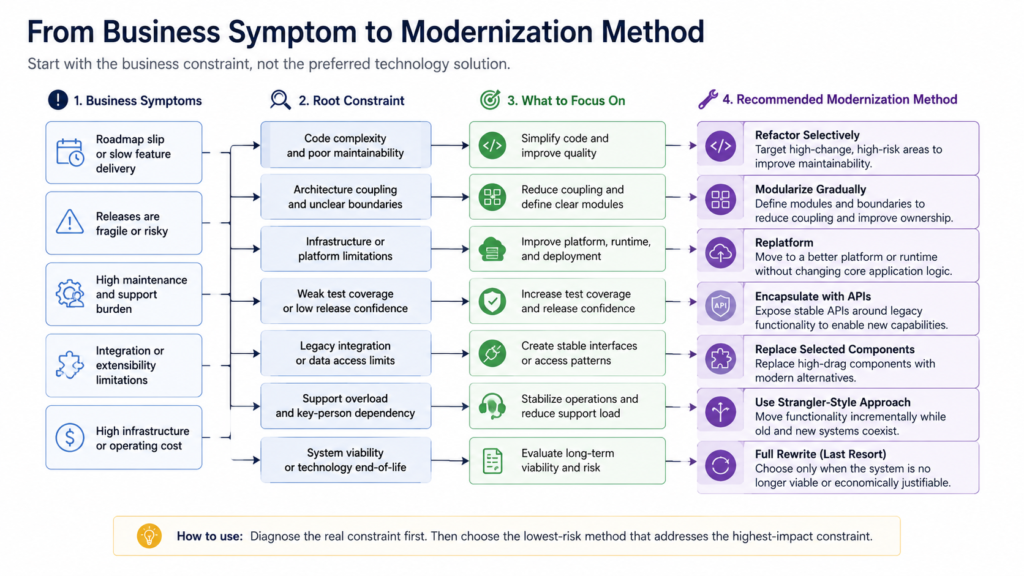
Modernization should not begin with the question "What should we move to?" It should begin with a more useful question: what business constraint is this system creating? That constraint may be roadmap drag, production instability, high support burden, poor integration, infrastructure cost, security exposure, or key-person dependency. Each constraint points to a different response.
Technical Debt, Legacy Systems, and Modernization: Definitions
Technical debt is the accumulated cost of past technical decisions that now make a system harder to maintain, change, test, secure, or scale. Not all technical debt is irresponsible. Some debt comes from reasonable tradeoffs made to meet a customer commitment, launch a product, or respond to urgent business needs. Debt becomes a serious issue when it consistently affects business outcomes.
A legacy system is a software system that remains important to the business but has become difficult to change, support, integrate, or operate using current practices. Legacy does not always mean obsolete. Many legacy systems are valuable precisely because they reflect how the business actually works.
Legacy system modernization is the process of improving a system's ability to support current and future business needs. It may involve code, architecture, infrastructure, testing, deployment, data, security, support processes, or team ownership. Modernization is broader than cloud migration, refactoring, or rewriting.
Why This Matters Operationally and Financially
Technical debt changes the economics of engineering. A team may still be busy, but a larger share of its capacity goes into support, bug fixing, coordination, release cleanup, and working around brittle areas of the system. This shows up operationally as slower delivery cycles, less predictable roadmap execution, more production incidents, longer regression cycles, and higher dependency on a few senior engineers.
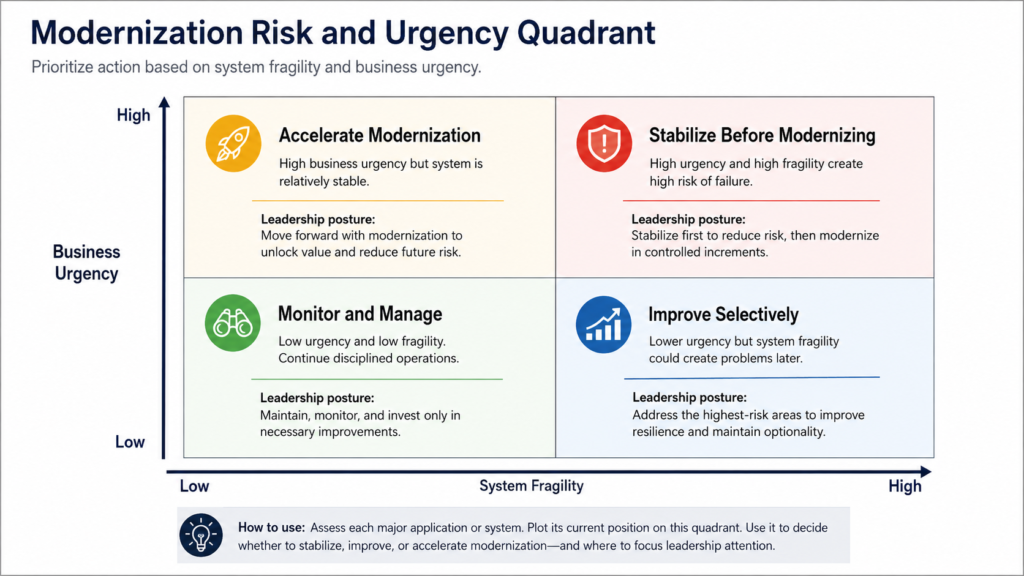
Financially, it means more engineering spend goes into maintaining the past instead of creating new value. The urgency of modernization varies by organization type:
Urgency Level
System Fragility
Recommended Posture
Low urgency
Low fragility
Monitor and manage: track debt accumulation, no immediate action
Low urgency
High fragility
Improve selectively: address highest-risk areas before they become urgent
High urgency
Low fragility
Accelerate modernization: move quickly while the system is still stable
High urgency
High fragility
Stabilize before modernizing: fragility makes big changes too risky
For independent mid-market software companies, technical debt often becomes a roadmap tax. For PE-backed software portfolios, platform risk can affect value creation plans, diligence readiness, and engineering leverage. For businesses running on proprietary software, brittle systems can threaten operational continuity, customer experience, and strategic initiatives.
The important point is that modernization is not only a technical improvement effort. It is a business decision about risk, capacity, cost, and timing.
The Most Common Root Causes
Many modernization problems start with short-term decisions that became permanent. A team ships a workaround to meet a deadline. A temporary integration becomes part of the core workflow. A manual release process keeps working, so no one fixes it. Over time, these choices compound.
Another common root cause is that the system grew beyond its original design. The product expanded, the business model changed, more integrations were added, and more teams began contributing. The architecture did not evolve at the same pace. Weak test coverage is a frequent constraint: if the team cannot confidently tell whether a change broke something, every release becomes more stressful, manual QA becomes the safety net, and engineers avoid changing risky parts of the system.
Maintenance burden then makes the problem worse. The same people responsible for roadmap delivery are pulled into support, incidents, and urgent fixes. Modernization work starts, stops, and loses momentum. Finally, organizations often choose a modernization method before diagnosing the real problem. Moving to the cloud may not fix code complexity. Breaking into microservices may create operational burden. Rewriting may recreate the same complexity in a new stack.
How to Compare Modernization Approaches: 5 Diagnostic Questions
A practical modernization decision starts with five questions.
What business outcome are we trying to protect or improve? The answer may be roadmap delivery, release reliability, operating cost, scalability, security, continuity, or customer experience.
How fragile is the current system? A system with poor documentation, weak test coverage, frequent incidents, and unclear dependencies may need stabilization before deeper changes begin.
Where is the real constraint? It may sit in the codebase, architecture, infrastructure, data model, integrations, test coverage, deployment process, team capacity, or ownership model.
How much disruption can the business tolerate? A company with customer commitments, regulatory deadlines, or seasonal operating constraints may need a lower-risk modernization path.
What capacity is available to execute? If the internal team is already consumed by roadmap delivery and support, modernization will likely require dedicated capacity or help from a partner that can integrate into the existing delivery model.
8 Modernization Methods and When to Use Each
1. Stabilize first
Stabilization is the right starting point when the system is too fragile to change safely. This may involve monitoring, incident cleanup, documentation, support process improvements, basic test coverage, environment stabilization, and ownership clarification.
Main benefit: Creates enough operational control to make future modernization safer.
Main risk: The organization may stay in support mode and never move into actual modernization.
2. Refactor selectively
Selective refactoring fits when specific parts of the codebase slow delivery or create recurring defects, but the overall architecture is still viable. The goal is not to clean up everything. It is to improve high-change, high-risk areas that affect delivery or reliability.
Main benefit: Improves maintainability without changing external behavior.
Main risk: Can become unfocused cleanup if disconnected from business value.
3. Replatform
Replatforming is useful when infrastructure, runtime, hosting, or deployment constraints are the main problem. Microsoft's Azure migration guidance describes multiple workload strategies including rehost, replatform, refactor, rearchitect, rebuild, replace, retire, and retain. The practical lesson is not the exact number of categories. It is that each workload should be evaluated based on its business driver, risk profile, and technical constraints.
Main benefit: Improves the operating environment without fully redesigning the system.
Main risk: May leave deeper architecture and code problems untouched.
4. Modularize gradually
Gradual modularization fits when the system is too tightly coupled. Teams cannot work independently, ownership is unclear, and small changes create unexpected effects elsewhere.
Main benefit: Makes change safer and more manageable over time.
Main risk: Can become over-architected if the team pursues structural purity rather than practical delivery improvement.
5. Encapsulate legacy functionality with APIs
API encapsulation works when a legacy system still performs valuable business functions but is hard to integrate or extend. Instead of replacing the system immediately, teams create controlled access points around key data or workflows.
Main benefit: New capabilities can move forward while the older system remains operational.
Main risk: Can add another layer that hides complexity without reducing it.
6. Replace selected components
Component replacement fits when a bounded subsystem is too expensive, risky, or difficult to maintain. Examples include replacing a billing module, reporting engine, integration layer, or unsupported dependency.
Main benefit: Removes a high-drag area without rewriting the full system.
Main risk: The team may discover that the component was not as isolated as expected.
7. Use a strangler-style modernization path
A strangler-style approach gradually moves functionality out of a legacy system while the business keeps running. Microsoft describes the Strangler Fig pattern as an incremental migration approach where specific pieces of legacy functionality are gradually replaced by new applications and services, allowing the old system to be decommissioned over time.
Main benefit: Reduces the risk of a large-scale replacement.
Main risk: Old and new systems may coexist for some time, creating data, routing, operations, and ownership complexity.
8. Full rewrite
A full rewrite may be justified when the current system is no longer economically or technically viable, the business model has changed materially, or incremental modernization would cost more than replacement. A rewrite should be treated as a business investment with explicit risk acceptance, not the default modernization strategy.
Main benefit: Can create a cleaner future-state foundation.
Main risk: High cost, long timelines, parallel-system complexity, and the possibility of rebuilding old business logic poorly.
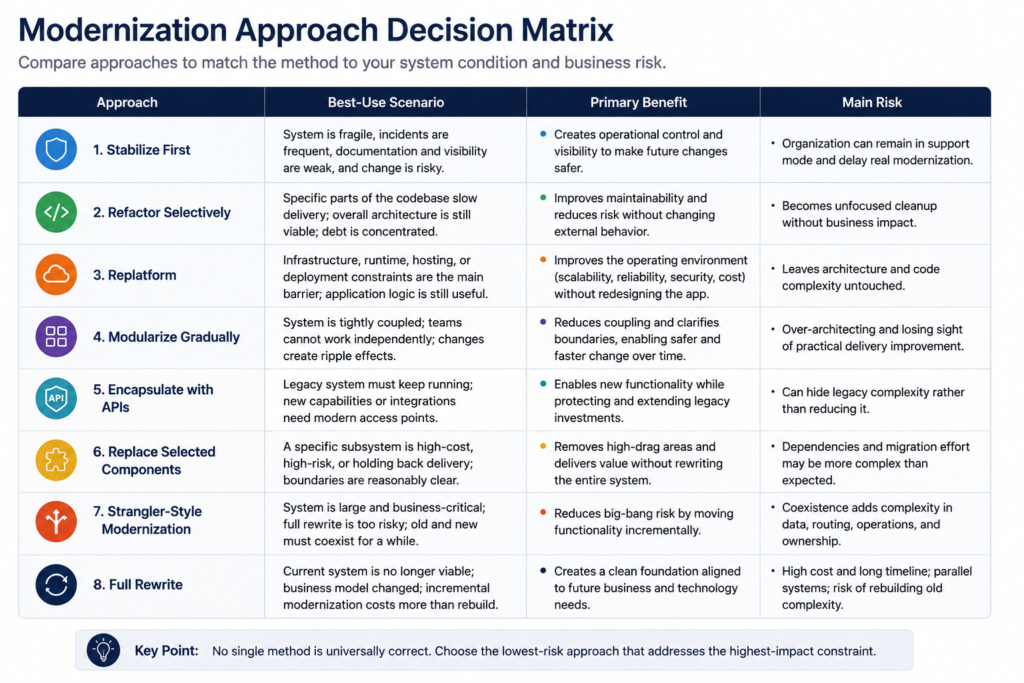
The 8-Method Decision Matrix
Method
Best-Use Scenario
Primary Benefit
Main Risk
Stabilize first
System too fragile to change safely
Creates operational control before modernization
Organization stays in support mode permanently
Refactor selectively
Specific areas slow delivery, architecture viable
Improves maintainability, no behavior change
Becomes unfocused cleanup disconnected from value
Replatform
Infrastructure or deployment is the main constraint
Improves operating environment without redesign
Leaves architecture and code problems untouched
Modularize gradually
System too tightly coupled for parallel delivery
Makes change safer over time
Over-engineering in pursuit of structural purity
Encapsulate with APIs
Legacy does valuable work but cannot be extended
New capability moves forward, old system runs
Adds a layer that hides complexity without reducing it
Replace components
Bounded subsystem creates disproportionate drag
Removes high-drag area without full rewrite
Component less isolated than expected
Strangler-style
Cannot safely replace all at once
Reduces large-scale replacement risk
Old and new coexist; data and routing complexity
Full rewrite
System no longer economically viable
Clean future-state foundation
High cost, long timeline, business logic risk
How This Works in Practice: 3 Scenarios
Scenario 1: Independent software company with roadmap slip and fragile releases
A mid-market SaaS company has a mature product, but roadmap items keep slipping because changes in a legacy module create regressions. QA is slow because automated coverage is thin, and senior engineers spend too much time reviewing risky changes.
The right approach is unlikely to be a full rewrite. The system still works. The better path is to stabilize the release process, add targeted test coverage, refactor the high-change module selectively, and modularize only the areas tied to roadmap friction.
Scenario 2: PE-backed PortCo with modernization pressure and maintenance drag
A PE-backed B2B software company has a product that supports the value creation plan, but its platform is aging. The engineering team is still delivering customer commitments, but every release requires extra regression testing because several core workflows depend on legacy modules with limited automated coverage. The PortCo CTO has been asked to improve delivery predictability without adding a large permanent team. The Operating Partner is concerned that support burden and platform fragility will surface during future diligence.
The right approach is not to move everything to the cloud or start a rewrite. A more practical path: assess the highest-risk modules against roadmap impact and support volume; separate recurring support work from modernization execution; stabilize release and regression practices around the most fragile workflows; replace one or two bounded components that create disproportionate drag; use a strangler-style approach where functionality cannot be replaced safely all at once. This keeps the modernization effort tied to delivery pressure, diligence readiness, capacity constraints, and the need to protect the value creation plan.
Scenario 3: Proprietary-software business with a critical legacy operating system
A business runs core operations on custom software built around its workflows. The system is old but deeply embedded in daily operations. Leaders want new digital capabilities, but the legacy system is hard to integrate.
A full replacement may create too much operational risk. A more practical path: stabilize and document the current system, encapsulate key legacy functions with APIs, build new workflows around the existing core, and gradually replace selected components over time.
What Risks and Constraints Leaders Should Watch
Treating modernization as a technology project only. Business stakeholders need to understand tradeoffs. Product leaders need to help sequence priorities. Finance may need a business case.
Modernizing without enough test coverage. If teams cannot detect regressions, technical improvement can temporarily increase release risk.
Choosing a method that solves the wrong problem. Replatforming does not fix poor architecture. Refactoring does not reduce infrastructure cost. APIs do not eliminate legacy complexity. Rewriting does not guarantee that business logic will be preserved.
Underestimating coexistence. Incremental modernization often means old and new systems run together. That requires clear ownership, data strategy, monitoring, and support procedures.
Running modernization with no dedicated capacity. If the same team owns roadmap delivery, support, incidents, and modernization, strategic work will lose to urgent work.
Common Pitfalls to Avoid
The most consistent mistakes in software modernization programs are predictable and preventable.
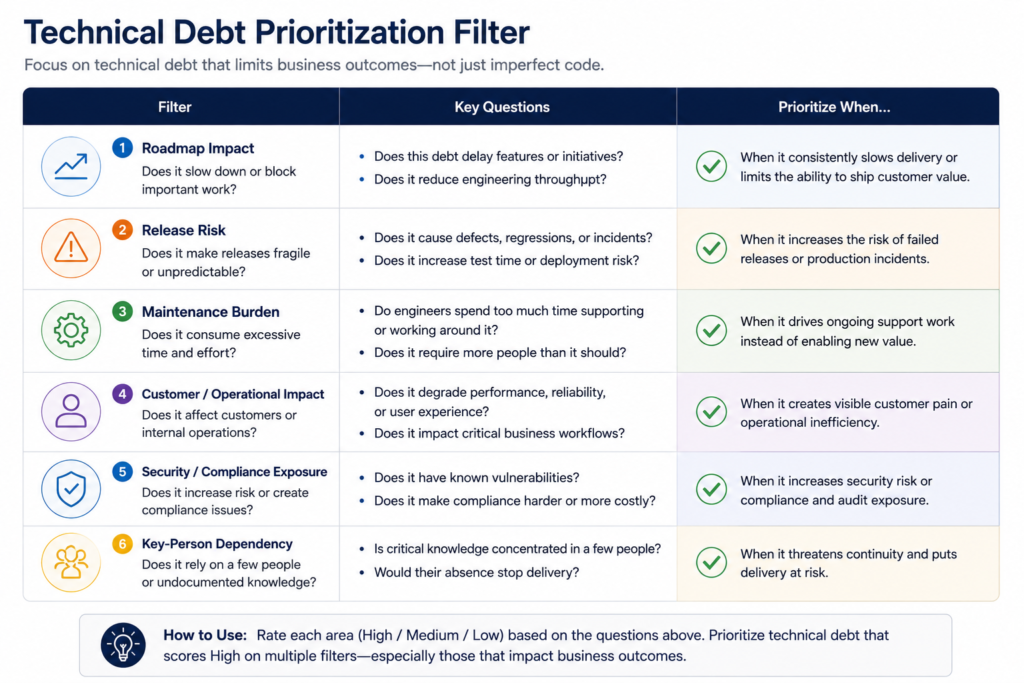
The first pitfall is calling everything technical debt. Leaders should distinguish between annoying debt, risky debt, and business-limiting debt. Debt deserves priority when it affects business outcomes, not simply because the code is imperfect. A useful prioritization filter applies six criteria: roadmap impact, release risk, maintenance burden, customer or operational impact, security or compliance exposure, and key-person dependency.
The second is choosing the method before diagnosing the constraint. A technical and business impact assessment should come first.
The third is treating modernization as separate from roadmap planning. Modernization work must be sequenced alongside product commitments, not hidden in the background.
The fourth is letting maintenance consume modernization capacity. If the same people own every urgent issue and every strategic improvement, the urgent work usually wins.
The fifth is measuring only technical activity. Better metrics include reduced support burden, faster regression cycles, fewer production incidents, improved deployment confidence, and better roadmap predictability. DORA's software delivery performance guidance identifies five useful measures for delivery outcomes: change lead time, deployment frequency, failed deployment recovery time, change fail rate, and deployment rework rate. These help modernization teams evaluate whether technical changes are improving delivery flow and release stability, not just producing technical activity.
What Implementation Path Should Companies Follow?
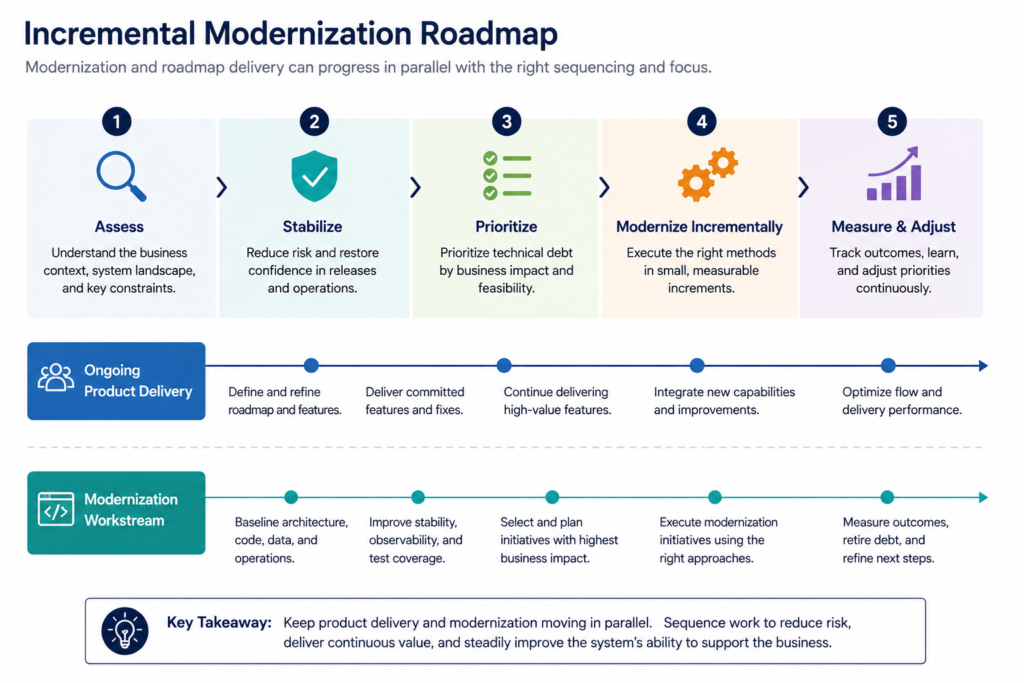
A practical modernization workflow follows five phases, which can run in parallel with ongoing product delivery when work is sequenced carefully.
Assess: Start with business constraints, not technical preferences. What is the system preventing the company from doing? Create a baseline across architecture, codebase health, test coverage, infrastructure, security, integrations, data dependencies, release process, support burden, and team ownership.
Stabilize: Before deeper changes, establish enough operational control to make modernization safe. Address the fragility, documentation, and process gaps that make changes unpredictable.
Prioritize: Rank debt by business impact. The highest-priority debt is usually the debt that slows roadmap delivery, creates recurring defects, consumes senior engineering capacity, increases release risk, blocks strategic initiatives, or creates operational exposure.
Modernize incrementally: Choose the appropriate method and sequence the work around delivery commitments. Avoid multi-quarter modernization efforts that produce no visible business value. Use incremental releases where possible. Make progress visible to product and business stakeholders.
Measure and adjust: Track business outcomes, not technical activity. Revisit the prioritization as the system evolves and delivery conditions change.
AWS describes application modernization as an iterative process with three high-level phases: assess, modernize, and manage. It also emphasizes that understanding an application's details and its relationships with other systems is a critical step before modernization work begins.
When Each Approach Is Not Appropriate
Choosing the wrong method is one of the most common modernization mistakes. Knowing when an approach does not fit is as important as knowing when it does.
Stabilization may not be enough when the system is no longer viable or has unsupported dependencies that must be removed.
Refactoring may not be appropriate when the target area is poorly understood, lacks test coverage, or will soon be replaced.
Replatforming may not help when the main problem is business logic complexity.
API encapsulation may not help if the legacy system is unstable or the underlying data is unreliable.
Component replacement may be too risky if boundaries are unclear.
A full rewrite may be inappropriate when the current system still contains valuable business logic, the company cannot tolerate a long parallel-system period, or leadership expects the rewrite to be faster than incremental modernization without evidence.
What This Means for Engineering Leaders
Mid-market software companies
For mid-market software companies, the most common modernization failure mode is choosing a method before diagnosing the constraint. A team that is slipping roadmap commitments because of a fragile module does not need a full rewrite. It needs targeted stabilization, test coverage, and selective refactoring in the areas that directly affect delivery. Leaders who invest in the diagnostic step first avoid the cost of solving the wrong problem.
When the internal team is already consumed by roadmap delivery and support, this type of work requires dedicated capacity. A that integrates into the existing delivery model can provide the modernization execution capacity that frees the internal team to stay focused on roadmap work. The caveat is important: not every external partner reduces burden. The partner must integrate into the client's operating model, engineering standards, and communication rhythm.nearshore engineering team
PE-backed software portfolios
For PE-backed software portfolios, platform risk is a value creation and exit readiness issue, not just an engineering concern. Legacy systems that create delivery fragility, support burden, or diligence exposure affect the hold-period execution plan regardless of how well the business otherwise performs. Operating partners who incorporate modernization sequencing into the value creation plan from the start of a hold period avoid the more expensive scenario of addressing platform fragility under time pressure near exit.
The two practical scenarios most relevant to PE-backed portfolios are PortCos that need to improve delivery predictability without adding permanent headcount, and PortCos where platform risk surfaces during diligence and needs to be addressed before a transaction. Both benefit from the same framework: assess the real constraint first, choose the lowest-risk method that addresses it, execute incrementally with dedicated capacity, and measure business outcomes rather than technical activity. If you want to discuss how this framework applies to a specific acquisition or portfolio company, our team at Scio would be glad to talk.
Frequently Asked Questions
What is legacy system modernization?
Legacy system modernization is the process of improving a software system's ability to support current and future business needs when that system has become difficult to change, support, integrate, or operate using current practices. It may involve code, architecture, infrastructure, testing, deployment, data, security, support processes, or team ownership. Modernization is not one method. It includes refactoring, replatforming, modularization, API encapsulation, component replacement, strangler-style migration, and full rewrites, each suited to a different constraint.
What is the difference between a refactor and a rewrite?
Refactoring improves the internal structure of existing code without changing its external behavior. It targets specific high-risk or high-change areas and can be done incrementally without disrupting the running system. A rewrite replaces the existing system with a new one, which requires running old and new systems in parallel during the transition and carries the risk of rebuilding old business logic incorrectly. Refactoring is lower risk and lower cost. A rewrite is higher risk and appropriate only when the current system is no longer economically or technically viable.
What is the Strangler Fig pattern in software modernization?
The Strangler Fig pattern is an incremental migration approach where specific pieces of legacy functionality are gradually replaced by new applications and services, allowing the old system to be decommissioned over time rather than replaced in a single large-scale effort. Microsoft describes it as a technique for migrating a legacy system incrementally by building a new system alongside the old one and slowly moving features until the legacy system can be retired. The main benefit is reduced replacement risk. The main risk is the coexistence period, where old and new systems must share data, routing, and operational responsibility.
How do you decide which technical debt to address first?
Start with the debt that affects business outcomes, not the debt that is simply old or imperfect code. The highest-priority technical debt is debt that slows roadmap delivery, creates recurring production defects, consumes senior engineering capacity, increases release risk, blocks strategic initiatives, creates operational exposure, or creates key-person dependency. The lowest priority is debt that is imperfect but not affecting delivery quality, reliability, or capacity. DORA's metrics, including change lead time, deployment frequency, and change fail rate, can help teams evaluate whether their modernization choices are improving business outcomes rather than just reducing technical imperfection.
Can modernization happen while roadmap delivery continues?
Yes, but only with careful sequencing, clear ownership, realistic capacity planning, and incremental delivery. Modernization loses to urgent work when both compete for the same people. The most effective approach is to separate modernization capacity from roadmap and support capacity, sequence modernization work in small increments that each deliver a visible business outcome, and keep product stakeholders informed of progress at the same cadence as roadmap delivery. AWS recommends an assess, modernize, and manage framework that treats modernization as iterative rather than a single large-scale initiative.
What are the most common modernization mistakes engineering leaders make?
The most consistent mistakes are: choosing a modernization method before diagnosing the real constraint, which leads to solving the wrong problem; treating modernization as a technology project rather than a business decision, which disconnects it from the priorities that drive resource allocation; letting maintenance work consume the capacity set aside for modernization; and measuring technical activity rather than business outcomes. A team can complete significant refactoring or infrastructure work without improving roadmap delivery speed, support burden, or release reliability, which are the outcomes that actually matter.
When does a nearshore partner add value in a modernization program?
When the internal team's capacity is already fully committed to roadmap delivery and support, and the work requires steady execution capacity that internal engineers cannot absorb without disrupting current commitments. A nearshore partner is most effective in legacy system modernization when it integrates directly into the client's delivery model, engineering standards, and communication rhythm rather than operating as a separate workstream. The constraint to watch is that not every external partner reduces burden. If the partner requires significant coordination overhead, it can absorb more capacity than it provides.
Key Takeaways
Modernization is a choice of method, not a single initiative.
Technical debt should be prioritized by business impact, not engineering preference alone.
Stabilization often needs to happen before deeper modernization.
Replatforming, refactoring, modularization, API encapsulation, component replacement, and rewriting solve different problems.
Full rewrites should be treated as high-risk business investments, not default modernization strategies.
The right partner can create execution capacity, but only if they integrate well with the client's delivery model.
Measure business outcomes, not technical activity: support burden, deployment frequency, change fail rate, and roadmap predictability.
DORA, Software Delivery Performance Metrics Guide. DORA's current guidance on five useful delivery performance measures: change lead time, deployment frequency, failed deployment recovery time, change fail rate, and deployment rework rate, directly relevant to measuring whether modernization improves business outcomes. https://dora.dev/guides/dora-metrics/
Scio blog, Legacy System Failure Risk: 5 Questions Every CTO Skips. Complementary analysis of how to evaluate legacy system risk using impact, probability, and recoverability dimensions, directly relevant to the diagnostic framework in this article. https://sciodev.com/blog/legacy-system-failure-risk/
Scio blog, Platform Modernization Strategy: How to Reduce Risk Without Pausing the Roadmap. Practical guidance on sequencing platform modernization alongside roadmap delivery, complementing the implementation path described in this article. https://sciodev.com/blog/platform-modernization-strategy/
Scio blog, Technical Debt Prioritization: 5 Proven Roadmap Fixes. Framework for prioritizing technical debt by business impact rather than engineering preference, directly relevant to the prioritization filter discussed in this article. https://sciodev.com/blog/technical-debt-prioritization/
For software holding companies and mid-market software businesses, platform modernization is often discussed too late and in the wrong language. A sound platform modernization strategy does not begin with architecture preferences. It begins with business risk. By the time technical debt conversations reach the board, the real question is not whether to modernize but how.
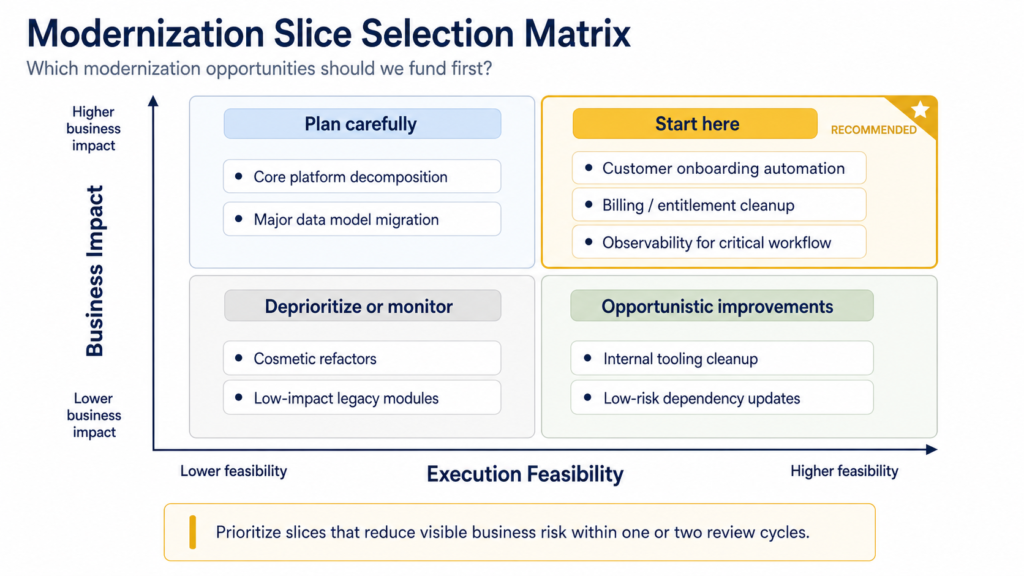
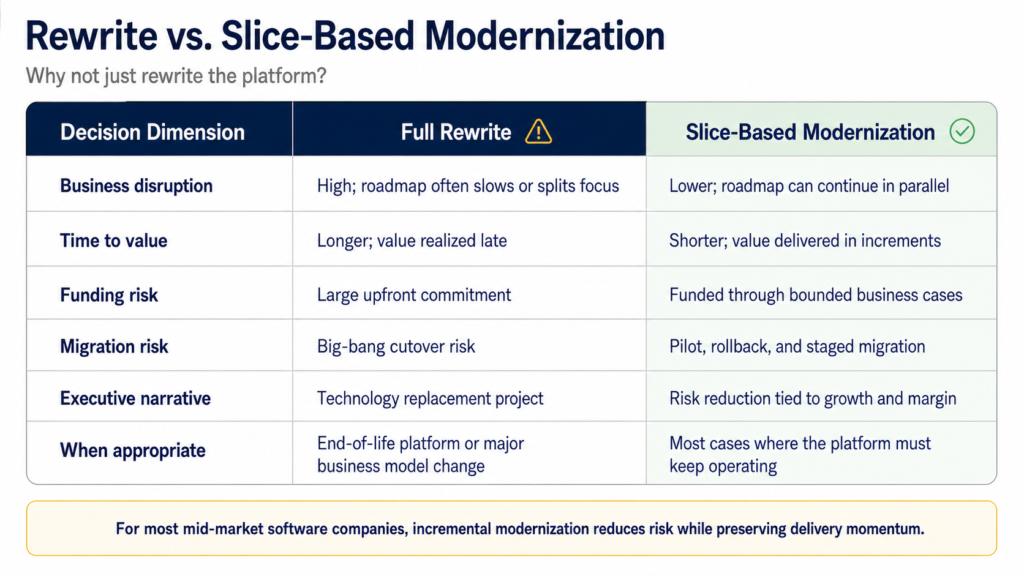
The practical question is not whether the platform has technical debt. Most mature software platforms do. The better question is whether platform health is starting to constrain the growth plan. McKinsey research indicates that technical debt can consume between 10 and 20 percent of IT budgets that would otherwise fund new capabilities. The wrong response is usually a large rewrite that competes with the roadmap and delays visible value. A better response is to modernize in slices: identify the workflows where platform risk is already affecting operations, revenue, or execution confidence, then improve them one at a time.
TABLE OF CONTENTS
A Few Definitions Before Discussing Modernization
Before discussing application modernization as a business issue, it is useful to clarify a few terms.
Platform health is the ability of a software platform to support reliable operations, timely product delivery, maintainable systems, scalable growth, secure infrastructure, and predictable cost to serve.
Technical debt is the accumulated cost of past technology decisions, shortcuts, outdated components, weak documentation, or deferred maintenance that makes future change slower, riskier, or more expensive. Not all technical debt is equally harmful. What matters is whether it is creating visible business risk or consuming meaningful capacity.
Modernization is the targeted improvement of systems, architecture, workflows, data flows, infrastructure, or engineering practices to reduce risk and improve business performance. It does not automatically mean replacing everything, rebuilding from scratch, or adopting new technology for its own sake.
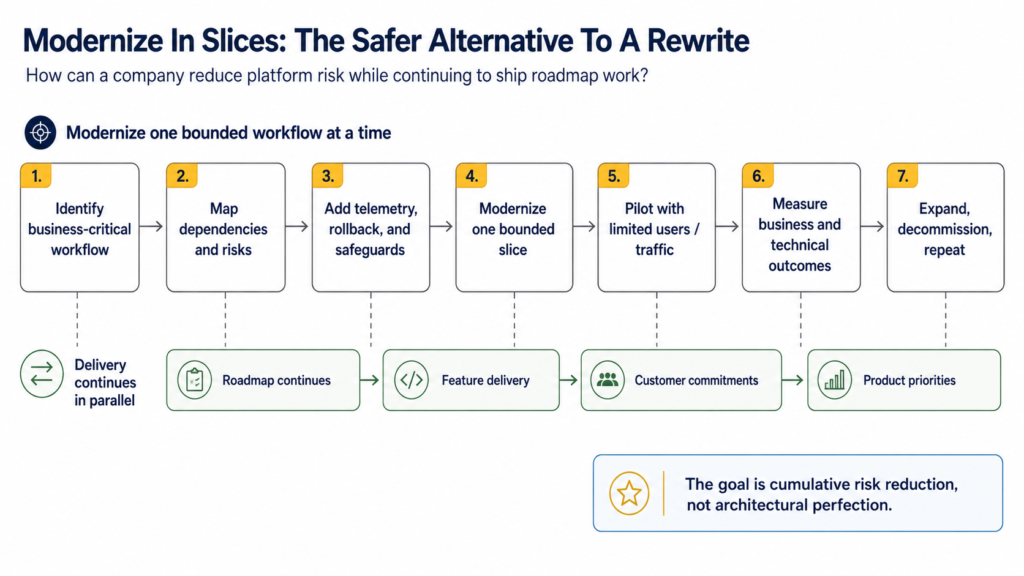
Modernize in slices means improving one bounded workflow, module, service, integration, or customer journey at a time. The existing system remains operational while selected slices are stabilized, replaced, or improved based on where risk is highest and business value is clearest.
A modernization program should not be a vague effort to clean up the platform. It should be a focused effort to reduce specific risks that are already affecting the business or could affect the next phase of growth.
When Does Technical Debt Become a Business Problem?
Technical debt becomes a business problem when it starts interfering with the company's ability to execute its growth plan.
For the CTO, the symptoms may look like fragile architecture, regression risk, slow release cycles, aging dependencies, or weak observability. For the CEO, they show up as missed commitments, delayed customer promises, slower product expansion, or a growing gap between strategic ambition and delivery capacity. For the CFO, they appear as margin leakage, unplanned engineering work, higher support cost, lower productivity, and uncertain future investment needs. For the Operating Partner, they become execution risk against the value-creation plan.
This is especially relevant for software holding companies and PE-backed software businesses. In these environments, the platform is expected to support a defined growth thesis. That thesis may include an acquisition integration, a new product expansion, a geographic move, or an exit. If the platform cannot support those moves, modernization is no longer an engineering preference. It becomes a risk-reduction priority.
Alvarez and Marsal describes technical debt as a significant M&A risk, noting that outdated applications, poor system architecture, and weak code quality can create valuation challenges, operational risk, and remediation costs that affect deal confidence. The issue is not that every technical flaw immediately reduces valuation. The issue is that visible platform risk makes the growth story harder to believe.
Why Does Platform Health Matter to EBITDA, Growth, and Valuation?
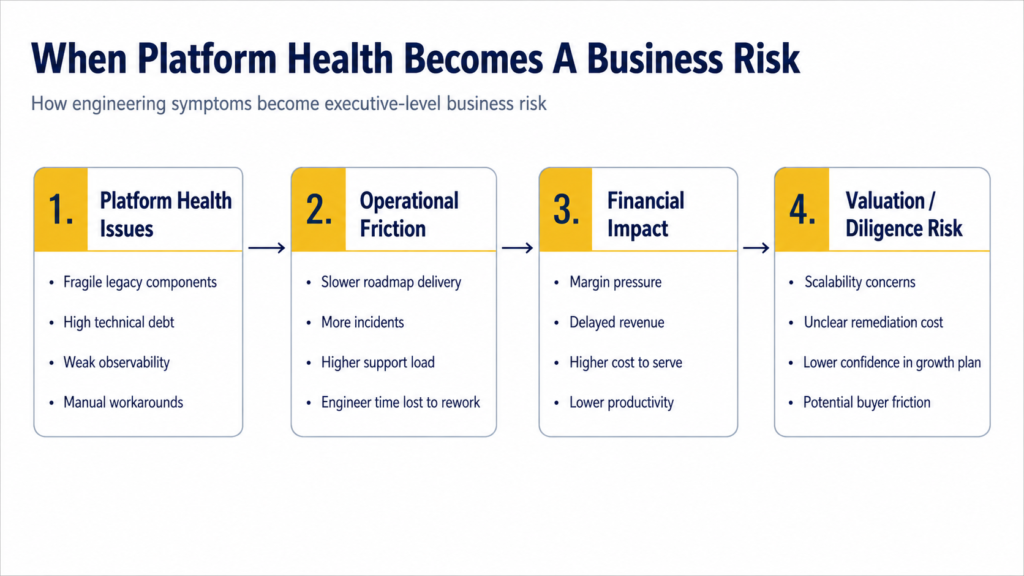
Weak platform health rarely appears as a single line item on the P&L. Instead, it shows up as accumulated friction across the business.
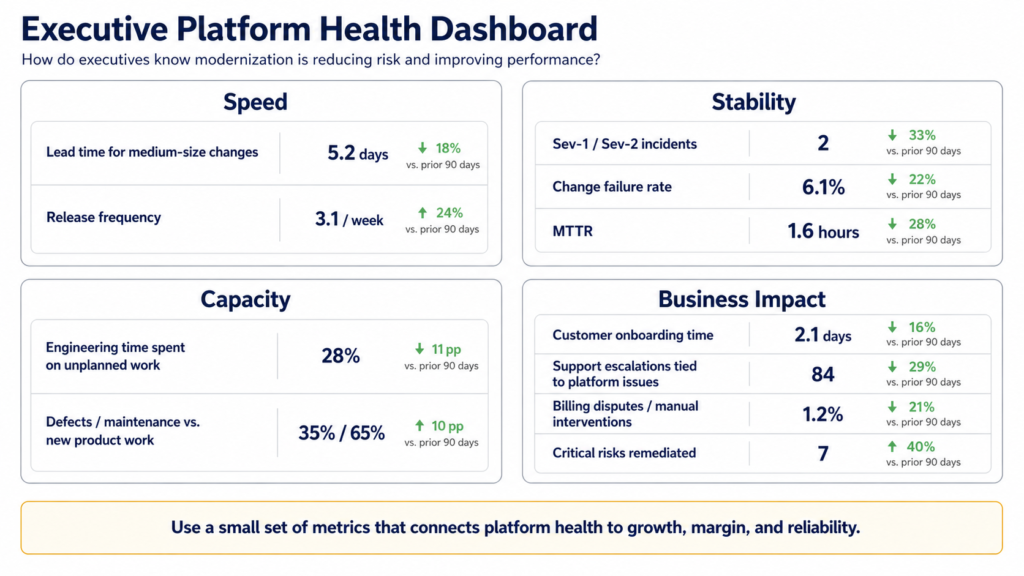
Operationally, it slows roadmap delivery. Medium-sized changes take longer because teams must understand fragile dependencies, test manually, and work around undocumented behavior. Releases become more cautious, fewer things ship on time, and customer commitments erode. Financially, the impact can be significant. Deloitte has reported that up to 70 percent of technology leaders view technical debt as a hindrance to innovation and the number one cause of productivity loss. For a PortCo, that lost capacity matters. If one-third of engineering time is consumed by debt-related maintenance, the company is effectively funding a shadow cost center that competes with roadmap execution.
That can affect the business in several ways:
Delayed revenue: Product features, integrations, and customer commitments ship later.
Higher cost to serve: Support, customer success, and engineering spend more time resolving avoidable issues.
Weaker retention: Reliability problems and slow improvements can damage customer confidence.
Lower productivity: Engineering capacity is consumed by rework, defects, and manual intervention.
Higher future investment needs: Buyers, boards, or investors may assume future remediation cost.
For investors and holding companies, the issue also affects underwriting. Alvarez and Marsal's software product and technology diligence practice evaluates whether the product, technology, and organization can support the target's planned growth. When the answer is uncertain, it can create EBITDA impairment exposure. Platform risk can affect valuation not because every buyer applies the same technical debt discount, but because platform uncertainty weakens confidence in the growth forecast.
What Usually Causes Platform Health to Deteriorate?
Most platform health problems are not caused by one bad decision. They usually come from repeated, rational decisions made under pressure.
Common root causes include:
Roadmap pressure without repayment discipline. Product teams ship features quarter after quarter while cleanup, test automation, documentation, and dependency upgrades are deferred.
Temporary fixes that became permanent. Manual scripts, one-off customer exceptions, hardcoded rules, fragile integrations, and support-driven workarounds slowly become part of the operating model.
Debt concentrated in critical assets. McKinsey has observed that technical debt is not evenly distributed. A set of 10 to 15 assets often drives the majority of the debt in an enterprise, and severity is not always obvious from the outside.
Weak observability. Teams cannot quickly see what is failing, where performance is degrading, or which release caused a problem.
Outdated components. Legacy frameworks, unsupported versions, old infrastructure, and unpatched dependencies create security, reliability, and hiring risks.
Poor data integrity. Billing, usage, entitlements, customer health, and operational reporting may depend on inconsistent data. That creates manual reconciliation and can become a diligence concern.
Knowledge concentration. A few senior engineers understand the risky parts of the system. When they are overloaded or leave, the platform becomes harder to change safely.
The pattern is familiar: the business pushes for speed, engineering absorbs complexity, and the real cost appears later as reduced agility, reduced reliability, or reduced confidence.
How Does a Platform Modernization Strategy Work in Practice?
The most effective modernization programs are workflow-centered, not technology-centered. The question is not "Should we move to a new architecture, new version, or new language?" The better question is: which business-critical workflows are creating the most risk, cost, or drag?
Typical workflows to evaluate include:
Product delivery and release: CI/CD pipelines, automated testing, code review, deployment frequency, rollback, and change failure rate.
Customer onboarding and provisioning: Account setup, tenant configuration, integrations, data migration, and implementation handoffs.
Billing, entitlements, and usage metering: Subscription rules, usage tracking, pricing logic, invoicing, and customer permissions.
Authentication and access: Identity, roles, permissions, admin controls, and customer access.
Reporting and analytics: Customer-facing reports, internal dashboards, product usage data, finance metrics, and data pipelines.
Core transaction workflow: Claims processing, order management, scheduling, payments, document processing, or any workflow directly tied to customer value delivery.
DORA's software delivery metrics offer a practical measurement language for these efforts. DORA tracks throughput through change lead time, deployment frequency, and failed deployment recovery time. It tracks stability through change failure rate and recovery time. These metrics connect engineering health to operational performance. They help leaders see whether modernization is actually improving speed, stability, and execution capacity.
Slice-Based Modernization vs. Full Platform Rewrite
Dimension
Modernize in Slices
Full Platform Rewrite
Delivery continuity
Roadmap continues during modernization
Roadmap often paused or severely constrained
Time to business value
Visible improvement per slice, weeks to months
Value delayed until late in project
Risk profile
Bounded and reversible at each slice
High: two platforms in parallel, divided attention
Capacity required
Can be run alongside roadmap with defined allocation
Most cases: platform is workable but accumulating risk
Platform near end-of-life, fundamental business model change
What Should Leaders Watch Out For Before Funding Modernization?
The main risk is confusing modernization with a rewrite. A rewrite feels clean. It promises a fresh start. But it often creates a second platform, divides attention, and delays value until late in the project. For mid-market companies, that is dangerous because the business still needs to ship, support customers, and close deals while the rewrite is underway.
AWS describes this risk clearly in its guidance on the strangler fig pattern. A big-bang migration introduces transformation risk and business disruption. While refactoring is underway, adding new features to the old system is difficult, which means the company is paying to maintain two platforms and receiving value from neither at full capacity.
Other constraints matter as well:
Data migration may be harder than expected.
Hidden dependencies may not be fully understood.
Internal teams may lack available capacity.
Product incentives may favor new features over platform improvement.
Finance may reject modernization unless the business case is clear.
Security or compliance issues may require faster remediation than a slice-based plan allows.
External engineering capacity can help, especially when internal teams are already stretched. Nearshore software engineering can be a strong model for this type of work because it can provide time-zone-aligned, technically senior capacity without requiring a long hiring process. The caveat is important: not all nearshore partners are suited for modernization work. Modernization requires disciplined engineering, product context, architectural judgment, and the ability to operate effectively within an existing system.
Realistic Examples of Modernizing in Slices
Example 1: Billing and entitlements
A mid-market SaaS company has recurring billing disputes because pricing rules, permissions, and usage tracking are spread across old code, spreadsheets, and manual support processes. A full rewrite would be excessive. A slice-based approach would start with one product line or customer segment. The team could create a cleaner entitlement layer, add reconciliation reporting, migrate the highest-risk accounts, and retire the legacy path once the new one is proven.
Business outcome: fewer billing disputes, less revenue leakage, lower support burden, and better finance confidence.
Example 2: Customer onboarding
A PortCo's growth plan depends on faster customer onboarding, but each new customer requires manual setup, custom scripts, and engineering intervention. The company selects the most common onboarding path, automates tenant setup, standardizes configuration, improves integration templates, and tracks onboarding cycle time. Once that path improves, the next most common path becomes the new slice.
Business outcome: faster time-to-value, reduced services burden, more scalable growth, and a better early customer experience.
Example 3: Reliability around a core workflow
A platform has frequent incidents in a high-value transaction workflow. The team knows the architecture is fragile, but the company cannot afford to pause roadmap delivery. Instead of rewriting the platform, the team defines service-level objectives, improves logging and monitoring, isolates one fragile dependency, introduces safer routing, and migrates a small portion of traffic to validate the improved path.
Business outcome: fewer severe incidents, faster recovery, less engineering time lost to firefighting, and a more credible growth plan.
These examples share a common pattern: the modernization effort is bounded, measurable, and tied to a business workflow. That is what makes it fundable, executable, and defensible to leadership and investors.
How to Modernize Without Pausing the Roadmap
A practical modernization program starts with value protection. Leaders should ask: where is platform health already creating visible business risk?
The best starting points are usually workflows with clear leadership relevance:
Customer-facing reliability issues
Slow roadmap delivery
High support load
Revenue leakage
Manual operations that constrain scale
Scalability constraints limiting growth
Security exposure
Diligence-sensitive platform gaps
From there, leaders should protect capacity. Modernization cannot depend on "extra time." It needs a defined allocation, preferably tied to roadmap work. For example, if a new pricing initiative requires changes to billing and entitlements, the company can modernize that slice while delivering the commercial initiative. This turns modernization from a separate workstream into a shared benefit.
The program should also include a small executive dashboard. Useful metrics may include lead time for change, release frequency, severe incidents, recovery time, change failure rate, engineering time spent on unplanned work, onboarding cycle time, billing disputes, support escalations, and critical risks remediated. Run the work quarterly. Review the platform risk register. Reallocate capacity. Decommission old components when safe. Modernization should become an operating rhythm, not a one-time rescue program.
When Slice-Based Modernization Is Not Enough
Slice-based modernization is not always the answer. If the core platform is near end-of-life, unsupported, insecure, or impossible to staff, incremental improvements may only delay a larger replacement. If the business model is changing fundamentally and the platform cannot support it incrementally, a more significant rebuild may be required.
If there is a severe security or compliance exposure, immediate remediation may be required. Some risks cannot wait for a gradual migration path. Slice-based modernization also fails when leadership refuses to protect capacity. It is less risky than a rewrite, but it is still real work. If modernization is expected to happen only after roadmap work is complete, it will not happen.
The approach works best when leaders are willing to make platform health visible, tie modernization to business outcomes, and sustain the effort over multiple quarters.
The 5 Most Common Platform Modernization Mistakes
The first mistake is starting with architecture instead of business risk. If the modernization case sounds like "engineering wants cleaner code," it will lose to roadmap pressure. The better case is tied to a specific business outcome: reducing support burden, improving revenue reliability, or enabling the next customer segment.
The second mistake is treating all technical debt equally. A cosmetic refactor is not the same as a billing defect that creates revenue leakage. A low-traffic legacy module is not the same as an unstable core workflow. Risk prioritization is the most important step in modernization planning.
The third mistake is adding new systems without retiring old ones. This increases complexity instead of reducing it. Every modernization slice should include decommissioning criteria. If the old path is not retired when the new one is proven, the company is maintaining two systems instead of one.
The fourth mistake is ignoring operating practices. Code improvements will not produce enough value if release management, testing, incident response, documentation, and ownership remain weak. Technical improvement and process improvement need to move together.
The fifth mistake is underestimating capacity. Internal teams may already be responsible for roadmap delivery, support, incidents, and customer escalations. A strong engineering partner can provide focused modernization capacity that allows internal teams to maintain roadmap momentum without absorbing the full modernization effort on top of their existing load.
What This Means for PE-Backed Portfolios and Mid-Market Software Companies
PE-backed software portfolios and software holding companies
For software holding companies and PE-backed portfolios, platform modernization is directly connected to value creation. The growth thesis may depend on integrating an acquisition, expanding into a new vertical, or preparing for an exit. Each of those moves requires a platform that can be changed predictably, scaled reliably, and described confidently during diligence. A disciplined modernization program tied to the value creation plan, with measurable business outcomes and a quarterly operating rhythm, is a meaningful part of the investment thesis execution.
For operating partners managing multiple portfolio companies, the PE-backed software portfolio context also shapes how engineering capacity is structured. Modernization work often requires bringing in additional capacity without disrupting the internal team. Dedicated nearshore engineering teams can provide the time-zone-aligned, technically senior support needed to run modernization in slices alongside the roadmap.
Mid-market software companies
For mid-market software companies, the challenge is balancing modernization against a roadmap that already consumes most of the available engineering capacity. The practical entry point is identifying one or two workflows where platform risk is already creating visible cost: a billing process that generates support escalations, an onboarding flow that requires manual engineering intervention, or a release process that generates frequent incidents. Improving one of those workflows produces measurable business value, demonstrates the model, and creates the case for a sustained program.
Independent software companies at this stage often find that the hardest part of modernization is not the technical work. It is building organizational alignment around the business case. Framing platform health as a value-protection program rather than a technical cleanup effort is the first step toward that alignment.
Frequently Asked Questions
Should we stop roadmap work to modernize the platform?
Usually no. In most mid-market software companies, stopping the roadmap to modernize creates more risk than it removes. The safer approach is to modernize selected slices while roadmap work continues, using defined capacity allocation and tying modernization slices to commercial initiatives where possible. The only cases where a more significant pause may be justified are severe security or compliance exposures, or platforms that are truly near end-of-life and cannot safely continue operating.
How much capacity should we allocate to platform modernization?
There is no universal percentage. Start with the business risk. If platform issues are delaying revenue, increasing support cost, or creating diligence exposure, the capacity case is already visible. A practical starting point is 15 to 20 percent of engineering capacity, tied to the highest-priority workflow rather than distributed across a broad backlog. That allocation should be protected, reviewed quarterly, and connected to specific business outcomes so it remains defensible when roadmap pressure increases.
Is a full platform rewrite ever the right approach?
Yes. A rewrite or major replacement may be appropriate when the platform is near end-of-life, the business model is changing fundamentally, or the security and compliance exposure cannot be resolved incrementally. What matters is that the decision is made for business reasons, not technical elegance. A rewrite should have a clear business case, a realistic capacity plan, and a defined transition that keeps the existing platform operational for customers while the new one is validated.
How should CFOs evaluate the business case for platform modernization?
CFOs should look beyond engineering cost. The business case should include cost to serve, incident burden, support escalations, delayed revenue, customer risk, and the estimated remediation cost that a future buyer or investor might apply during diligence. Platform modernization is not primarily an engineering investment. It is a margin improvement program, a reliability improvement program, and a risk reduction program. When presented in those terms, with measurable outcomes tied to specific workflows, it competes more effectively for capital allocation.
Key Takeaways for Business Leaders
Technical debt becomes material when it constrains growth, reliability, margin, customer trust, or diligence confidence. At that point, it is no longer a technical problem. It belongs on the leadership agenda.
Modernization should be framed as value protection, not technical cleanup. Full rewrites often create more risk than they remove, especially when the business must keep shipping. The practical pattern is a disciplined platform modernization strategy built around slices, starting with business-critical workflows where risk is already visible and measurable. Progress should be tracked with operational and financial metrics, not only engineering activity.
Scio helps software holding companies, PE-backed software companies, and mid-market software organizations add disciplined nearshore engineering capacity to reduce platform risk while continuing to support the roadmap. If this is relevant to where your organization is right now, I would be glad to talk it through.
References and Further Reading
Alvarez and Marsal, Software Product and Technology Diligence Practice. M&A advisory practice evaluating platform health as an investment risk factor, including how technical debt creates valuation uncertainty and operational risk during acquisition diligence. alvarezandmarsal.com
McKinsey and Company, Technology and Digital Research. Research on technical debt distribution in enterprise software, including the finding that 10 to 15 assets typically drive the majority of technical debt and the EBITDA impact of deferred platform investment. mckinsey.com
Deloitte Insights, Technical Debt and Innovation Research. Research reporting that up to 70 percent of technology leaders identify technical debt as the primary cause of productivity loss and a significant barrier to innovation capacity. deloitte.com
DORA (DevOps Research and Assessment), State of DevOps Report. Annual research defining software delivery performance metrics including change lead time, deployment frequency, change failure rate, and recovery time as the measurement language for platform modernization outcomes. dora.dev
AWS, Strangler Fig Pattern and Migration Guidance. Architectural guidance on incremental migration patterns, including the strangler fig approach that underpins slice-based modernization and the documented risks of big-bang rewrite migrations. docs.aws.amazon.com
Gartner, Technical Debt and Software Platform Management Research. Analysis of how technical debt accumulates in enterprise software portfolios, the business impact on delivery capacity and EBITDA, and the governance practices that support sustainable platform investment. gartner.com
Harvard Business Review, Engineering Leadership and Organizational Performance. Research on how platform health, engineering investment decisions, and technical risk management affect long-term business performance and growth capacity. hbr.org
NIST, Cybersecurity Framework and Software Security Guidance. U.S. government framework for software security risk assessment, relevant to the security and compliance modernization scenarios where slice-based approaches must be accelerated. nist.gov
Scio blog, Technical Debt Hidden Cost: 5 Real Risks CTOs Underestimate. Detailed breakdown of how technical debt creates hidden business cost beyond engineering metrics, directly relevant to building the business case for platform modernization. sciodev.com
Most AI initiatives do not fail because of the model. They fail because the system underneath is not ready. Python technical debt ai scalability problems are the silent constraint that surfaces only when load increases, and by then, the damage to timelines and budgets is already done.
This article is for CTOs and engineering leaders who have approved AI investment and are now discovering that the infrastructure beneath it was not designed for what comes next. The problem is fixable. But not with more features.
David is a CTO at a fast-growing fintech company. The board has just approved $500,000 to build an AI-powered fraud detection engine. The opportunity is real. The pressure is immediate.
But his Django monolith is fragile. Every backend change introduces risk. Payment flows break under edge cases. Deployments require coordination across multiple teams.
No one calls it this, but there is already an architect making decisions. Not David. Not his team. The real architect is technical debt.
Most teams do not fall behind because of lack of talent. They fall behind because they optimize for output instead of system behavior. Shipping features feels like progress. Under the surface, systems degrade.
At some point, every CTO faces the same dilemma: keep shipping AI features fast, or stabilize the foundation before scaling. The problem is not visibility. The problem is measurement. When 30 to 40 percent of engineering time goes to rework, debugging, or dealing with legacy constraints, the system is already constrained before AI enters the picture.
If you want to understand whether your Python system is ready for AI scale, you do not need opinions. You need signals. The DORA research program has tracked engineering performance across thousands of teams for over a decade. These four metrics are the strongest predictors of whether a system will hold under AI workloads.
Metric
Healthy System
High Tech Debt System
Lead Time for Changes
< 3 days
10 to 15+ days
Deployment Frequency
Daily
Weekly or less
Change Failure Rate
< 10%
20 to 40%
Mean Time to Recovery
< 1 hour
Hours or days
When these metrics degrade, AI initiatives do not fail immediately. They fail when load increases. Latency compounds. Pipelines break under inference volume. Deployment windows shrink. Teams lose confidence in the system, and velocity drops precisely when the business needs it most.
Many teams underestimate how much their runtime environment affects scalability. Python has evolved significantly across recent versions. Teams running pre-3.11 are operating with hidden constraints that become visible only when AI workloads hit production.
What changed in modern Python
Python 3.11 and 3.12 introduced meaningful performance gains in CPython, better concurrency handling, and improved memory efficiency. These are not incremental improvements. For inference-heavy workloads, latency differences are measurable under realistic load conditions.
Faster execution through CPython optimizations (up to 60% faster than Python 3.10 in benchmarks)
Better async support for handling concurrent AI inference requests
Improved memory profiling tools that surface hidden allocation problems
The next shift: Free-Threading in Python 3.13
Python 3.13 introduces the option to remove the Global Interpreter Lock (GIL), enabling real multi-threaded execution. This matters directly for AI. Inference workloads, data pipelines, and real-time processing benefit from parallel execution in ways that were not possible in earlier Python versions.
The critical caveat: upgrading Python alone does not solve the problem. If your architecture is tightly coupled, removing the GIL increases the speed at which existing problems surface. You need the architecture to be ready before the runtime can help you.
When systems reach this point, many teams consider a full rewrite. That is usually a mistake. Rewrites introduce more risk than they remove, and the new system inherits the same design decisions made under pressure unless the team explicitly changes how decisions are made.
The alternative is surgical refactoring: targeted changes that reduce risk without destabilizing what already works. For a detailed treatment of how to approach this without derailing the roadmap, see Why Technical Debt Rarely Wins the Roadmap.
The Modular Monolith approach
Instead of breaking everything into microservices immediately, high-performing teams evolve their systems gradually. The goal is not fragmentation. It is control. A modular monolith maintains the deployment simplicity of a single application while creating internal boundaries that allow individual components to be replaced or scaled independently.
Strangler Fig Pattern in practice
The Strangler Fig Pattern, popularized by Martin Fowler, is the most practical approach for teams that cannot afford to stop delivery while refactoring. The implementation follows a clear sequence:
Keep stable business logic in Django where it already works
Build new AI-driven endpoints using FastAPI for high-performance async handling
Route traffic incrementally to new services as they are validated in production
Decompose only the components where performance or scalability requires it
The architecture below reflects what this looks like in practice:
Layer
Technology
Purpose
Core System
Django
Stable business logic — do not touch what works
AI Services
FastAPI
High-performance, async endpoints for inference
Communication
Redis / RabbitMQ
Async event-driven processing between services
Data Layer
PostgreSQL / Data Pipelines
Consistent state management across layers
This approach reduces risk while enabling scalability. It avoids the all-or-nothing bet of a full rewrite and gives the team measurable checkpoints throughout the process.
AI coding assistants increase development velocity. That is real. But without architectural oversight, they accelerate the accumulation of technical debt faster than most teams can manage.
AI-generated code tends to optimize locally. It solves the immediate problem in front of it without visibility into the broader system. The result is code that passes tests, ships quickly, and introduces subtle coupling or duplication that only becomes visible under load.
The teams that use AI tooling effectively are not the ones who generate the most code. They are the ones who maintain clear architectural boundaries, review AI-generated contributions for system-level implications, and treat code velocity as a means to delivery, not as the goal itself.
The real question is not whether your team has Python developers. It is how your system behaves under pressure: can you deploy daily without fear? Can your system handle spikes in inference requests? Can engineers make changes without cascading failures? If the answer is no, the constraint is architecture, not talent.
For companies in Texas, particularly in Austin and Dallas where engineering speed and business responsiveness are competitive requirements, the decision around Python technical debt is not just technical. It is strategic.
Staff augmentation vs. architectural partnership
Most organizations facing this problem reach for the same solution: add more developers. That addresses capacity but not the root cause. The table below shows why the two approaches produce different outcomes:
Approach
Focus
Outcome
Risk Level
Staff Augmentation
Adding developers
Short-term velocity
High — accumulates debt
Architectural Partner
System design + delivery
Scalable, production-ready AI
Low — managed debt
Teams that scale AI successfully do not just add capacity. They change the way architectural decisions are made.
Working with a dedicated nearshore engineering team gives mid-market companies access to the senior engineering expertise needed to design and execute a surgical refactor without halting delivery. Time zone alignment with US teams, particularly from Mexico, means that architectural decisions happen in real time rather than across asynchronous handoffs that slow progress.
For teams that need to augment capacity within an existing engineering structure, staff augmentation provides senior Python engineers who can operate within your workflow and contribute to both delivery and system quality from day one.
What the outcome looks like
Back to David. Instead of pushing forward with AI on top of a fragile system, his team paused. They reduced technical debt in the payment flow. They modularized the fraud detection service. They improved deployment pipelines.
Metric
Before
After
Lead Time for Changes
12 days
3 days
Deployment Frequency
Weekly
Daily
Change Failure Rate
30%
< 10%
The $500,000 AI initiative succeeded. Not because of a better model. Because the system was finally ready.
Frequently Asked Questions
What is a healthy Technical Debt Ratio for engineering teams?
A healthy Technical Debt Ratio is generally considered to be below 5 percent of the total codebase estimated remediation cost relative to development cost. In practice, the more useful signal is time spent: if 30 to 40 percent or more of engineering hours go to rework, debugging, or working around legacy constraints, the system is already constrained regardless of the formal ratio.
Why is FastAPI used for AI services instead of Django?
FastAPI is built on Python's async capabilities and supports concurrent request handling natively, which matters significantly for inference workloads. Django is synchronous by default and was designed for request-response web applications, not for the low-latency, high-concurrency demands of AI endpoints. The Strangler Fig approach uses both: Django for stable business logic that already works, FastAPI for new AI-driven services where performance is critical.
Can AI-generated code replace expert engineers in Python systems?
No. AI-generated code can increase velocity for well-defined tasks, but it does not provide architectural judgment. It optimizes locally without visibility into system-level consequences. Teams that use AI coding tools effectively pair them with strong architectural oversight. Without that oversight, AI-generated code accelerates technical debt accumulation rather than reducing it.
What is the Strangler Fig Pattern and when should teams use it?
The Strangler Fig Pattern is a refactoring strategy where new functionality is built alongside existing systems rather than replacing them outright. Traffic is routed incrementally to new components as they are validated, and old components are retired gradually. Teams should use it when they cannot afford to halt delivery during refactoring and need a low-risk path to modernization.
How do DORA metrics predict AI scalability problems?
DORA metrics measure delivery health, not activity. Lead time for changes, deployment frequency, change failure rate, and mean time to recovery reflect how well a system supports continuous delivery. When these metrics degrade, it indicates architectural constraints that will be amplified by AI workloads. A system with a 30 percent change failure rate and 12-day lead times will not support reliable AI inference at scale.
What does free-threading in Python 3.13 mean for AI workloads?
Python 3.13 introduces an experimental option to disable the Global Interpreter Lock, enabling true multi-threaded execution. For AI workloads, this means inference pipelines, data processing, and real-time tasks can execute in parallel without the coordination overhead that the GIL previously imposed. However, taking advantage of this requires architectures designed for concurrent execution. Tightly coupled systems will not benefit and may surface race conditions that were previously hidden.
If your system is not ready, AI will expose it. Not immediately. But under load, under scale, and under the scrutiny of a board that approved a significant investment.
The teams that succeed with AI are not the ones with the most advanced models. They are the ones that addressed their architecture before the pressure arrived. They reduced technical debt surgically. They modularized critical services. They measured delivery health through signals, not gut feel. And they made sure the engineers responsible for system design were operating close enough to the work to catch problems before they became production incidents.
Scio builds high-performing engineering teams for U.S. software companies. If you're ready to scale delivery without sacrificing quality, let's talk.
DORA (DevOps Research and Assessment), "State of DevOps Report" — Multi-year research program tracking engineering performance metrics across thousands of teams. Primary source for Lead Time, Deployment Frequency, Change Failure Rate, and MTTR benchmarks. dora.dev
Python Software Foundation, "What's New in Python 3.13" — Official documentation covering free-threading (no-GIL), performance improvements, and new language features relevant to AI workloads. docs.python.org
Martin Fowler, "Strangler Fig Application" — Original description of the Strangler Fig Pattern as a low-risk approach to incrementally replacing legacy systems. martinfowler.com
Nicole Forsgren et al., "The SPACE of Developer Productivity" — ACM Queue — Research framework for measuring software developer productivity across five dimensions beyond ticket counts and activity metrics. queue.acm.org
McKinsey & Company, "Yes, You Can Measure Software Developer Productivity" — Analysis of how engineering teams can apply delivery-focused measurement to diagnose system health and technical debt. mckinsey.com
FastAPI Official Documentation — Technical reference for building high-performance, async Python APIs suitable for AI inference endpoints. fastapi.tiangolo.com
NIST, AI Risk Management Framework (AI RMF 1.0) — U.S. government framework for managing risk in AI systems across the development and deployment lifecycle. airc.nist.gov
Stack Overflow Developer Survey 2024 — Annual survey covering Python adoption trends, AI tool usage, and developer productivity across over 65,000 respondents. survey.stackoverflow.co
Scio blog, "From Commits to Outcomes: A Healthier Way to Talk About Engineering Performance" — How engineering leaders can shift from activity metrics to delivery health indicators for more accurate system assessment. sciodev.com
Scio blog, "Why Technical Debt Rarely Wins the Roadmap" — Practical framework for prioritizing technical debt reduction without stalling product delivery. sciodev.com
Software supply chain risk used to live at the edge of the organization. In 2026, it runs through the center. Most production software is assembled from third-party services, open-source libraries, cloud infrastructure components, and AI-generated code. That means every production system carries risk layers that no single team fully understands.
For CTOs and Heads of Platform, this shift is not theoretical. It directly affects reliability, regulatory compliance, audit readiness, and long-term architectural integrity. The goal is not to eliminate exposure. It is to understand it, structure it, and manage it with clarity.
Very little production software is written entirely from scratch. Most systems are assembled from third-party services, open-source libraries, cloud infrastructure components, and increasingly, AI-generated code and embedded models.
As a result, software supply chain risk no longer sits at the edge of the organization. It runs directly through the center of every production system. Previously, leaders asked whether a vendor was secure. Today, the more relevant question is broader: do we understand the full risk surface of what is running in production?
For engineering leadership, this shift is not theoretical. A vulnerability in a widely used open-source dependency can cascade across transitive chains. An AI-generated function may introduce insecure patterns without clear traceability. A third-party API may embed model-driven behavior that no team member fully understands. Software supply chain exposure has evolved from a procurement concern into a systems-level engineering discipline.
Open source powers modern software. It accelerates development, reduces duplication of effort, and fosters innovation. Yet it introduces a form of risk that is often underestimated: transitive exposure.
When a team installs a single library, it rarely pulls only one component. It may introduce dozens or hundreds of indirect dependencies. These transitive chains create a hidden network of code that few teams fully map or continuously monitor.
Structural risks within open-source dependency networks
Transitive dependencies that expand silently over time
Abandoned or under-maintained packages with no active security response
Delays in applying security patches after vulnerability disclosure
Licensing complexity across nested components
Inconsistent version management across services
A widely cited example of cascading vulnerability was the Log4j incident, which demonstrated how deeply a single library can propagate across software ecosystems. Many organizations discovered they were using affected components indirectly, sometimes without awareness. This is where practices such as Software Bills of Materials (SBOMs) become essential. SBOMs provide structured visibility into dependencies, versions, and license obligations, forming the foundation of disciplined supply chain risk management.
Third-party APIs introduce a different risk profile than open-source dependencies. Vendor risk management can no longer rely on initial onboarding assessments alone. Vendors evolve. Their internal architectures change. Sub-dependencies shift. The SLA documented at contract signing may not reflect current operational reality.
Modern vendor evaluation must be continuous: ongoing security reassessments, periodic contract and SLA reviews, and active monitoring of architectural changes that affect the risk surface. For engineering teams that have grown through acquisition or rapid scaling, inherited vendor relationships often carry undocumented risk that surfaces only under audit or incident conditions.
The introduction of AI into development workflows adds a distinct layer of software supply chain complexity. AI-generated code can accelerate feature development and assist with refactoring and documentation. However, it also introduces opacity into the engineering lifecycle.
Key risk questions behind AI-generated code
What training data influenced this output?
Does the generated logic embed insecure patterns?
Is the licensing provenance clear?
Can we trace the reasoning behind specific implementation decisions?
Unlike traditional libraries, AI-generated code often lacks explicit origin attribution. Subtle vulnerabilities or architectural inconsistencies may persist even when developers review and adapt model output. Beyond the code itself, model behavior introduces dynamic risk: model version drift altering output characteristics over time, evolving prompt structures that change implementation patterns, and embedded AI services shifting performance profiles without notice.
For experienced engineering leaders, the solution is not to prohibit AI usage. It is to implement structured governance controls: AI usage policies embedded into engineering standards, mandatory human review before production merges, documentation of model integration points, and clear version tracking for AI-assisted components.
Individually, third-party vendors, open source, and AI-generated code each introduce manageable exposure. Collectively, they form a dynamic and interconnected system. This convergence is where systemic risk emerges.
AI-generated code may depend on open-source libraries carrying unpatched vulnerabilities. Third-party APIs may integrate embedded AI services whose internal models evolve over time. Teams may inherit legacy dependencies without clear documentation or traceability. The result is production environments that contain components no current team member fully understands. This is not incompetence. It is a function of scale and complexity.
Effective engineering leaders approach supply chain exposure as a systems discipline. Governance must encompass architecture review processes, dependency visibility and tracking, clear accountability ownership, and structured risk assessment cycles.
Layer
Traditional Focus
2026 Risk Evolution
Leadership Response
Third-Party Vendors
Contracts and SLAs
Embedded model behavior, API drift, opaque sub-dependencies
For mid-market software companies without dedicated security or platform engineering teams, these risk layers accumulate without structured oversight. The most common failure mode is treating supply chain governance as a one-time audit activity rather than a continuous engineering discipline.
Where to start
Implement SBOM generation for your three most critical production systems first.
Establish a dependency review cadence rather than waiting for vulnerability disclosures.
Create a formal AI usage policy before the next major AI-assisted feature reaches production.
Assign explicit ownership for each third-party integration, not just the original implementer.
Organizations that collaborate with disciplined engineering partners often benefit from structured review cycles and consistent dependency governance already embedded in delivery processes. For related context on managing technical debt alongside supply chain complexity, see Why Technical Debt Rarely Wins the Roadmap.
If your team is building a governance framework from scratch, our engineering team at Scio can support the architecture review and accountability structure required to manage this systematically.
Modern software systems concentrate risk where AI-generated code, open source dependencies and third-party services intersect within a single architecture.
Is open source too risky to use in production systems?
No. Open source is foundational to modern software development and remains the right choice for the vast majority of use cases. The risk is not in using open source. It is in using it without visibility and governance. Teams that maintain current SBOMs, monitor transitive dependencies, and have clear patch management processes can use open source safely at scale.
How does AI-generated code affect compliance in regulated industries?
AI-generated code introduces compliance ambiguity in two ways: licensing provenance and traceability. If AI-generated code replicates patterns from open-source repositories under restrictive licenses, organizations may unknowingly incur license obligations. From a traceability perspective, regulated industries increasingly require audit trails for production logic. AI-generated code without documentation of the model version, prompt, and review process creates gaps that audit and compliance teams cannot close after the fact.
What is an SBOM and why is it critical in 2026?
A Software Bill of Materials (SBOM) is a structured, machine-readable inventory of all components, dependencies, and licenses in a software system. In 2026, SBOMs are increasingly required by government procurement standards (the U.S. Executive Order on Cybersecurity mandated them for federal software suppliers) and are becoming standard practice for enterprise vendor evaluation. They provide the dependency visibility that makes supply chain governance actionable rather than theoretical.
Should AI-generated code be restricted in production environments?
Restriction is the wrong framing. Structure is the right one. AI-generated code that goes through mandatory human review, is documented at the model version level, and follows clear usage policies carries manageable risk. AI-generated code that enters production without review, documentation, or accountability is a supply chain liability regardless of how useful it appeared during development.
How do small and mid-market engineering teams manage these risks without a dedicated security function?
Start with the highest-impact, lowest-overhead practices: automated dependency scanning integrated into CI/CD pipelines, a simple AI usage policy that requires human review before merge, and SBOM generation for your most critical systems. These three changes provide significant risk reduction without requiring a dedicated security team. Governance discipline embedded in delivery processes scales more sustainably than a separate security audit function.
What is model version drift and why does it matter?
Model version drift occurs when an embedded AI service or model is updated by its provider, changing output characteristics without explicit notification to the consuming team. For teams that rely on consistent AI behavior in production workflows, this can introduce subtle regressions or unexpected outputs that are difficult to diagnose. Tracking model versions, monitoring output distributions, and establishing performance baselines are the practices that make drift detectable before it affects users.
Responsible engineering in 2026 is defined by transparency. Software supply chain risk cannot be eliminated. It can be structured, monitored, and managed with accountability.
The organizations that handle this well are not the ones with the most sophisticated tooling. They are the ones with the clearest ownership, the most consistent review processes, and the architectural discipline to treat their dependency network as a living system rather than a static list.
That discipline extends to the engineering partners organizations choose to work with. For teams looking to build this governance capacity, our team at Scio works with engineering leaders to design review cycles and accountability structures that hold up under audit.
NIST, Special Publication 800-161 Rev. 1: Cybersecurity Supply Chain Risk Management — U.S. government framework for managing software supply chain risk across acquisition, development, and operations. csrc.nist.gov
CISA, "Software Supply Chain Security Guidance" — U.S. Cybersecurity and Infrastructure Security Agency guidance on SBOM adoption, dependency management, and supply chain security practices. cisa.gov
OWASP Top 10 for Large Language Model Applications — Security risk reference specifically addressing AI-generated code, prompt injection, and model behavior risks in production environments. owasp.org
OpenSSF (Open Source Security Foundation), "Security Scorecard" — Open-source tooling and research for evaluating the security posture of open-source dependencies and maintainer activity. openssf.org
NVD, CVE-2021-44228 (Log4Shell) — National Vulnerability Database entry for the Log4j vulnerability that demonstrated cascading transitive dependency exposure at global scale. nvd.nist.gov
NIST, AI Risk Management Framework (AI RMF 1.0) — Framework for managing risk in AI-assisted development, including traceability, governance, and continuous monitoring requirements. airc.nist.gov
GitHub Security Advisories — Database of security vulnerabilities in open-source packages, used for dependency vulnerability monitoring and patch management. github.com
Scio blog, "Why Technical Debt Rarely Wins the Roadmap" — How accumulated technical debt compounds supply chain risk in mature production systems. sciodev.com