

The staff augmentation vs dedicated teams debate shows up in every conversation about scaling engineering at mid-market software companies. And almost every time, the comparison is reduced to the same two variables: hourly rate and time to fill a seat. That framing misses the point entirely. The real question is not how fast you can add a developer or what the rate card looks like. The real question is which model allows your engineering organization to deliver more, retain knowledge, and operate as a cohesive unit under the pressure of a growth plan.
Most mid-market CTOs have worked with both models at some point. Staff augmentation through providers like BairesDev or Toptal, where individual contractors are placed into your team and you manage them directly. Dedicated teams through partners that assign a stable group of engineers to your product on a long-term basis. And yet, the decision between the two is often made based on procurement criteria rather than engineering criteria. This article breaks down three factors that change the decision when you evaluate them honestly, and it explains when each model genuinely makes sense.
Table of Contents
Why the Staff Augmentation vs Dedicated Teams Decision Gets Oversimplified
The oversimplification starts with how the decision is framed. Procurement teams evaluate engineering capacity the same way they evaluate any vendor: cost per unit, contract flexibility, and speed of delivery. Those are legitimate criteria, but they describe the transaction, not the outcome. They answer the question 'How much does it cost to fill this seat?' without asking 'What happens to my engineering organization six months after the seat is filled?'
The second problem is that the industry itself blurs the lines. Many providers describe their offering as 'dedicated teams' when the actual delivery model is closer to staff augmentation with a different label. The individuals rotate, the provider manages bench and availability rather than product outcomes, and the relationship is structured around hours delivered rather than capabilities built. If the engineers working on your product change every four to six months, you do not have a dedicated team. You have staff augmentation with a longer contract.
The third and most consequential problem is that the factors that matter most for engineering outcomes, specifically ownership, knowledge retention, and integration depth, are invisible in a rate card comparison. They only become visible after you have been working with a partner for six months or more, which is exactly when switching costs make it expensive to change direction. The right time to evaluate these factors is before you sign, not after you discover their absence.

Three Factors That Change the Staff Augmentation vs Dedicated Teams Decision
These three factors are not theoretical preferences. They are structural differences in how each model affects your engineering velocity, knowledge base, and team cohesion over time. Each one compounds: a small advantage in month one becomes a significant advantage by month six, and a critical one by month twelve.
| Dimension | Staff Augmentation | Dedicated Team | Why It Matters |
| Ownership model | You manage the individual. Provider manages availability. | Team lead owns delivery outcomes. Shared accountability. | Determines who is responsible when things go wrong. |
| Knowledge retention | Knowledge lives in your team. If the contractor leaves, it leaves too. | Knowledge stays in the team. Transitions are managed internally. | Protects roadmap continuity and reduces ramp-up cycles. |
| Integration depth | Individual joins your rituals. Cultural alignment varies. | Team integrates at process level. Shared standards and cadence. | Affects communication overhead and defect rates. |
| Ramp-up time | Fast initial placement. Slow productivity ramp per person. | Slower initial setup. Faster sustained delivery after ramp. | Total time-to-value, not just time-to-seat. |
| Cost structure | Lower visible cost per hour. Higher hidden costs (management, turnover, ramp). | Higher visible cost per hour. Lower total cost of delivery over 12+ months. | Total cost of engineering output, not cost per hour. |
Factor 1: Ownership and Accountability
In a staff augmentation model, the provider is accountable for placing a qualified individual in your team. After that, accountability transfers to you. You manage the person's work, you integrate them into your processes, you handle performance issues, and you absorb the cost when someone does not work out. The provider's obligation is to replace the individual, not to ensure the work gets done.
In a dedicated team model, the partner shares accountability for delivery outcomes. A team lead on the partner side participates in sprint planning, contributes to architecture decisions, and takes ownership of specific modules or workstreams. When something goes wrong, the conversation is between two engineering leaders who share context, not between a procurement manager and a staffing coordinator.
This difference becomes critical when your company is under pressure to deliver. Growth plans, board milestones, product launches, and customer commitments do not pause while you onboard a replacement for a contractor who did not work out. A partner that shares ownership of outcomes has skin in the game. A provider that sells hours does not.
Factor 2: Knowledge Retention and Team Continuity
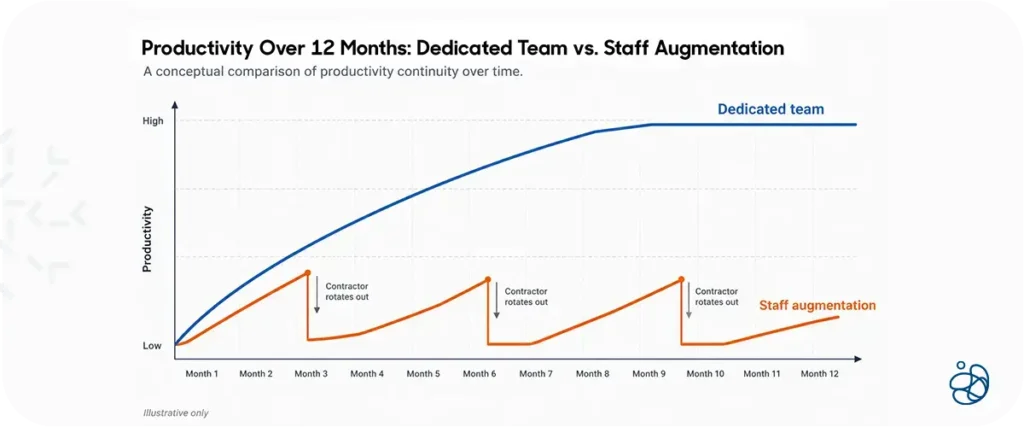
Knowledge retention is the factor most CTOs underestimate until they experience it. In a staff augmentation model, the contractor learns your codebase, your business logic, your deployment process, and your edge cases. That knowledge lives in their head. When they leave, and turnover in staff augmentation is structurally high because the model incentivizes the provider to rotate talent toward new engagements, the knowledge leaves with them. The next contractor starts from scratch.
The 2024 DORA State of DevOps Report found that team stability is one of the strongest predictors of software delivery performance. Teams with stable membership consistently outperform teams with high turnover across all five DORA metrics: deployment frequency, lead time, change failure rate, failed deployment recovery time, and reliability. This finding is not surprising, but it does quantify what most CTOs know intuitively: rotating people through a codebase destroys velocity.
A dedicated team model addresses this structurally. The team is assigned to your product for the long term. When an individual transition occurs (and they do occur in any model), the partner manages the knowledge transfer internally. The incoming engineer is onboarded by teammates who already understand your system, not by your internal team. That difference saves weeks of ramp-up per transition and protects your roadmap continuity.
Factor 3: Integration Depth and Cultural Alignment
Integration depth is the degree to which external engineers operate as part of your engineering organization rather than alongside it. In a staff augmentation model, integration depends entirely on how well your internal team absorbs the new person. Some contractors integrate beautifully. Others remain on the periphery, contributing code but never fully understanding the product, the customer, or the 'why' behind the technical decisions.
In a dedicated team model, integration happens at the team level, not the individual level. The team adopts your coding standards, participates in your code reviews, uses your tools, and aligns with your sprint cadence. Over time, the dedicated team develops product intuition, which is the understanding of what the customer needs, what the architecture can support, and what trade-offs are worth making. That product intuition is impossible to develop in a three-month engagement and extremely difficult to develop when individuals rotate.
The practical impact shows up in communication overhead and defect rates. Teams that are deeply integrated produce fewer misunderstandings, fewer rework cycles, and fewer defects that reach production. For a mid-market software company that ships to paying customers, every defect that reaches production has a cost: support tickets, customer confidence erosion, and engineering time diverted from the roadmap.
When Does Staff Augmentation Actually Make Sense?
Staff augmentation is not inherently inferior. It is the right model in specific situations, and dismissing it entirely would be dishonest. Here are the scenarios where it genuinely works well.
Short-term, well-defined projects with clear scope. If you need three React developers for a four-month project that has a fixed spec and a clear end date, staff augmentation is efficient. You are not building long-term capability. You are renting capacity for a bounded task. The knowledge retention risk is low because the scope is contained.
Skill-specific gaps that your team can manage. If your team needs a DevOps engineer to set up a CI/CD pipeline and your existing team lead can manage the work, a single augmented resource makes sense. The management overhead is low because the work is defined and the expertise is specific.
Exploratory or experimental work. If you are prototyping a new feature direction and you want to test a technology without committing internal resources, bringing in a specialist on a short-term basis lets you explore without overhead.
The pattern across these scenarios is clear: staff augmentation works when the engagement is short, the scope is defined, and the knowledge created does not need to persist beyond the project. When any of those conditions is false, the dedicated team model produces better outcomes over time.
What Should CTOs Evaluate When Choosing a Dedicated Team Partner?
If you decide that a dedicated team is the right model, the next challenge is distinguishing genuine dedicated team partners from staff augmentation providers using different branding. These five questions will reveal the difference quickly.
What is your average team tenure on a single client product? If the answer is less than 12 months, the provider is rotating talent. Genuine dedicated teams maintain core membership for two years or more.
How do you handle transitions when a team member leaves? The right answer involves an internal knowledge transfer process managed by the partner, not by your team. If their answer is 'we will find a replacement,' that is staff augmentation.
Who is accountable for delivery outcomes? If the answer points only to the individual developers, that is staff augmentation with a team label. A real partner has a team lead or delivery manager who shares accountability for sprint commitments, quality, and velocity.
How does your team integrate with our engineering processes? Look for specifics: code review participation, architecture decision involvement, shared tooling, aligned sprint cadence. Vague answers about 'flexibility' and 'adapting to your needs' usually mean they do not have a structured integration process.
Can I talk to a CTO at a company similar to mine who has worked with you for more than a year? This is the single most revealing question. Providers that genuinely operate a dedicated team model have long-term clients who will vouch for the experience. Providers that rotate talent have a harder time producing these references.
What This Means for Independent Mid-Market Software Companies
For independent mid-market software companies with 30 to 200 engineers, the staff augmentation vs dedicated teams decision carries specific weight. Your engineering team is large enough to have specialization but small enough that every person's contribution is visible. Adding the wrong model does not just waste budget. It disrupts team dynamics, creates management overhead, and can actually slow you down.
The math works differently at mid-market scale than it does at enterprise scale. An enterprise company with 500 engineers can absorb 20 augmented contractors without significant cultural disruption. A company with 50 engineers that brings in 10 contractors has fundamentally changed the composition of its team. If those 10 people rotate every six months, the company spends more time onboarding than building.
Mid-market CTOs who need to scale engineering without losing team cohesion should evaluate partners that offer dedicated engineering teams designed for long-term integration. The criteria outlined above, especially team tenure, transition management, and shared accountability, are the filters that separate partners who understand mid-market engineering from those who are simply selling seats.
There is also a timing dimension. If your company is approaching a funding round, an acquisition, or a major product launch, the knowledge continuity that a dedicated team provides becomes even more valuable. Investors and acquirers evaluate engineering team stability. A team composed of long-tenured dedicated engineers tells a different story than a team with a rotating roster of contractors.
Frequently Asked Questions
Is a dedicated team more expensive than staff augmentation?
The hourly rate for a dedicated team is typically 10% to 20% higher than staff augmentation because it includes team coordination, knowledge management, and transition planning. However, the total cost of delivery over 12 months is usually lower because you avoid repeated ramp-up cycles, reduce management overhead, and eliminate the productivity loss caused by turnover. The right comparison is cost per feature delivered, not cost per hour billed.
How long does it take for a dedicated team to reach full productivity?
A well-structured dedicated team typically reaches 70% to 80% productivity within the first four to six weeks, and full productivity by month three. This is slower than placing an individual contractor, but the productivity is sustained. Staff augmentation reaches initial productivity faster per individual, but the cycle resets every time a contractor rotates out.
Can I start with staff augmentation and switch to a dedicated team later?
Yes, but the transition has a cost. The augmented individuals may not stay when the model changes, and the new dedicated team needs its own ramp-up period. Starting with the model you intend to use long-term avoids paying for two ramp-up cycles.
What size engineering team benefits most from a dedicated team model?
Companies with 30 to 200 engineers see the most impact from dedicated teams. Below 30, the integration overhead of any external model can be disproportionate. Above 200, the organization is typically large enough to absorb augmented resources without significant disruption. The mid-market range is where team cohesion, knowledge retention, and cultural alignment matter most.
How do I measure whether my dedicated team is performing well?
The same way you measure your internal team. DORA metrics (deployment frequency, lead time, change failure rate, recovery time) are the industry standard for delivery performance. Additionally, track team tenure, sprint commitment accuracy, and the ratio of new feature work to rework. A dedicated team that delivers consistently on sprint commitments with low rework is performing well.
What happens if I am not satisfied with a dedicated team member?
A good dedicated team partner manages this proactively. The team lead identifies performance issues early, provides coaching, and initiates transitions when needed. Because the partner maintains bench depth and shared product knowledge within the team, replacing an individual does not reset the entire team's understanding of your product. This is structurally different from staff augmentation, where replacing a contractor means starting the onboarding process from zero.
The Bottom Line
The staff augmentation vs dedicated teams decision is not a procurement decision. It is an engineering decision that affects your team's velocity, your product's quality, and your company's ability to deliver on its growth plan. The three factors that most CTOs overlook, ownership, knowledge retention, and integration depth, are precisely the factors that determine whether external engineering capacity accelerates your roadmap or creates drag.
Staff augmentation has its place: short-term, well-scoped projects where knowledge persistence is not required. But for mid-market software companies that need sustained engineering capacity over 12 months or more, the dedicated team model produces better outcomes by every measure that matters. The key is choosing a partner that actually operates this model, not one that labels staff augmentation with a different name.
If you are evaluating how to scale your engineering team without sacrificing cohesion or velocity, we are happy to walk through how our dedicated team model works in practice. No pitch, just a conversation about what has worked for companies in a similar position to yours.
References and Further Reading
- DORA, Accelerate State of DevOps Report 2024. Annual research on software delivery performance, including findings on team stability as a predictor of delivery outcomes across all five DORA metrics. https://dora.dev/research/2024/dora-report/
- DORA, Software Delivery Performance Metrics. Guide to the five DORA metrics for measuring engineering team performance: deployment frequency, lead time, change failure rate, recovery time, and reliability. https://dora.dev/guides/dora-metrics/
- Deloitte, Global Outsourcing Survey 2024. Survey of 500+ executives on the evolution of talent sourcing, showing the shift from cost-driven to capability-driven outsourcing and the rise of multidimensional sourcing models. https://www.deloitte.com/global/en/issues/work/global-outsourcing-survey.html
- Deloitte, Global Business Services Survey 2025. Research on shared services and outsourcing trends, covering digital capability development, talent strategies, and service delivery model evolution. https://www.deloitte.com/us/en/services/consulting/services/shared-services-survey.html
- Gartner, Technical Debt Management. Research on measuring, prioritizing, and remediating technical debt in software organizations, relevant to understanding the hidden costs of engineering model choices. https://www.gartner.com/en/infrastructure-and-it-operations-leaders/topics/technical-debt
- Bain & Company, Margin Growth in Software Investing. Analysis of 33 software buyouts showing that projected margin improvements consistently trail actuals, with engineering execution as a contributing factor. https://www.bain.com/insights/wanted-margin-growth-in-software-investing-global-private-equity-report-2025/
- McKinsey & Company, People and Organizational Performance. Research hub covering talent management, team effectiveness, and organizational design principles relevant to engineering team scaling decisions. https://www.mckinsey.com/capabilities/people-and-organizational-performance/our-insights
- Stack Overflow, Developer Survey 2024. Annual survey of 65,000+ developers covering technology trends, work preferences, and team dynamics that inform engineering team design decisions. https://survey.stackoverflow.co/2024/