

Staying relevant in a rapidly evolving industry is both a challenge and an opportunity for tech professionals. Whether you are a seasoned developer or just starting your journey, investing in the right engineering skills in 2025 can set you apart. The pace of change has not slowed down, and the teams that deliver consistently are the ones that grow consistently.
Here are three engineering skills 2025: DevOps and Automation, Emerging Technologies, and Advanced Architectures and Patterns.
Table of Contents
1. DevOps and Automation
The demand for seamless software delivery and efficient operations continues to grow, making DevOps and automation indispensable for modern tech teams.
Continuous Integration and Deployment (CI/CD)
Automating the entire software lifecycle, from code integration to deployment, is a cornerstone of DevOps. Tools like Azure DevOps, GitHub Actions, or Jenkins build robust CI/CD pipelines. Key deployment strategies worth mastering:
- Blue-Green Deployments: Minimize downtime by maintaining two identical environments.
- Canary Releases: Gradually introduce changes to a subset of users before full rollout.
- Rolling Updates: Replace instances incrementally to ensure high availability throughout.
Infrastructure as Code (IaC)
IaC allows you to manage and provision infrastructure through code. Tools like Terraform and Azure Resource Manager enable scalable and repeatable deployments. Explore modular configurations and integrate IaC with your CI/CD pipelines for end-to-end automation.
Monitoring and Logging
Visibility is key in a distributed world. Prometheus and Grafana offer real-time monitoring. Centralized logging solutions using the ELK Stack (Elasticsearch, Logstash, Kibana) or Azure Monitor provide the observability layer that keeps distributed systems manageable.
Containerization and Orchestration
Containers are a fundamental building block of modern applications. Deepen your knowledge of Docker and Kubernetes, focusing on scaling, managing workloads, and using Helm Charts to simplify Kubernetes application deployments.
2. Emerging Trends and Technologies
Groundbreaking technologies continuously reshape the tech landscape. Staying ahead means embracing the trends shaping the future.
Artificial Intelligence and Machine Learning
AI continues to reshape industries, and knowing how to integrate it into your applications is essential. Explore ML.NET to add machine learning capabilities to .NET Core applications. Python libraries like Scikit-Learn, TensorFlow, or PyTorch provide strong foundations for AI development. Cloud platforms like Azure Cognitive Services offer ready-to-use AI models for vision, speech, and natural language processing, suitable for developers looking to implement AI without building from scratch.
Blockchain and Web3
Blockchain technology is evolving beyond cryptocurrencies. Learning to develop smart contracts using Solidity, or building enterprise blockchain solutions with Hyperledger Fabric, positions you in areas like decentralized finance or supply chain transparency.
IoT and Edge Computing
The Internet of Things is expanding rapidly. Azure IoT Hub supports solutions that connect and manage devices. Edge computing platforms like Azure Edge Zones allow you to process data closer to its source, enabling low-latency applications for IoT devices.
3. Advanced Architectures and Patterns
Mastering advanced architectures and design patterns is crucial for building scalable and maintainable applications as complex systems grow.
Design Patterns
Familiarity with common design patterns elevates problem-solving skills. Three foundational categories:
- Creational Patterns: Singleton, Factory, Abstract Factory.
- Structural Patterns: Adapter, Facade, Composite.
- Behavioral Patterns: Observer, Strategy, Command.
Distributed Systems
Microservices and cloud-native development require a deep understanding of distributed systems. Key topics include:
- Service Discovery: Tools like Consul or Kubernetes DNS for finding services in dynamic environments.
- Circuit Breakers: Libraries like Polly to manage failures gracefully.
- Distributed Tracing: Tools like Jaeger or Zipkin for tracing requests across services.
Event-Driven Architectures
Event-driven systems enable high scalability and resilience. Learn about message brokers like RabbitMQ, Kafka, or Azure Event Hub. Patterns like event sourcing and CQRS (Command Query Responsibility Segregation) handle complex workflows effectively.
Scalability and Performance Optimization
Efficient systems design requires mastery of:
- Caching: Tools like Redis or Azure Cache for Redis.
- Load Balancing: Solutions like NGINX, HAProxy, or cloud-native load balancers.
- Database Sharding: Partitioning data to scale databases effectively.
What This Means for Engineering Leaders
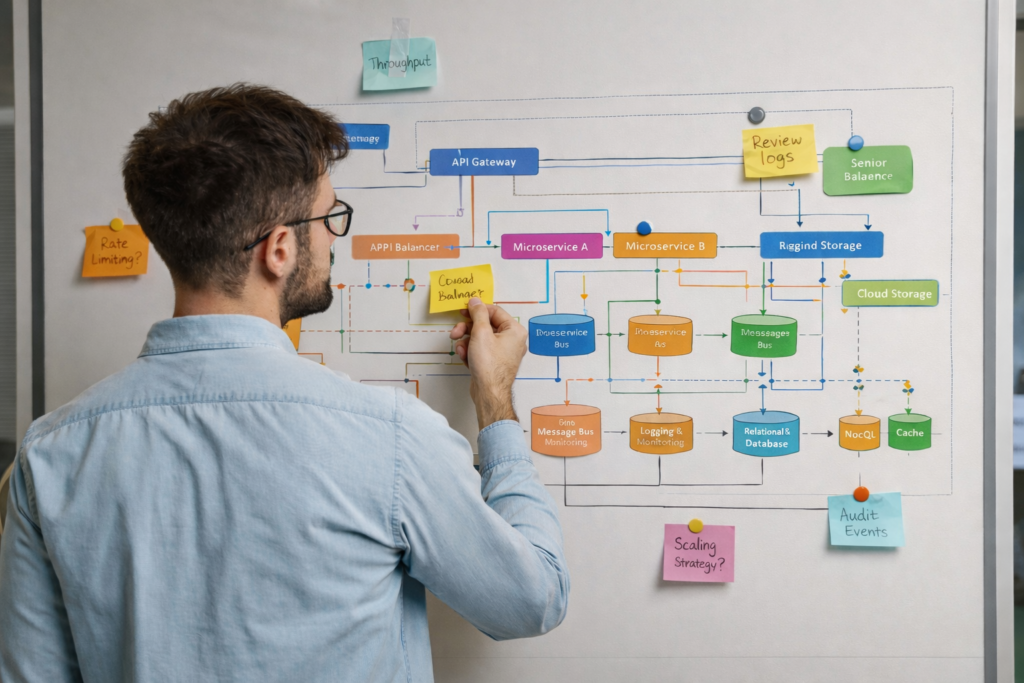
For engineering leaders, these engineering skills 2025 priorities are not just individual development goals. They shape how teams are structured, how candidates are evaluated, and how technical debt is managed.
Mid-market software companies
For mid-market software companies the challenge is prioritizing which skill areas to develop across a lean engineering team. DevOps maturity tends to deliver the fastest measurable ROI, since CI/CD and observability improvements reduce the operational friction that consumes disproportionate engineering time. AI integration matters next, as it affects product differentiation. Architecture patterns matter most for longer-horizon technical health.
A dedicated nearshore engineering team that already operates with strong DevOps practices and modern architecture knowledge reduces the upskilling burden on internal teams and accelerates delivery quality.
PE-backed software portfolios
For PE-backed portfolios, these skill areas affect exit readiness. Teams with strong CI/CD pipelines, modern architecture patterns, and observable systems present lower technical risk during diligence. Skills gaps in these areas show up as operational fragility and become valuation concerns.
If your organization is thinking through how to close engineering skills gaps systematically, our team at Scio is happy to discuss what we have seen work in practice.
Frequently Asked Questions
What engineering skills should teams prioritize in 2025?
Teams should prioritize DevOps and automation maturity, AI and ML integration capabilities, and advanced architecture patterns including distributed systems and event-driven design. Mastering these domains ensures teams can build scalable, intelligent, and secure modern systems. The right priority order depends on the team's current technical debt level and growth stage, with DevOps fundamentals typically delivering the fastest operational improvement.
Why is observability essential for modern engineering teams?
Observability is crucial because it significantly shortens the time to detect and resolve issues in complex, distributed environments. Unlike simple monitoring, it provides the "why" behind system behaviors through traces, logs, and metrics. Teams without strong observability spend disproportionate time on incident diagnosis, which consumes capacity that should go toward product delivery.
Which architectural patterns matter most for scalable systems?
Event-driven architectures, distributed systems fundamentals, and modern caching and scaling strategies are the backbone of responsive and resilient software. Design patterns at the individual component level matter equally: teams that apply creational, structural, and behavioral patterns consistently produce more maintainable systems that are faster to extend and safer to modify as requirements evolve.
How can engineering leaders build these skills without pausing delivery?
By embedding skill development into delivery cycles rather than treating it as a separate track. CI/CD improvements, for example, are best learned by improving the existing pipeline rather than running parallel training exercises. Architecture pattern development happens most effectively during design reviews for real features. Mentorship programs that pair senior engineers with developers on active projects create the context that makes new skills stick in production environments.
Build Forward in 2025
2025 is brimming with opportunities for tech professionals to grow and thrive. By focusing on DevOps and automation, emerging technologies, and advanced architectures, teams can future-proof their delivery capacity and make a meaningful impact on their products.
The most effective growth strategies are the ones that connect learning directly to the work already underway. Let this year be the one where your team embraces these skills not as an afterthought, but as part of how you deliver. If you want to discuss how to structure that growth alongside real delivery commitments, I would be glad to think through it with you.
References and Further Reading
- Microsoft Azure DevOps Documentation. Official reference for Azure DevOps pipelines, CI/CD configuration, deployment strategies, and IaC integration patterns. https://docs.microsoft.com/en-us/azure/devops/
- DORA (DevOps Research and Assessment), State of DevOps Report. Annual research benchmarking CI/CD maturity, deployment frequency, and the DevOps practices most associated with high software delivery performance. https://dora.dev/publications/
- Kubernetes Documentation. Authoritative reference for Kubernetes architecture, deployment patterns, scaling strategies, and the orchestration practices that underpin modern containerized systems. https://kubernetes.io/docs/home/
- Apache Kafka Documentation. Technical reference for event-driven architecture using Kafka, including event sourcing patterns, producer-consumer models, and distributed messaging at scale. https://kafka.apache.org/documentation/
- Martin Fowler, Enterprise Integration Patterns. Comprehensive reference for distributed systems patterns including event-driven architecture, CQRS, circuit breakers, and the design patterns that underpin modern microservices systems. https://martinfowler.com/
- Stack Overflow Developer Survey 2024. Annual benchmark on which tools, frameworks, and architectural approaches engineering teams are using in production, providing context for the 2025 skills priorities. https://survey.stackoverflow.co/2024/
- IEEE, Software Engineering Standards and Research. Academic and industry research on software architecture patterns, distributed systems design, and the engineering practices that produce maintainable and scalable systems. https://www.ieee.org/