A growing QA queue often signals deeper process issues upstream: scope creep, oversized pull requests, insufficient dev-level tests, or ambiguous acceptance criteria. A QA bottleneck software delivery problem is rarely just a QA problem. This decision-tree diagnostic framework helps CTOs and VPs of Engineering at mid-market software companies pinpoint the true root cause of release delays and restore delivery predictability.
The framework below draws on DORA's State of DevOps research, Atlassian's developer-experience surveys, and LinearB's 2026 engineering benchmarks. None of it argues that QA is never the constraint. It argues that the location of the queue tells you where flow is stopping, not automatically why.
Table of Contents
Why QA Becomes the Convenient Scapegoat
A large "Ready for QA" queue is an easy metric to blame when releases slip, but it rarely tells the full story. In many mid-market teams, tickets linger there because of hidden dependencies, incomplete tests, or requirement shifts, not simply tester capacity.
Symptom vs. Root Cause: Test Delays vs. Process Failures
DORA's 2024 State of DevOps research emphasizes that software delivery bottlenecks typically emerge from unstable priorities and unclear acceptance criteria, with QA delay acting as a visible symptom, not always the root cause. The queue is where the backup becomes visible. It is rarely where the backup started.
Impact on Sprint Cadence and Stakeholder Confidence
When a software delivery bottleneck gets misdiagnosed as a QA capacity issue, predictable sprints give way to firefighting and late-stage regression cycles. Atlassian's 2024 developer-experience survey of more than 2,100 developers and engineering leaders found that 69 percent of developers lose at least eight hours a week to workflow inefficiencies, roughly a fifth of a standard workweek, and fewer than half believed leadership was aware of how much.
Four Upstream Failure Modes Behind QA Bottlenecks
These four upstream patterns are what most consistently surface downstream as a QA queue, even when the QA team itself is functioning well. Each one compresses the time or clarity QA actually needs, so the queue grows for reasons that have nothing to do with tester headcount.
Scope Creep Blowing Out Test Estimates
Requirement changes, customer exceptions, and small additions that continue after development begins expand the testable scope while the release date stays fixed. DORA found that unstable organizational priorities meaningfully reduce productivity and increase burnout, which is the research basis for treating scope creep as a delivery risk rather than routine agile flexibility.
Oversized Pull Requests That Stall Review and Test Cycles
Large or long-lived PRs make review slower, defects harder to localize, and the regression surface bigger. LinearB's 2026 benchmarks, drawn from more than 8.1 million pull requests across 4,813 teams, put the elite 75th-percentile threshold below 100 changed lines per PR and elite cycle time under 25 hours, well below what most teams that report QA overload actually ship.
Gaps in Dev-Level Test Coverage Pushing Work Downstream
When developers hand off code without fast, reliable automated tests behind it, QA ends up finding defects that could have been caught in minutes during development. DORA's guidance recommends automated suites with feedback in under ten minutes and developers able to reproduce and fix failures in their own environment, precisely so this handoff does not happen.
Ambiguous Acceptance Criteria Leading to Repeated QA Rework
Stories that describe desired functionality without specifying edge cases, error behavior, or what counts as done force testers to discover expected behavior during validation. A 2024 empirical study of agile requirements found that requirement ambiguity is directly linked to lower test efficacy and higher rework, which matches what shows up as defect ping-pong between developers and QA.
QA Bottleneck Software Delivery: How Do You Diagnose It?
The framework below is a flowchart in structure even though it reads as a sequence: measure the queue, map where time is actually spent, follow the branching logic to the primary constraint, then confirm the diagnosis against deployment data.
Step 1: Measure Queue Length and Cycle Time
Start with data. Track average and 90th-percentile QA queue age over at least three delivery cycles, not one problematic sprint, to separate a real trend from noise.
Step 2: Map Delays to Process Nodes
Chart where time actually accumulates: before QA, during active testing, or blocked after QA but before release. Separate active testing time from time lost to environment access, unclear requirements, or dependency waits.
Step 3: Follow the Branching Logic to the Primary Bottleneck
Four interpretive rules do most of the diagnostic work:
High QA queue, high rejection rate: points upstream toward incomplete work, unclear acceptance criteria, or weak developer testing.
High QA queue, low rejection, high test utilization: is more consistent with a genuine QA capacity constraint.
High QA queue, dominated by blocked time: points to environments, test data, or dependency and decision latency, not tester execution speed.
Stable QA flow, long end-to-end lead time: means the real bottleneck sits elsewhere, in review, deployment, or release governance.
Step 4: Validate Findings With Deployment and Defect Metrics
Correlate the diagnosis against deployment success rate, defect origin, and rework rate. DORA recommends pairing lead time, failed-deployment rate, and rework rate as the leading indicators that confirm whether the identified constraint is the real one.
The table below summarizes the four most common patterns.
Each of the four upstream failure modes has a specific, concrete fix rather than a generic recommendation to hire more testers or buy more tooling. Applied together, they address scope, batch size, developer testing, and requirement clarity as one connected system.
Tightening Scope Definition and Change Control
Set explicit release cutoffs and require trade-offs, not overtime, for any change after commitment. Make requirement stability a visible metric in retrospectives instead of an assumed constant.
Enforcing PR Size Limits and Feature Flag Strategies
Reference elite benchmarks such as LinearB's sub-100-line threshold as a prompt for investigation, not a rigid rule. Use feature flags to decompose large changes into smaller, independently reviewable and testable slices.
Shifting Left: Embedding Automated Tests in Development
Require developer-owned unit and integration tests as a condition of handoff, and measure coverage against risk-critical behavior rather than raw line count. Fast, reliable CI feedback is what keeps this discipline sustainable.
Refining User Stories and Acceptance Criteria With Stakeholders
Bring product, engineering, and QA into story refinement together, before coding starts. Track post-development clarification requests as a retro metric so ambiguous acceptance criteria stop being invisible.
How Does This Connect to Release Confidence?
Fixing the four upstream failure modes is what actually rebuilds release confidence, since confidence comes from accumulated evidence across the delivery process, not from a slower gate or a faster coding tool alone. The two practices below are how that evidence gets built and kept relevant over time.
Embedding QA Earlier for Continuous Feedback
High-performing teams treat testing as a continuous activity where developers and testers work side by side, not a phase that starts once coding is declared complete. DORA's research links this pattern to both stronger speed and stronger stability, not a trade-off between the two.
Aligning QA Metrics With Business Outcomes
Map QA throughput and quality to outcomes that matter to the business: escaped defects reaching customers, incident frequency, and the reliability of release-date commitments, rather than defect counts or raw queue length in isolation.
What This Means for Mid-Market Engineering Leaders
Mid-market independent software companies feel this problem more acutely than larger organizations because they typically have enough specialization to create handoffs, a dedicated QA function, a dedicated DevOps function, but not enough staffing to backstop every specialist. A QA lead or release manager becoming a single point of failure is a common, specific risk at this scale.
It also matters that a named QA department can quietly shift how the rest of the organization thinks about ownership: developers optimize for shipping code, QA becomes accountable for catching what should have been caught earlier, and the queue grows as a byproduct of that incentive split. Scio works with independent software companies to embed quality ownership across the whole delivery system rather than isolating it in one team, through dedicated nearshore engineering teams that share the same delivery standards as your internal staff.
Frequently Asked Questions
u003cstrongu003eWhat is a QA bottleneck in software delivery?u003c/strongu003e
A QA bottleneck is when work accumulates in the QA stage waiting for validation, retesting, or sign-off. That backlog is often a symptom of an upstream delivery problem rather than a pure QA capacity shortfall.
u003cstrongu003eHow do I tell if QA is the real constraint or just where the problem becomes visible?u003c/strongu003e
Track QA rejection rate alongside blocked versus active testing time. High rejection or high blocked time both point upstream. High active utilization with low rejection is a much stronger signal of a genuine QA capacity constraint.
u003cstrongu003eWhy do oversized pull requests cause QA problems?u003c/strongu003e
Large PRs slow review, complicate merging, expand the regression surface, and push more defect risk downstream at once, overwhelming both reviewers and testers even when average QA capacity looks adequate on paper.
u003cstrongu003eShould we set a fixed pull request size limit?u003c/strongu003e
Use a benchmark like LinearB's sub-100-line elite threshold as a prompt for investigation, not a mandate. A rigid line-count rule tends to produce artificial splitting rather than genuinely smaller, better-decomposed changes.
u003cstrongu003eCan adding more testers alone fix the bottleneck?u003c/strongu003e
Not usually. Unless capacity is genuinely the constraint, which the diagnostic framework can confirm, adding testers without fixing the upstream cause tends to leave delivery predictability exactly where it started.
u003cstrongu003eWhen is it time to bring in outside help?u003c/strongu003e
If QA still shows up as the confirmed system constraint after the upstream failure modes are addressed, or unpredictable releases persist despite process changes, external diagnostic or quality-engineering support can accelerate root-cause work.
The Bottom Line
The visible QA queue is rarely the true system constraint in a mid-market engineering organization. It is a signal that deserves structured investigation, not an automatic verdict against the testing team, and the decision-tree framework above is what turns that investigation into something repeatable.
Applying this decision-tree framework to your next release lets you replace anecdotal blame with evidence, so investment goes toward the actual constraint, whether that is scope stability, PR size, developer testing, acceptance clarity, or genuine QA capacity. If you want a second set of eyes on where your QA bottleneck software delivery problem actually starts, our team at Scio would be glad to walk through the diagnostic with you.
References and Further Reading
Google Cloud / DORA. State of DevOps Report 2024, covering delivery bottleneck diagnosis and QA in the context of the whole delivery system. https://cloud.google.com/devops/state-of-devops
Most CTOs I talk to already know where their technical debt lives. They know which modules are brittle, which frameworks are overdue for an upgrade, which parts of the codebase only two senior engineers fully understand. Awareness is not the problem.
The problem is the economics. Addressing debt means pulling capacity away from roadmap work, and in most mid-market software companies, roadmap commitments have names attached to them: a customer who signed a contract, a board that approved a product plan, a sales team that already made promises. Technical debt reduction gets deferred not because leaders do not understand it, but because the math has always been hard to justify.
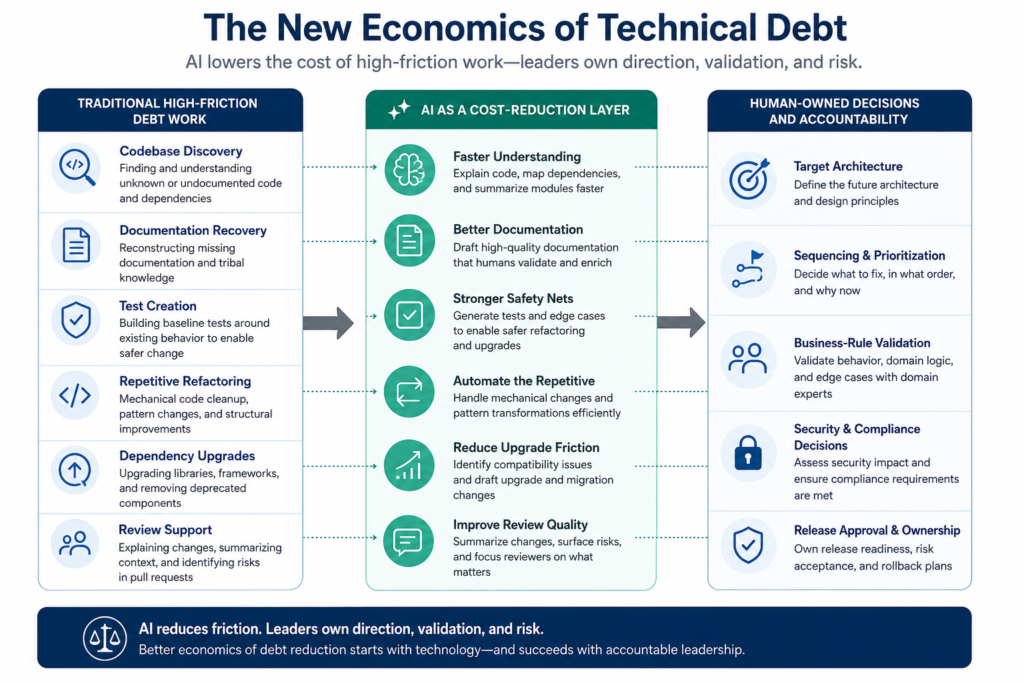
AI is starting to change that math. Not by making technical debt disappear, but by lowering the cost of specific work that has historically kept modernization from starting at all. I want to be precise about what that means in practice, because the risk of oversimplifying it is real.
Table of Contents
What Technical Debt Actually Costs at Scale
In early growth, technical shortcuts are often reasonable. A young product team validating a market, closing early customers, or responding to changing requirements cannot always make optimal technical decisions. That is not irresponsible. It is the reality of building software under uncertainty.
The problem is what happens when that codebase grows up. The same system now supports more customers, more integrations, more product expectations, and more revenue. What was once "good enough" becomes a constraint. A framework upgrade delayed one quarter becomes a recurring risk. A poorly documented workflow becomes a key-person dependency on two engineers who are already overloaded.
Technical debt charges interest on every change. I think of it in five categories that I have seen play out consistently across the companies we work with at Scio:
Delivery interest: features take longer because the system is difficult to change.
Quality interest: fragile areas produce more defects and regression risk.
Knowledge interest: only a few people understand important workflows, creating concentration risk.
Opportunity cost: engineers maintain fragile systems instead of enabling product growth.
Financial drag: rework, incidents, support effort, and slower delivery reduce the return on engineering investment.
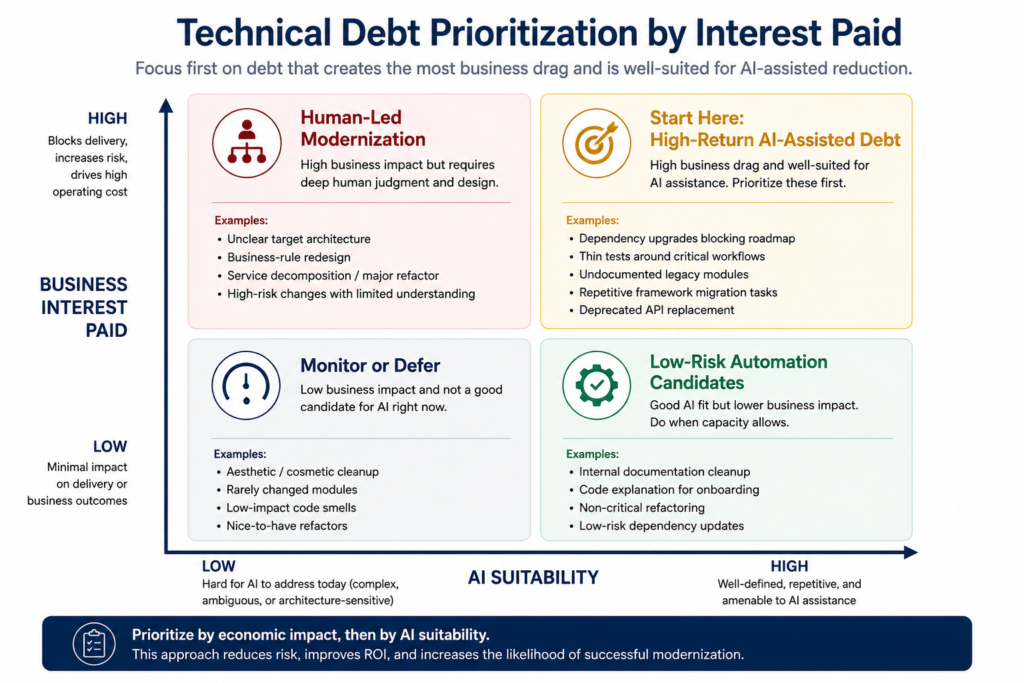
The right economic question is not "How much technical debt do we have?" It is "Which debt is charging the highest interest, and which parts of that debt are now cheaper to reduce with AI support?" That reframe is what I want to focus on here.
How AI Shifts the Economics
AI technical debt reduction works by lowering the cost of specific activities that have historically been the most expensive and least glamorous part of modernization: understanding what is actually there before changing it.
McKinsey has reported that generative AI can meaningfully reduce time spent on documentation tasks and speed refactoring, particularly when work is structured and repetitive. Sonar's developer research identifies documentation, test coverage, debugging, and refactoring as the areas where AI can have a positive impact on technical debt. These findings align with what I see in practice.
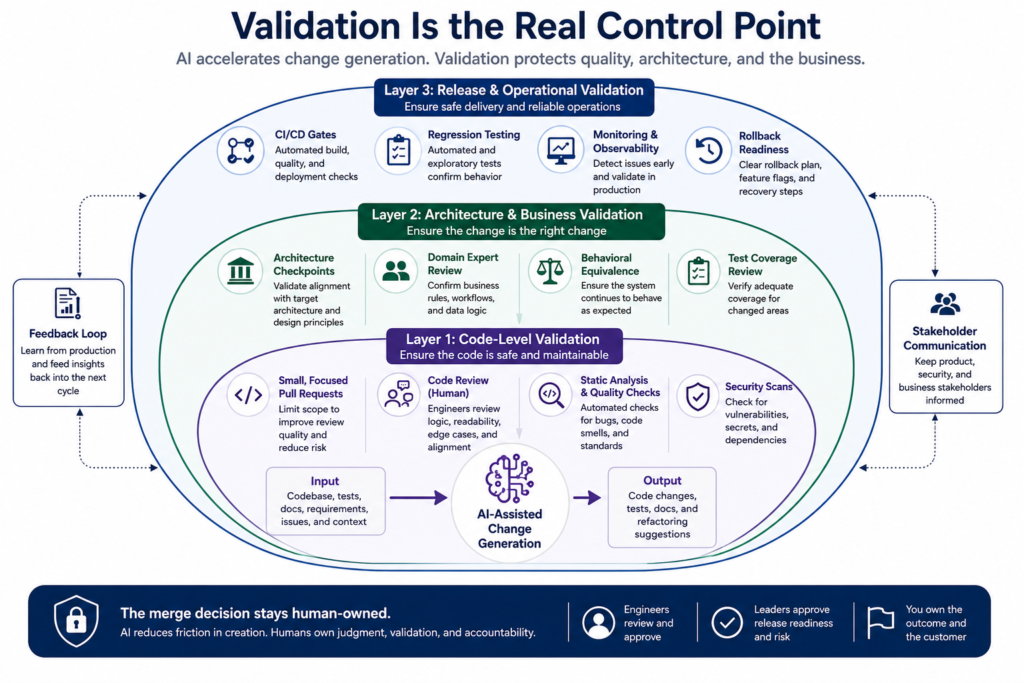
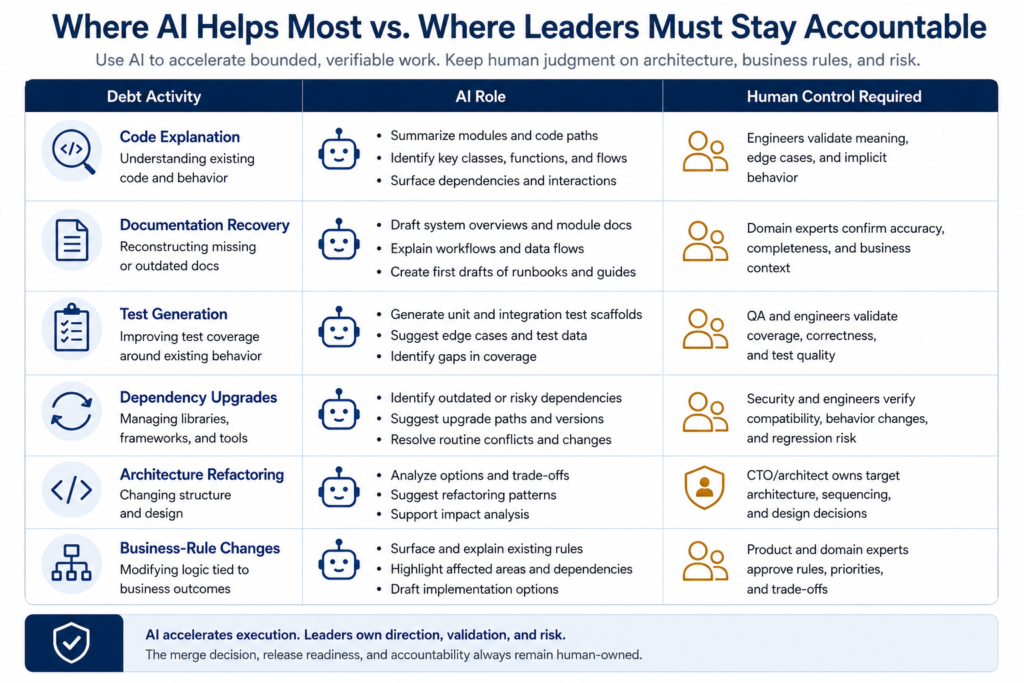
The sweet spot for AI is bounded, verifiable work. It can help teams explain unfamiliar code, summarize modules, and identify dependencies. It can draft documentation that engineers and domain experts then validate. It can generate baseline tests around existing behavior, which is often the prerequisite for safer refactoring. It can support dependency upgrades, framework migrations, deprecated API replacement, and repetitive transformations where the source and target patterns are clear.
What AI cannot do: decide what the platform should become, determine which business rules must be preserved, or define the modernization sequence that best supports the company's roadmap. Those decisions still require senior engineering judgment. The economic shift is real, but it is more narrow than most vendor narratives suggest.
Why Debt Persists Even When Leaders Know It Exists
I want to address this directly because I hear it often. Leaders know the debt is there. They know it is slowing delivery. And they still defer it, sprint after sprint. There are structural reasons for that.
The first is that modernization competes with roadmap work, and roadmap commitments are visible in ways that platform health is not. A customer waiting for a feature shows up in a customer success call. Technical debt shows up as slower estimates and higher incident rates, which are easier to absorb quietly than to explain to a board.
The second is that the first phase of modernization is the least glamorous and most expensive. Before changing a legacy system, teams need to understand it. That means code archaeology, dependency mapping, documentation recovery, test repair, and business-rule validation. This is where AI can help the most, but it is also where teams most often underestimate the effort.
The third is weak test coverage. Many teams know what they want to refactor but cannot prove that behavior will remain stable afterward. Without tests, every change feels like a production incident waiting to happen. That fear is rational, and it is one of the most common reasons modernization stalls.
Forrester has argued that technical debt includes a broader portfolio of deferred technical investment, including knowledge gaps, unsupported technologies, system inflexibility, and redundant systems. I agree with that framing. The narrower view of technical debt as "bad code" misses the organizational and architectural dimensions that are often the most expensive to carry.
What AI-Assisted Work Looks Like in Practice
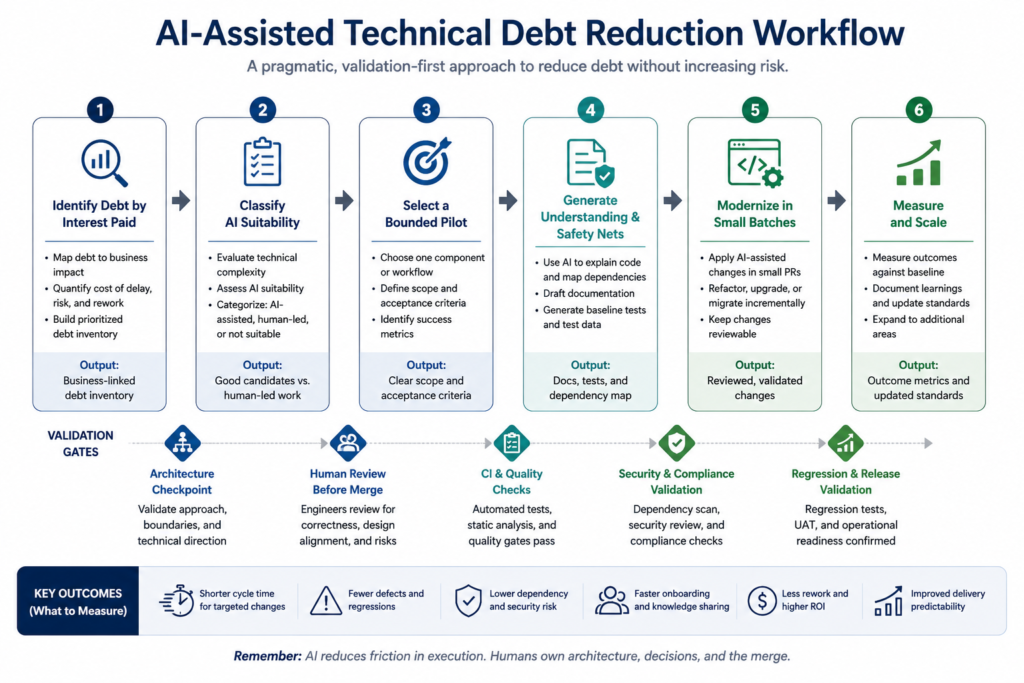
A practical workflow starts with a debt inventory based on interest paid. Which debt repeatedly slows delivery? Which blocks upgrades? Which increases incident exposure? Which concentrates knowledge in too few people? That prioritization should be driven by business drag, not engineering frustration.
The next step is matching work to the right level of AI involvement. This is where I see the most mistakes. Teams either avoid AI entirely, which is conservative but leaves real efficiency gains on the table, or they use AI as a bulk code generator, which creates a verification burden that can exceed the original problem.
The goal of a disciplined AI technical debt reduction program is to reduce the cost of the work that enables modernization, not to automate the modernization decisions themselves.
AI Suitability: What to Use AI For and What to Keep Human
Good AI candidates
Human-led with AI support
Poor AI-first candidates
Documentation recovery
Architecture refactoring
Ambiguous product behavior
Code explanation and summarization
Service decomposition
Unclear target architecture
Dependency mapping
Business-rule validation
High-risk changes without tests
Test generation around existing behavior
Migration sequencing
Security, billing, compliance workflows
Repetitive refactoring with clear patterns
Release planning
Customer-specific logic without expert review
Framework upgrades, deprecated API replacement
Architecture review and validation
Changes where no domain expert is available
The key constraint I always come back to: AI is most useful when it makes disciplined engineering work cheaper. It becomes a risk when it substitutes for deciding what the system should become.
What Risks to Watch
Plausible code is not the same as correct code. AI-generated output can look clean and still miss an edge case, preserve the wrong abstraction, or introduce a security issue. I think this is the most important thing to hold onto when evaluating AI modernization tools, because the surface of the output is not a reliable signal of its correctness.
Superficial cleanup is a related risk. A team can remove visible complexity while creating deeper maintainability problems. Recent research warns that AI-generated changes can introduce code smells, correctness issues, and redundancy that are harder to detect than the original debt.
Architecture drift is the third risk I see most often. When teams accept AI-generated changes without architecture review, the system can become less coherent over time. Local improvements weaken the larger design without anyone noticing until the damage is significant.
DORA's 2024 research on generative AI in software delivery makes a point I find important: individual productivity gains do not automatically translate into system-level delivery outcomes. Faster local work does not improve throughput or stability if teams are creating larger changes, weaker feedback loops, or more review burden. The bottleneck shifts from writing code to verifying whether generated changes are safe and coherent.
Finally: be skeptical of vendor case studies. Many AI modernization examples come from enterprise environments or vendor-led programs. They are useful signals, but mid-market companies should validate the approach in their own codebase before scaling.
How to Start: A Sequenced Approach
Reframe debt as economic drag. Ask where the company is paying interest every sprint. Slow roadmap delivery, release instability, rework, extended onboarding, knowledge concentration. That is your debt inventory.
Identify AI-suitable debt. Start with bounded, testable work: documentation recovery, dependency upgrades, test generation, repetitive modernization. Leave architecture decisions, business-rule validation, and compliance-sensitive changes to humans.
Choose one pilot. One module, repository, service, or upgrade. Define what "done" means before using AI. Create a validation-first workflow: baseline tests, small pull requests, architecture checkpoints, human review, CI checks, release monitoring.
Measure in business terms. Reduced rework, shorter cycle time, fewer regressions, better onboarding, lower dependency risk. Lines changed and files migrated are incomplete metrics.
Scale only after learning. Document what worked. Update coding standards. Train teams on approved use cases. Expand only when review and validation capacity can keep up with generation speed.
What This Looks Like Across Three Scenarios
Scenario 1: The deferred framework upgrade
A mid-market SaaS company has delayed a major framework upgrade for three years. The system still works, but every feature touching that area takes longer. The original engineers are gone, documentation is thin, and test coverage is incomplete. The useful move is not asking AI to complete the upgrade. The team uses AI to summarize modules, identify deprecated dependencies, draft documentation, and generate baseline tests around critical workflows. Senior engineers then separate the mechanical changes from the design-sensitive ones. The upgrade becomes scoped and fundable rather than vague and risky.
Scenario 2: The roadmap tax hidden in a legacy module
A product team keeps missing estimates because a pricing or permissions module is hard to change. Product leaders see slow delivery. Engineering leaders know the issue is concentrated debt. AI helps explain code paths, summarize business rules, identify frequently changed areas, and generate tests around high-risk paths. Product and engineering then validate which behaviors are essential and which are accidental complexity. The modernization effort gets tied directly to roadmap predictability, which makes it fundable at the executive level.
Scenario 3: The strategic initiative blocked by platform constraints
A company wants to launch a new integration, an AI-enabled feature, or an enterprise workflow. The current architecture makes the initiative slow and risky. AI supports dependency mapping, documentation recovery, test scaffolding, and repetitive refactoring. Senior engineering leaders still own the target architecture, sequencing, and release plan. The result is a clearer path to the strategic initiative without pretending that AI can make the hard trade-offs.
What This Means for Engineering Leaders
CTOs and VPs of Engineering at mid-market software companies
For mid-market software companies the most common mistake I see is treating AI modernization as a binary choice: either ignore it or run it as a background automation project. Neither works. The right framing is to identify specific modernization work that AI can make cheaper and safer to start, then run a disciplined pilot with explicit acceptance criteria and human review at every step.
A nearshore engineering team that already operates within a mature technical review model can add meaningful capacity for this kind of work, particularly for documentation recovery, test generation, and bounded refactoring that would otherwise compete directly with roadmap delivery. The constraint is always the same: the partner needs to integrate into your architecture standards and delivery rhythm, not operate as a separate AI experiment.
Operating Partners at PE-backed software portfolios
For PE-backed software portfolios technical debt is a value creation and exit readiness issue. A PortCo that carries significant debt in its most actively changed modules will see that debt show up as delivery predictability problems, recurring incidents, and diligence findings. AI-assisted modernization can accelerate debt reduction in bounded, high-drag areas without requiring a large permanent headcount increase, which is particularly relevant for companies where the hold period timeline limits how much can be built organizationally.
The practical sequence I recommend for PortCos is to start with a debt inventory tied to the value creation plan, pilot AI-assisted work in the highest-drag area, and measure outcomes in business terms before expanding. That sequence produces evidence the Operating Partner and board can evaluate, which is more durable than a modernization narrative that depends on vendor case studies. If you want to walk through how this applies to a specific portfolio company, I would be glad to talk.
Frequently Asked Questions
What is AI technical debt reduction and what makes it different from traditional modernization?
AI technical debt reduction uses AI tools to lower the cost of the discovery, documentation, testing, and repetitive transformation work that has historically made modernization too expensive to start. What makes it different from traditional modernization is that AI can compress the front-end work, understanding what is there before changing it, which has always been the most time-consuming and least fundable part of a debt reduction program. What has not changed is that architecture decisions, business-rule validation, migration sequencing, and release planning still require senior engineering judgment.
Which types of technical debt are best suited for AI-assisted reduction?
The best candidates are bounded, testable, and repetitive: documentation recovery, code explanation and summarization, dependency mapping, baseline test generation around existing behavior, repetitive refactoring with clear patterns, framework upgrades, and deprecated API replacement. The worst candidates are debt in areas where the target architecture is unclear, business rules are poorly understood, no domain expert is available, or the changes affect security, billing, compliance, or customer-specific logic without expert oversight.
What is the biggest risk when using AI for technical debt work?
The biggest risk is treating plausible code as correct code. AI-generated output can look clean and still miss an edge case, preserve the wrong abstraction, or introduce a security issue. The second risk is that faster code generation shifts the bottleneck to review and validation, and if review capacity cannot keep up with generation speed, teams create new hidden debt rather than reducing the existing kind. DORA's 2024 research on generative AI confirmed that individual productivity gains do not automatically translate into better system-level delivery outcomes when feedback loops and batch sizes are not managed carefully.
How should a mid-market CTO start an AI-assisted debt reduction program?
Start with the economics, not the tools. Identify the debt that is charging the highest business interest: which modules are slowing roadmap delivery, blocking upgrades, generating recurring incidents, or concentrating knowledge in too few people. Then find the AI-suitable subset of that debt, typically documentation recovery, test generation, and repetitive refactoring, and run one bounded pilot with explicit acceptance criteria and human review at every step. Measure in business terms: reduced rework, shorter cycle time, fewer regressions, better onboarding. Scale only after that pilot produces documented evidence of what works in your specific codebase.
Where I Stand on This
AI does not eliminate technical debt. I want to be clear about that because the marketing narrative around AI and modernization often implies it does. What AI can do is lower the cost of specific modernization work that has previously been too expensive to justify starting. That is a meaningful shift, but it is narrower than it often gets presented.
The companies that will benefit most from this shift are the ones that approach it with the same discipline they would apply to any engineering investment: clear acceptance criteria, strong review practices, architecture ownership, and measurement tied to business outcomes rather than activity. Faster code generation makes technical judgment more important, not less. The decisions about what the platform should become, which business rules must be preserved, and which modernization sequence best supports the roadmap still belong to engineering leaders.
At Scio, we support mid-market software companies and PE-backed portfolios that need to reduce technical debt without pausing roadmap delivery. We work within the client's architecture, delivery rhythm, and quality standards because we know that the value of modernization is not the code generated. It is the engineering leverage created. If this is a conversation worth having for your organization, I would be glad to start it.
Sonar, State of Code Developer Survey Report. Developer research identifying documentation, test coverage, debugging, and refactoring as the areas where AI tools have the most positive impact on technical debt. https://www.sonarsource.com/state-of-code-developer-survey-report.pdf
Forrester, What Technical Debt Means to IT Professionals. Forrester research arguing that technical debt includes a broader portfolio of deferred technical investment than code quality alone, including knowledge gaps, unsupported technologies, system inflexibility, and redundant systems. https://www.forrester.com/blogs/what-technical-debt-means-to-it-professionals/
DORA, 2024 State of DevOps Report. Research finding that while AI adoption increased individual productivity and job satisfaction, it also had negative effects on delivery stability and throughput when batch sizes, feedback loops, and review practices were not managed carefully. https://dora.dev/research/2024/dora-report/
Scio blog, Technical Debt Prioritization: 5 Proven Roadmap Fixes. Complementary framework for prioritizing technical debt by business impact rather than engineering preference, directly relevant to the debt inventory approach described in this article. https://sciodev.com/blog/technical-debt-prioritization/
Scio blog, Technical Debt Financial Risk: How to Make the Business Case. Analysis of the financial dimensions of technical debt, including how to build an investment case for debt reduction that connects to roadmap predictability and business outcomes. https://sciodev.com/blog/technical-debt-financial-risk/
Scio blog, Legacy System Modernization: 8 Approaches for CTOs. Broader analysis of modernization methods beyond AI-assisted work, covering when to stabilize, refactor, replatform, modularize, or replace components of a legacy platform. https://sciodev.com/blog/legacy-system-modernization/
If you search for "what is productivity software," most answers stop at the definition. What they skip is the part that matters to engineering leaders: whether the tools you already have are making your team faster, or quietly making delivery harder.
For CTOs and VPs of Engineering managing distributed teams, especially across the U.S. and Latin America, that distinction is critical. The question is not which tools your team uses. It is whether those tools support a healthy execution system or add friction to it.
Productivity software refers to digital tools that help individuals and teams plan, organize, manage, and complete work more efficiently. In business settings, this typically includes communication platforms, project management tools, documentation systems, collaboration software, and workflow automation tools.
That is the standard definition.
The more useful definition for engineering leaders is this: productivity software is the layer of technology that shapes how work moves through a team. It can reduce friction, improve visibility, and help teams coordinate. But without clear operating principles, it can also create noise, fragmentation, and decision fatigue.
Productivity software is an enabler. It is not a substitute for operational discipline.
That is why two teams can use the exact same stack and get very different results. One moves with consistency, clarity, and trust. The other gets buried under updates, handoffs, and tool sprawl. The difference is rarely the software itself. It is the system around it.
Most software teams do not struggle because they lack tools. They struggle because they have too many of them, with too little alignment on how they should be used.
A tool is introduced to improve collaboration. Then another to improve visibility. Then another to document decisions. Then another to automate workflows. Over time, the stack becomes a patchwork of overlapping systems, each with its own notifications, rituals, owners, and expectations.
Engineers start their day in Slack, move into Jira, check GitHub, review documentation in Notion, respond to messages in Teams, update status in a dashboard, then join a meeting to clarify what should already be clear. Everyone looks busy. Progress looks visible. But deep work keeps getting interrupted.
This is one of the most expensive hidden costs in software delivery. A team can be highly active and still underperform. Closing tickets is not the same as delivering value. Sending updates is not the same as making progress.
Busy is not the same as productive
One of the most common mistakes engineering organizations make is measuring activity instead of output. Number of tickets closed. Comments posted. Standups completed. These are visible, which makes them tempting. But they are not always meaningful indicators of team health.
Real productivity in software development is about sustained delivery of valuable, stable work. It is about flow: can developers stay focused long enough to solve meaningful problems? Can the team move changes into production without excessive delays? Do tools reduce ambiguity, or create more of it?
When leaders focus too heavily on visible activity, they risk optimizing for surface-level order instead of delivery performance. That usually leads to more process, more reporting, and more interruptions.
Most productivity software falls into five broad categories. Each serves a real purpose. Each also introduces risk when used without discipline.
Category
Examples
When It Works
When It Breaks
Communication
Slack, Microsoft Teams
Fast clarification, async alignment
Constant interruptions, context switching
Project management
Jira, Linear, Asana
Track work, assign ownership
Over-processing, more updates than delivery
Documentation
Notion, Confluence
Knowledge sharing, onboarding
Stale pages, erodes trust, reverts to meetings
Dev tools
GitHub, Copilot, CI/CD
Accelerate execution in healthy systems
Speed without alignment increases technical debt
Automation
Workflow tools, scripts
Reduce repetitive manual work
Fragmented ownership, harder to troubleshoot
Mature teams do not evaluate tools only by features. They evaluate them by total operational impact. A useful tool is not just one that does more. It is one that creates less friction. If adding a tool requires your team to maintain another system, attend another briefing, or learn another interface, those costs are real even if they are invisible on a spreadsheet.
This is why some of the best productivity gains come from subtraction. Fewer tools used more intentionally, with clear norms around them, consistently outperforms larger stacks without discipline.
If ticket counts and activity metrics are not enough, what should engineering leaders watch instead?
The most useful indicators are the ones tied to delivery health, not tool usage. For engineering teams, metrics such as cycle time, lead time for changes, deployment frequency, and change failure rate are far more meaningful than how active a team appears inside collaboration platforms. The DORA research program, which has tracked engineering performance data across thousands of teams for over a decade, consistently shows these four measures as the strongest predictors of software delivery performance.
A team with healthy execution moves work from idea to production with less friction. It deploys consistently. It recovers from issues efficiently. It avoids long periods where work gets stuck between handoffs, reviews, or approvals.
That does not mean metrics should be used mechanically. Good leaders combine quantitative measures with qualitative observation. They pay attention to whether developers seem overloaded, whether communication feels fragmented, whether onboarding is smooth, and whether dependencies create unnecessary delays. For more on this, see From Commits to Outcomes: A Healthier Way to Talk About Engineering Performance.
Cognitive load is the hidden variable
If you want to understand why a team feels slower than expected, look beyond the tools and study the mental overhead required to use them. Cognitive load is the amount of mental effort required to perform a task. In engineering, that load comes from many places: system complexity, unclear priorities, fragmented communication, poor documentation, frequent interruptions, and constant tool switching.
When cognitive load is too high, productivity drops even if the team is talented and motivated. This is one reason why adding software does not always improve results. Every new tool introduces another interface, another set of rules, another stream of alerts, and another place where work can get lost.
High-performing engineering organizations try to protect focus. They reduce unnecessary decisions. They make ownership obvious. They keep workflows simple. They create communication norms that support deep work instead of constantly breaking it. A cleaner operating environment often does more for delivery velocity than a more advanced software stack.
As teams grow, complexity rises. More people means more dependencies, more communication paths, more reporting needs, and more risk of fragmentation. At small scale, teams can absorb a surprising amount of inefficiency. At larger scale, those same issues become expensive.
Tool sprawl is one of the first problems to show up. Different teams adopt different systems. Product prefers one platform, engineering another, operations a third. Soon there is no single source of truth, only partial visibility spread across multiple environments.
Ownership starts to blur. Instead of using tools to support process, teams begin shaping process around the limitations of tools. People ask what Jira wants instead of what the product needs. The workflow becomes the authority, even when it no longer reflects how good work actually happens.
Documentation quality declines unless there is strong discipline behind it. Pages accumulate, but relevance fades. Engineers stop trusting the knowledge base because they are not sure what is current. As trust drops, teams fall back on meetings and side messages. Onboarding gets harder. New team members must learn not just the codebase, but the hidden rules of the tool ecosystem.
The common thread in all of these problems is not software failure. It is systems failure. The tools may still function. But the execution environment around them becomes too noisy, too fragmented, or too dependent on tribal knowledge to sustain high performance.
Mid-market software companies face a version of this challenge that enterprises typically do not. You are scaling fast enough to need real systems, but often without the infrastructure teams that large organizations can deploy to manage tool complexity.
At this stage, the productivity conversation is really about two things: team design and operational proximity.
The team design problem
Most mid-market CTOs underestimate how much engineering time tool management actually consumes. Evaluating, implementing, integrating, and maintaining productivity software takes sustained senior engineering effort. When that bandwidth is constrained, teams default to the path of least resistance, which is usually adding another tool rather than improving the system around the existing ones.
The result is compounding fragmentation. Each tool added without a clear operating model makes the next one harder to integrate. Over time, the stack becomes the problem rather than the solution. For a detailed look at how technical debt compounds this issue, see Why Technical Debt Rarely Wins the Roadmap.
The proximity problem in distributed teams
If a team works across large timezone gaps, the cost of ambiguity rises significantly. Clarifications take longer. Handoffs slow down. Review cycles stretch. A question that could be resolved in five minutes becomes a delay of half a day. Over time, the tools stay the same, but the operating rhythm weakens.
This is why operational proximity matters more than most leaders expect. Teams that can collaborate in real time, solve blockers quickly, and stay aligned during the working day consistently experience less friction than teams spread across disconnected schedules. For companies in Texas and across the U.S., working with a dedicated nearshore engineering team in Latin America provides the time zone alignment needed to keep delivery cycles tight without the overhead of full-time hires.
For teams that need to scale capacity quickly without restructuring their entire hiring model, staff augmentation offers a middle path: senior engineering capacity embedded in your existing workflow, operating within your tools and processes rather than adding new ones.
Frequently Asked Questions
What is productivity software and what does it include?
Productivity software refers to digital tools that help individuals and teams plan, organize, manage, and complete work more efficiently. In engineering contexts, it typically includes communication platforms (Slack, Teams), project management tools (Jira, Linear, Asana), documentation systems (Notion, Confluence), development tools (GitHub, CI/CD platforms, code assistants), and workflow automation tools.
Why do productivity tools often fail to improve engineering team performance?
They often fail because of tool sprawl, fragmented workflows, poor ownership definitions, stale documentation, and the cognitive load created by too many parallel systems. Adding tools without clear operating norms creates noise rather than clarity. The problem is rarely the tool itself. It is the execution system around it.
What is the productivity paradox in software teams?
The productivity paradox describes the situation where a team uses more tools and produces more visible activity but delivers less value. It happens when communication volume increases but decision-making slows, when dashboards multiply but deployment frequency drops, or when process overhead consumes the engineering time it was meant to protect.
How do you measure engineering productivity beyond ticket counts?
The most reliable approach is to look at delivery-focused indicators such as cycle time, lead time for changes, deployment frequency, and change failure rate. These are the four key metrics identified by the DORA research program across thousands of engineering teams. They measure how efficiently work flows through the system, not how active a team appears inside collaboration tools.
What is cognitive load and why does it matter for productivity?
Cognitive load is the mental effort required to perform a task. In engineering, it accumulates from system complexity, unclear priorities, fragmented communication, and constant tool switching. When cognitive load is too high, productivity drops regardless of team talent or motivation. High-performing teams actively reduce cognitive load by simplifying workflows, clarifying ownership, and limiting the number of active systems.
How does timezone alignment affect engineering productivity?
Timezone misalignment increases the cost of ambiguity. Questions that take minutes to resolve synchronously can become half-day delays in async-only environments. For distributed engineering teams, working with partners in overlapping time zones (such as Latin America for U.S.-based companies) significantly reduces coordination friction and keeps delivery cycles tighter.
Productivity software matters. In the right environment, it can improve collaboration, reduce manual work, and make delivery more visible. But tools do not create productive teams on their own.
The teams that perform well over time are not the ones with the most software. They are the ones with the clearest systems. They know how work moves. They protect deep work. They keep collaboration close to the work itself. They reduce friction instead of normalizing it. If your team feels slower than it should despite using modern tools, the answer is probably not another platform. It is a deeper look at team design, communication norms, ownership clarity, and operational distance.
Scio builds high-performing engineering teams for U.S. software companies. If you're ready to scale delivery without sacrificing quality, let's talk.
DORA (DevOps Research and Assessment), "State of DevOps Report" — Multi-year research program tracking engineering performance across thousands of teams worldwide. Primary source for cycle time, deployment frequency, lead time, and change failure rate benchmarks. dora.dev
Nicole Forsgren, Margaret-Anne Storey et al., "The SPACE of Developer Productivity" — ACM Queue paper introducing the SPACE framework for measuring developer productivity across five dimensions. queue.acm.org
McKinsey & Company, "Yes, You Can Measure Software Developer Productivity" — Analysis of developer productivity measurement frameworks and their practical application in enterprise teams. mckinsey.com
Stack Overflow Developer Survey 2024 — Annual survey of over 65,000 developers on tools, workflows, AI adoption, and productivity practices. survey.stackoverflow.co
Harvard Business Review, "Collaborative Overload" — Research on how collaboration tools and meeting culture reduce individual output capacity in knowledge work teams. hbr.org
GitHub, "The State of Open Source and AI" (Octoverse 2024) — Data on how engineering teams are adopting AI-assisted development tools and their measured impact on delivery. github.blog
NIST, "Artificial Intelligence Risk Management Framework (AI RMF 1.0)" — Relevant for teams integrating AI-powered productivity tools into regulated engineering environments. airc.nist.gov
Scio blog, "From Commits to Outcomes: A Healthier Way to Talk About Engineering Performance" — Field-level perspective on shifting from activity metrics to delivery health indicators. sciodev.com
Scio blog, "Why Technical Debt Rarely Wins the Roadmap" — How accumulating technical debt compounds the productivity problems that tools alone cannot solve. sciodev.com
Engineering leaders are no longer choosing between innovation and stability. They're expected to deliver both, at speed, while the underlying conditions keep shifting. Boards push for faster product cycles. Customers expect reliable platforms. Investors and operating partners watch every line of R&D spend. And AI tools have already entered daily workflows, accelerating output while quietly expanding complexity.
AI changes how engineers work. It reshapes expectations around talent. It expands architectural and governance risk. For CTOs and VPs of Engineering, those pressures don't show up as abstract trends. They show up in sprint planning, architecture reviews, hiring decisions, compliance audits, and post-incident retrospectives.
Table of Contents
How AI Acceleration Is Changing Engineering Work
AI integration is often described as a productivity shift. AI-assisted coding tools, automated test generation, and documentation summarization compress repetitive work. Engineers prototype faster. Logs are analyzed more efficiently. Knowledge retrieval is immediate rather than manual.
The shift goes deeper than tooling. AI changes workflows, not just output speed.
Engineers move from authors to reviewers
Instead of writing every solution line by line, engineers spend more of their time evaluating, refining, and validating AI-generated suggestions. The role shifts from primary author to critical reviewer and systems thinker. Judgment becomes central.
Iteration cycles shorten, and so does review depth
When prototypes move from concept to working version in days rather than weeks, product teams often expand scope. That enables innovation, but it also raises the risk of architectural shortcuts. Review windows compress. Governance weakens unless it's reinforced deliberately.
Knowledge distribution changes
Junior engineers can produce sophisticated patterns with AI assistance. Without contextual understanding, they can introduce subtle inconsistencies that compound over time. Senior engineers spend more time reviewing intent and system impact than producing raw code.
Leaders looking for a governance baseline can start with the AI Risk Management Framework from the National Institute of Standards and Technology, which provides structure around monitoring and accountability.
AI acceleration doesn't eliminate engineering rigor. It increases the need for it. Leaders have to define review thresholds, architectural checkpoints, and ownership boundaries. Otherwise, speed outpaces structural integrity. In distributed and nearshore environments, this clarity matters even more. Time-zone alignment supports collaboration, but shared standards are what sustain quality.
AI Talent Strategy in the AI Era
As AI reshapes engineering work, talent expectations shift with it. Hiring criteria change. Mentorship models need to adapt. Performance evaluation has to evolve. AI talent strategy and AI governance are inseparable.
The bar for senior engineers rises
When AI accelerates output, differentiation moves toward architectural judgment, cross-functional alignment, and system design clarity. Senior engineers interpret tradeoffs. They assess long-term maintainability. They evaluate risk exposure in ways AI can't.
Junior engineers face a different challenge
AI can amplify their productivity, but it can also mask knowledge gaps. Without structured mentorship, dependency on suggestions replaces foundational learning. Leadership has to protect skill-development pathways deliberately.
Cultural cohesion gets harder in distributed teams
AI adoption fragments workflows when usage standards differ across groups. Inconsistent practices create friction and uneven quality. Leaders need to align teams around shared norms for AI use, review expectations, and documentation discipline.
This is one of the reasons time-zone alignment is more than a logistical preference for software companies operating across North America. Real-time collaboration is what makes shared standards stick. Asynchronous handoffs across continents tend to amplify the inconsistencies AI introduces, not absorb them.
Retention dynamics shift too. Engineers expect exposure to AI tools as part of professional growth. Organizations that restrict experimentation risk disengagement. Organizations that allow unrestricted adoption without guardrails risk destabilizing delivery.
Engineering leadership in this era isn't about maximizing output per headcount. It's about building balanced teams that combine AI fluency with structural accountability. That balance is what protects morale, delivery predictability, and long-term credibility.
Where AI Risk in Software Engineering Increases
AI adoption expands the AI risk in software engineering surface in concrete ways. Each one shows up in the work, not in the abstract.
AI-generated code introduces variability
Many suggestions are accurate. Some hide subtle security vulnerabilities or edge cases that escape detection. Over time, inconsistencies accumulate into architectural fragility, the kind that doesn't surface in any single sprint but degrades the platform across quarters.
Third-party model dependency creates external exposure
API changes, service outages, pricing shifts, or policy modifications affect production systems. The vendor may be at fault. Engineering leadership is still accountable for continuity and compliance.
Monitoring complexity grows
Systems that integrate AI components require expanded observability. Drift detection, output validation, and dependency tracking have to complement traditional logging and metrics. Without them, failures show up indirectly through degraded user experience rather than explicit alerts.
Compliance expectations expand
Data handling practices, audit trails, and explainability requirements demand structured governance. This matters most for organizations in regulated industries (healthcare technology, insurtech, fintech) and for any company managing sensitive customer data.
Risk is operational, not abstract. It shows up in incident response cycles, audit findings, and production instability. As velocity rises, so does exposure.
Governance has to evolve, but it shouldn't create paralysis. Effective governance clarifies decision rights, review responsibilities, and accountability boundaries. Organizations that build risk awareness into sprint rituals and architecture reviews tend to avoid reactive firefighting. Resilience and innovation aren't opposing forces. Resilience is what makes sustainable innovation possible.
The Convergence Problem: Why These Forces Cannot Be Managed Separately
The most significant challenge for engineering leaders isn't AI in isolation. It's the interaction between AI acceleration, evolving talent structures, and expanding risk.
Faster output increases the number of production changes. Each change introduces potential impact. If review bandwidth doesn't scale with output, quality degrades. Talent gaps amplify governance strain. Junior engineers leaning heavily on AI without adequate oversight increase fragility. AI dependency adds structural complexity through model APIs, fallback logic, monitoring layers, and data pipelines. These additions require coordination across platform, security, and product teams. When communication discipline weakens, blind spots emerge.
This convergence turns leadership into a systems exercise. Tool adoption affects hiring needs. Hiring strategy affects review capacity. Review capacity influences risk exposure. These dimensions can't be managed independently.
Engineering leaders have to think in feedback loops, not isolated initiatives. Introducing AI-assisted development should trigger parallel investment in code review standards and mentorship bandwidth. Expanding experimentation should coincide with updated monitoring dashboards and compliance clarity.
Organizations that struggle most often pursue acceleration without reinforcing structure. The ones that succeed anticipate that speed will stress talent pipelines and governance models, and they prepare accordingly. This is where long-term delivery models matter. Teams that operate with cultural alignment, shared accountability, and disciplined communication adapt more smoothly to AI-driven change. Stability and innovation coexist when leadership recognizes their interdependence.
A Practical Framework for Managing AI in Engineering Teams
The following table illustrates how these forces interact, and what leadership response each one calls for.
Force
Immediate Effect
Amplified Risk
Leadership Response
AI Acceleration
Faster iteration cycles
Reduced review depth
Establish review thresholds and architectural checkpoints
Talent Evolution
Changing skill mix
Mentorship gaps
Formal AI literacy and senior oversight programs
Expanded Risk Surface
More dependencies
Compliance exposure
Strengthen monitoring and governance clarity
Distributed Teams
Broader collaboration
Communication drift
Standardize workflows and documentation discipline
Each force affects the others. Leadership responses have to operate at system level, not at the level of any single tool or hiring decision.
Five Structural Practices Engineering Leaders Can Apply
Governance without paralysis. Define clear boundaries for AI usage. Establish where human review is mandatory. Clarify escalation paths before incidents occur, not after.
Talent development aligned with AI adoption. Pair junior engineers with senior reviewers. Build AI literacy into onboarding, mentorship tracks, and performance evaluations.
Monitoring expansion. Extend observability beyond traditional metrics. Track model behavior, output validation, and third-party dependency stability.
Architectural clarity. Maintain explicit documentation of system boundaries. Avoid embedding AI components without defined interfaces and ownership.
Communication discipline. Standardize workflows across distributed teams. Encourage transparent experimentation while preserving shared engineering standards.
Together, these practices create balance. They enable experimentation while protecting reliability. They allow innovation without sacrificing accountability.
What This Looks Like in Mid-Market Software Companies and PE-Backed Portfolios
The same convergence shows up differently depending on context.
Independent mid-market software companies
For independent software companies with 30 to 200 employees, the most common pattern is a roadmap under pressure while internal hiring stays expensive and slow. AI offers a tempting shortcut. The risk is using AI to compensate for missing capacity rather than to amplify a stable team.The leaders who get this right often pair AI adoption with nearshore engineering teams for software companies, adding integrated capacity that absorbs scope without thinning out review depth.
PE-backed software portfolios and PortCos
For PE-backed software portfolios, the conversation is shaped by EBITDA discipline, hiring constraints, and modernization timelines tied to the investment thesis. AI adoption tends to compete directly with cost-control mandates: more tools, more vendors, more dependencies, all while permanent headcount stays frozen. The convergence problem is sharper here, because every governance gap is also a financial risk visible to the board. Operating partners increasingly look for delivery models that combine AI fluency with cost predictability and continuity across multiple PortCos.
Distributed and nearshore teams
Across both contexts, dedicated engineering teams (stable, integrated, time-zone aligned) give leadership the structural clarity that AI-accelerated delivery requires. Rotating contractors and short-term staff augmentation work against the convergence problem. Continuity is what allows shared standards to actually take hold.
Frequently Asked Questions
Does AI reduce the need for senior engineers?
No. AI raises the need for senior engineers who can evaluate architectural implications, validate assumptions, and guide junior contributors. As output accelerates, judgment becomes more critical, not less.
How can leaders prevent AI-driven quality decline?
Set mandatory review thresholds, reinforce architectural guardrails, and expand monitoring coverage. AI should support human expertise, not replace oversight.
What risks increase when AI tools are widely adopted?
Dependency on third-party models, inconsistent code patterns, compliance exposure, and reduced transparency in decision-making all increase without structured governance.
Can smaller engineering teams manage AI governance effectively?
Yes, as long as governance is lightweight but explicit. Clear ownership, defined review points, and transparent monitoring let lean teams manage AI responsibly without bureaucratic overhead.
What metrics help leaders balance speed and stability?
Cycle time, defect escape rate, architectural review coverage, incident recovery time, and dependency stability metrics together give a balanced view of velocity and resilience.
Disciplined Acceleration Is the Real Advantage
Engineering leaders today operate under intersecting pressures. AI accelerates workflows. Talent expectations shift. Risk surfaces expand. Treating these as separate conversations creates fragmentation and fragility.
When leaders treat convergence as a systems challenge, they can design governance, mentorship, and monitoring structures that scale alongside innovation. The result isn't slower delivery. It's disciplined acceleration.
The advantage doesn't come from tools alone. It comes from software engineering leadership clarity that balances innovation with accountability, speed with structure, and ambition with resilience. Software companies that build culturally aligned, high-performing engineering teams, and integrate AI responsibly within them, are the ones positioned for durable growth.
Scio builds high-performing engineering teams for U.S. software companies. If you're ready to scale delivery without sacrificing quality, let's talk.
Most technology organizations are no longer debating whether to use AI. The real question has shifted to something more uncomfortable and more consequential: is the AI we have deployed actually performing in ways that matter to the business?
For many leadership teams, this is where clarity breaks down. Dashboards show AI model performance scores. Vendors cite benchmarks. Internal teams report steady improvements. And yet, executives still experience unpredictable outcomes, rising costs, and growing tension between engineering, product, and compliance. The gap is not technical sophistication. It is framing.
Table of Contents
Why Traditional AI Metrics Are No Longer Enough
Accuracy, precision, recall, and benchmark scores were designed for controlled environments. They work well when the goal is to compare models under static conditions using fixed datasets. They are useful for research. They are insufficient for operating AI inside real products.
In production, models do not run in isolation. They interact with messy data, evolving user behavior, legacy systems, and human decision-making. A model that looks strong on paper can still create instability once embedded into workflows that matter.
Traditional metrics tell you how a model performed at a moment in time. They do not tell you whether the system will behave predictably next quarter, under load, or during edge cases that carry business risk.
The same pattern has played out before in software. Reliability engineering did not mature by focusing on unit test pass rates alone. It matured by measuring system behavior under real operating conditions, a shift well documented in Google's Site Reliability Engineering practices. The focus moved from correctness in isolation toward latency, failure rates, and recovery. AI systems embedded in production environments are now at the same inflection point.
The AI Model Performance Metrics Leaders Should Track in 2026
Effective AI oversight in 2026 requires a different category of metrics. These are not about how smart the model is. They are about how dependable the system is. The most useful leadership-level signals share a common trait: they connect technical behavior to operational impact.
Key metrics that matter in practice:
Reliability over time. Does the system produce consistent outcomes across weeks and months, or does performance drift quietly until something breaks?
Performance degradation. How quickly does output quality decline as data, usage patterns, or business context changes?
Cost per outcome. Not cost per request or per token, but cost per successful decision, recommendation, or resolved task.
Latency impact. How response times affect user trust, conversion, or internal workflow efficiency.
Failure visibility. Whether failures are detected, classified, and recoverable before they reach customers or regulators.
The table below maps these metrics to the leadership questions they answer:
Metric Type
What It Measures
Why It Matters for Leaders
Accuracy & Benchmarks
Model output on predefined test datasets
Useful as a baseline. Insufficient once the model operates in real systems with changing conditions.
Temporal Reliability
Consistency of results over weeks and months
Indicates whether AI can be trusted for workflows where predictability is non-negotiable.
Performance Degradation
Decline in output quality due to data or context shift
Helps leaders anticipate failures before they reach users or regulators.
Cost per Outcome
Total cost to produce a successful decision or result
Connects AI performance directly to business efficiency and ROI, rather than cost per request.
Latency Impact
Response time experienced by users or dependent systems
Affects user trust, adoption rate, and workflow usability at scale.
Failure Recovery
Speed and safety of error detection and recovery
Determines risk exposure, operational resilience, and the blast radius of an incident.
These metrics do not replace model-level evaluation. They sit above it. They give leaders a way to reason about AI the same way they reason about any critical production system.
AI Model Performance in Context, Not in Isolation
One of the most common mistakes leadership teams make is evaluating AI models as standalone assets. In reality, AI model performance emerges from context.
A model's behavior is shaped by the environment it operates in, the quality of upstream data, the decisions humans make around it, and the constraints of the systems it integrates with. Changing any one of these variables can materially alter outcomes.
Consider the realities leaders encounter in production:
Data quality shifts over time, often subtly and without alerting anyone.
User behavior adapts once AI is introduced, changing the input distribution the model was calibrated on.
Human reviewers intervene inconsistently, depending on workload and incentives.
Downstream systems impose constraints that were not visible during model development.
In this environment, asking whether the model is good is the wrong question. The better question is whether the system remains stable as conditions change.
This is why performance monitoring must be continuous and contextual. It is also why governance frameworks are increasingly tied to operational metrics. The NIST AI Risk Management Framework emphasizes ongoing monitoring and accountability precisely because static evaluations fail in dynamic systems.
Governance, Risk, and Trust as AI Performance Signals
Trust is often discussed as a cultural or ethical concern. In practice, it is an operational signal.
When trust erodes, users override AI recommendations. Teams add manual checks. Legal reviews slow releases. Costs rise and velocity drops. None of this shows up in an accuracy score.
By 2026, mature organizations treat trust as something that can be measured indirectly through system behavior and process friction. Performance signals tied to governance include:
Explainability at decision points. Not theoretical model transparency, but whether teams can explain outcomes when it matters to a client, regulator, or internal stakeholder.
Auditability. The ability to reconstruct what happened, when, and why. Without this, incident response becomes guesswork.
Bias monitoring over time. Not one-time fairness checks, but trend analysis as data and usage evolve across months and quarters.
Appropriateness thresholds. Clear criteria for when good enough is safer than best possible, especially in high-stakes domains.
In regulated or high-impact domains, these signals are often more important than marginal gains in output quality. A slightly less accurate model that behaves predictably and can be defended under scrutiny is frequently the better business choice.
How Mid-Market CTOs Should Apply These Metrics in Practice
Mid-market software companies with 30 to 200 engineers face a specific challenge with AI performance monitoring: they are large enough to deploy AI into production, but typically do not have dedicated MLOps teams to build sophisticated monitoring infrastructure from scratch.
The goal is not to turn CTOs into data scientists. It is to equip leaders with better questions and better review structures. In practice, this means shifting how AI model performance is discussed in architecture reviews, vendor evaluations, and executive meetings.
Effective leaders consistently ask:
How does this system behave when inputs change unexpectedly?
What happens when confidence is low or data is missing?
How quickly can we detect and recover from failure?
What costs increase as usage scales?
Which risks are increasing quietly over time?
Dashboards that matter reflect these concerns. They prioritize trends over snapshots. They surface uncertainty rather than hiding it. And they make tradeoffs visible so decisions are explicit, not accidental.
For teams building or maintaining AI-integrated products, dedicated engineering teams with experience in production AI systems can accelerate the time to meaningful monitoring without the overhead of building a full internal MLOps function.
Frequently Asked Questions
Why are traditional AI metrics insufficient for business decisions?
Traditional metrics like accuracy and recall are designed for static test conditions. In production, models interact with changing data, evolving user behavior, and legacy system constraints. A model that performs well on a benchmark can still produce unstable outcomes in real workflows. Business leaders need metrics that reflect system behavior over time, not performance at a single point in time.
What are the most important AI performance metrics for technology executives?
Temporal reliability, cost per outcome, failure recovery speed, and latency impact. These translate technical behavior into operational language and help leaders evaluate whether AI is functioning as a stable system asset rather than a research artifact.
How does trust in AI affect operational costs?
When trust erodes, organizations add manual checks, review cycles, and exception handling that accumulate into significant operational overhead. These costs rarely appear in AI performance dashboards but show up consistently in team bandwidth, release velocity, and incident response load.
Why is continuous monitoring vital for AI governance?
AI systems operate in dynamic environments. Data quality shifts, user behavior adapts, and downstream systems evolve. A model that was well-calibrated at launch can degrade quietly over months. Continuous monitoring converts that gradual degradation into a visible, actionable signal before it becomes an incident or a regulatory exposure.
How should a mid-market CTO prioritize AI performance monitoring without a dedicated MLOps team?
Start with the two metrics that carry the most business risk: cost per outcome and failure visibility. Cost per outcome tells you whether AI is economically viable at scale. Failure visibility tells you whether you will know when it breaks before your customers or regulators do. Both can be instrumented with relatively modest tooling and maintained without a specialized team.
The Bottom Line
AI model performance in 2026 is not about perfection. It is about predictability.
The organizations that succeed are not the ones with the most impressive demos or the highest benchmark scores. They are the ones that understand how their systems behave under real conditions and measure what actually protects outcomes.
For technology leaders, this requires a mental shift. Stop asking whether the model is good. Start asking whether the system is trustworthy, economical, and resilient. That is how AI becomes an asset rather than a liability.
If you are evaluating how to build or maintain AI-integrated engineering systems with the right level of operational rigor, start a conversation with Scio.
NIST AI Risk Management Framework (AI RMF 1.0). U.S. government framework for managing risk across the AI lifecycle, including ongoing monitoring and accountability. https://airc.nist.gov/
Stanford HAI: AI Index Report. Annual report on the state of AI, including deployment trends, performance benchmarks, and governance developments. https://aiindex.stanford.edu/report/
EU AI Act: Official Text and Implementation Guidance. The European Union's binding AI regulation, with direct implications for governance, auditability, and high-risk system requirements. https://artificialintelligenceact.eu/
Partnership on AI: Research and Resources. Multi-stakeholder organization publishing research on responsible AI deployment, fairness monitoring, and accountability frameworks. https://partnershiponai.org/
Prompt engineering delivered fast results. That speed made it feel like strategy. For many engineering teams, the two became conflated, and that conflation is now showing up as production failures, governance gaps, and AI investments that cannot defend themselves under scrutiny.
This article is for CTOs and engineering leaders who have moved past the demo phase and are now discovering that sustainable AI development practices require something more structured. The discipline exists. The path from prompt optimization to production reliability is well-defined. This article maps it.
Large language models became accessible through simple APIs and user interfaces. With minimal setup, engineers and product teams could begin experimenting immediately. Unlike traditional machine learning pipelines requiring dataset preparation and training cycles, prompt experimentation delivered visible improvements within minutes.
This immediacy reinforced a perception that AI value could be unlocked quickly without deep architectural investment. Many early use cases aligned naturally with prompt-centric workflows: drafting content, summarizing documents, generating code snippets, and extracting structured information. In these contexts, prompt refinement often delivered measurable gains. The problem was not the technique. It was the assumption that it would scale.
It would be inaccurate to dismiss prompt engineering entirely. When applied appropriately, it plays a meaningful role within responsible AI development.
Rapid prototyping: During early experimentation, prompt iteration accelerates discovery. Teams can test feasibility without committing to infrastructure investments.
Controlled internal workflows: Internal productivity tools such as summarization assistants typically operate within defined boundaries. When the risk profile is low and human review is embedded, prompt refinement can be sufficient.
Knowledge extraction and classification: In document analysis tasks, carefully designed prompts reduce noise and improve consistency, especially when combined with retrieval-augmented techniques.
These strengths are contextual. As systems expand beyond tightly controlled environments, additional requirements emerge. For context on how engineering teams are navigating this inflection point, see AI at Work: What Engineering Teams Got Right and Wrong.
The transition from prototype to production introduces complexity that prompt optimization alone cannot absorb.
Lack of version control
Unlike traditional code artifacts, prompts are often modified informally. Without structured versioning, teams lose traceability. When outputs change, root cause analysis becomes difficult. Was it a model update, a prompt modification, or context drift?
Inconsistent outputs in production environments
Language models are probabilistic systems. Even with temperature controls, variability persists. In regulated industries or customer-facing features, inconsistency undermines trust and predictability.
Security and compliance gaps
Sensitive data may pass into prompts without structured governance. The NIST AI Risk Management Framework establishes that governance and monitoring are foundational to trustworthy AI systems. The OWASP Top 10 for Large Language Model Applications documents the most common production AI failure modes, several of which emerge directly from ungoverned prompt practices.
Observability blind spots
AI systems require additional evaluation layers: drift detection, output validation, bias monitoring, and behavior consistency tracking. Prompt tuning does not create observability pipelines. For more on which metrics actually matter, see AI Model Performance Metrics That Matter for Leaders.
Sustainable AI development focuses on system architecture, lifecycle management, and governance discipline rather than text input optimization.
Dimension
Prompt Engineering Focus
Sustainable AI Systems Focus
Objective
Improve immediate response quality
Ensure reliability and accountability
Governance
Minimal or informal
Formal controls and policies
Monitoring
Rarely implemented
Continuous performance tracking
Scalability
Limited to prompt context
Architecturally designed-in
Risk Management
Reactive adjustments
Proactive oversight frameworks
Vendor Flexibility
Often tied to a specific model
Abstracted via interfaces
The five capabilities that sustainable AI development requires are: model evaluation frameworks with defined benchmarks, continuous monitoring and drift detection, data governance covering logging and access control, human-in-the-loop workflows with explicit escalation paths, and architectural encapsulation of AI components. Teams that build these foundations, as discussed in AI Is a Force Multiplier, But Only for Teams with Strong Fundamentals, consistently compound AI value rather than accumulate AI debt.
For mid-market software companies, the gap between prompt-driven AI and sustainable AI development practices usually becomes visible at the same moment: when an AI feature moves into production and the team realizes they have no monitoring, no rollback plan, and no clear owner for system behavior.
Mid-market software companies
At this scale, engineering teams typically lack dedicated platform or AI infrastructure functions. The path forward is embedding three specific disciplines into existing delivery: version control for prompts, output monitoring cadences, and explicit human review gates before production releases.
Working with a dedicated nearshore engineering team that already operates with these disciplines embedded is one of the fastest ways mid-market companies close the governance gap without rebuilding their engineering culture.
PE-backed software portfolios
For PE-backed organizations, the risk is portfolio-level. AI features shipped without governance frameworks create liability that surfaces during due diligence. Standardizing a lightweight AI maturity checklist across portfolio companies, covering version control, monitoring, accountability, and vendor abstraction, creates a practical portfolio-level control. For more context, see AI-Driven Change Management for Engineering Leaders in 2026.
If your team is at the inflection point between experimentation and production governance, talk to our team at Scio about building discipline without slowing delivery.
Yes, as a technique within a larger system. It adds real value during prototyping, for controlled internal tools, and for knowledge extraction tasks where risk is low. The problem is treating it as a substitute for architectural discipline, governance, and monitoring. Teams that use prompt engineering within a mature AI development practice get compounding value.
When does prompt optimization make sense versus architectural investment?
Prompt optimization makes sense when the use case is well-scoped, the risk profile is low, and outputs are reviewed by humans before anything consequential happens. Architectural investment is warranted when AI moves into customer-facing features, regulated workflows, or any context where inconsistent output creates business, legal, or reputational risk.
Do all companies need an AI governance framework?
Any company with AI in a production environment needs at minimum a lightweight governance structure covering version control, output monitoring, accountability ownership, and human review gates. The NIST AI Risk Management Framework provides a scalable structure that works for both low-risk and high-risk use cases.
How is AI system reliability measured beyond accuracy scores?
The most meaningful signals are temporal consistency, drift rate, recovery time, and cost per successful outcome. These connect technical behavior to operational impact in ways that accuracy benchmarks cannot. See AI Model Performance Metrics That Matter for Leaders for a detailed breakdown.
What is the first step toward sustainable AI development practices?
Start with version control for prompts and model configurations. It is the lowest-overhead change that creates the most immediate traceability. Once teams can track what changed and when, root cause analysis becomes possible. From there, add output monitoring for your most critical AI feature and assign explicit ownership for that feature's reliability.
How does sustainable AI development relate to traditional software engineering discipline?
It mirrors it closely. The same principles apply: version control, testing, monitoring, clear ownership, and architectural separation of concerns. Teams with strong software engineering discipline find the transition more natural because the habits are transferable. The new elements are AI-specific: drift detection, output validation, and model version management.
Prompt engineering enabled experimentation. It demonstrated possibility. But possibility is not durability.
As AI capabilities mature, the conversation must shift from output optimization to system reliability and operational integrity. The organizations that build sustainable AI development practices are not just more defensible under audit. They iterate faster because they spend less time firefighting.
If your team is navigating this transition, talk to our team at Scio about how to build AI discipline without disrupting delivery.
References and Further Reading
NIST, AI Risk Management Framework (AI RMF 1.0) — U.S. government framework establishing governance and monitoring as foundational to trustworthy AI systems in production. airc.nist.gov
OWASP Top 10 for Large Language Model Applications — Security risk reference documenting the most common production AI failure modes including prompt injection and insecure output handling. owasp.org
McKinsey Global Institute, "The State of AI in 2024" — Annual benchmark on AI adoption patterns, the gap between experimentation and production, and the governance disciplines distinguishing high performers. mckinsey.com
Google, Site Reliability Engineering Book — Foundational reference for how production reliability is achieved through systematic monitoring and operational discipline, principles that apply directly to AI systems. sre.google
IEEE, "Ethically Aligned Design: AI Standards Overview" — IEEE standards body reference on responsible AI development including accountability and traceability requirements. standards.ieee.org
Stack Overflow Developer Survey 2024 — Data on how engineering teams are adopting AI tools and the gap between AI usage and AI reliability discipline. survey.stackoverflow.co
Scio blog, "AI at Work: What Engineering Teams Got Right and Wrong" — Field-level analysis of how teams are succeeding and failing at AI adoption in production, including the governance patterns that distinguish stable implementations. sciodev.com
Scio blog, "AI Model Performance Metrics That Matter for Leaders" — How to measure AI system reliability through operational signals rather than accuracy benchmarks. sciodev.com