Over the past decade, engineering teams across the US have shifted their expectations of what a healthy workplace looks like. What once revolved around rigid structures and top-down direction now emphasizes transparency, shared ownership, and a culture where people can bring both their technical skills and human strengths to the table.
For CTOs and engineering leaders, this shift is not theoretical. It affects hiring pipelines, retention, delivery predictability, and the performance of nearshore partners supporting product teams. Developers today want more than a list of sprint tasks. They want meaningful collaboration, consistent communication, and an engineering team culture that helps them grow.
Table of Contents
The Evolution of the Modern Developer
A decade ago, most engineering teams favored senior developers who could operate with minimal guidance, navigate legacy systems, and bring predictable stability to long-term roadmaps. That workforce shaped not only technical expectations but also the cultural rhythm of engineering organizations.
"Back in 2007, early in Scio's history, we primarily hired senior developers because the work required it. Our teams were heavily focused on .NET projects, and we needed people with years of experience. Most engineers were 30+, many starting families, and their priorities revolved around stability and long-term career paths." — Helena Matamoros, Head of Human Capital, Scio
Today's developer landscape looks completely different. The explosion of frameworks, cloud platforms, open-source tooling, and cross-disciplinary workflows has opened the door for a much wider range of profiles. Junior and mid-level developers arrive with strong technical foundations, exposure to collaborative tools, and a mindset shaped by community-driven learning.
Another important evolution is social. Helena highlights that today's developers break the old introverted-engineer stereotype. They value connection, cross-team learning, and real collaboration. Openness to collaborate is far more common than it was a decade ago. People want to connect, share, and be part of something bigger than their tasks. This mindset is critical because collaboration is not a buzzword at Scio. It is a competency. It is part of hiring. It is part of onboarding. It is the first filter applied to anyone joining the organization.
How Engineering Team Culture Shapes Collaboration Across Borders
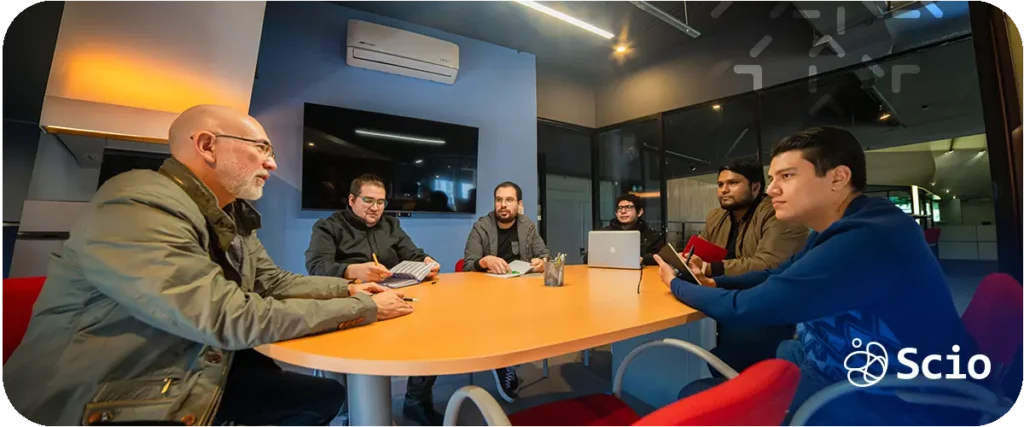
For engineering leaders in the US, one of the biggest questions when evaluating a nearshore partner is cultural alignment. Skill matters. Experience matters. But the day-to-day collaboration between distributed teams determines whether a partnership succeeds.
"We're a nearshore company with talent across Mexico and Latin America. Some Scioneers visit the office often, but many work fully remote. Our challenge is making sure no one feels like they're working alone. People want to know that what they do matters. They want to feel part of a whole." — Helena Matamoros, Head of Human Capital, Scio
A strong collaborative culture does not mean constant consensus. It means shared clarity. It means knowing who to ask for help. It means understanding how one person's work supports the goals of the team. In remote or hybrid engineering environments, this level of alignment requires deliberate effort.
5 Proven Collaboration Wins from Scio's Approach
1. Regular cross-team syncs and transparent project communication
Isolation is the enemy of distributed team performance. Regular cross-team syncs, transparent communication about project status and priorities, and shared visibility into architectural decisions create the conditions where engineers can make better local decisions without needing to escalate constantly. When the broader context is available, autonomy becomes productive rather than risky.
2. Mentorship and shared code reviews
Mentorship and peer code review are not just quality mechanisms. They are culture mechanisms. When engineers regularly review each other's code in a constructive, learning-oriented environment, they build the interpersonal familiarity and shared technical language that makes collaboration at speed possible. At Scio, this is embedded into the standard engineering process, not offered as an optional program.
3. Cultural initiatives that create shared identity
For distributed teams, a shared identity does not emerge from proximity. It must be deliberately designed through programs that connect engineers to each other and to the mission of the organization. This matters for nearshore partnerships specifically because engineers who feel connected to Scio's culture and their client's culture simultaneously deliver work that reflects both. They are not caught between two organizational identities. They inhabit both comfortably.
4. Programs that celebrate learning and continuous improvement
Scio Elevate Mentorship and internal learning programs create structured pathways for engineers to grow alongside their client engagements. When developers see a clear growth trajectory within a stable partnership, retention improves. And when retention is high, the institutional knowledge that makes senior-level delivery possible accumulates rather than resetting with every departure.
5. Team building that builds trust across time zones
Trust in distributed teams does not develop passively. It requires intentional investment in the human relationships behind the technical work. Team-building that connects engineers personally, not just professionally, creates the psychological safety that makes honest technical conversations possible. This is where engineering team culture most directly affects delivery: when engineers trust each other enough to surface risks early, propose alternatives, and take ownership of outcomes rather than just tasks.
Collaborative vs. Non-Collaborative Teams: A Direct Comparison
| Area | Collaborative Team | Non-Collaborative Team |
| Communication | Clear, frequent, and proactive | Inconsistent and reactive |
| Knowledge Sharing | Structured peer reviews and mentorship | Silos and limited visibility |
| Delivery Predictability | Stable, low-friction workflows | Frequent surprises and delays |
| Team Morale | High engagement and shared ownership | Low trust and disengagement |
| Onboarding | Accelerated through shared norms and culture | Slow and fragmented, dependent on individuals |
How Scio Builds a Culture Where Everyone Matters
The foundation of Scio's engineering team culture is intentional design. Every program, from hiring to mentorship, is built around the idea that people do better work when they feel seen, supported, and part of a community.
Helena highlights that Scio invests heavily in helping developers understand how their contributions connect to real product outcomes. This alignment creates meaning, reduces ambiguity, and strengthens a developer's sense of purpose. Engineers are not just delivering tasks. They are contributing to a shared goal with the client.
Creating a place where everyone matters requires clear expectations, consistent communication, fair opportunities for growth, recognition that values consistency over competition, mentorship that helps developers level up, and development plans that support long-term careers. Many nearshore or offshore vendors prioritize throughput. Scio prioritizes people. This is not altruistic. It is operational strategy. High-performing teams emerge when people feel supported, trusted, and connected.
"Collaboration is at the heart of everything we do. It isn't something we add on top. It's the way we hire, the way we build teams, and the way we support our clients." — Helena Matamoros, Head of Human Capital, Scio
What This Means for US Engineering Leaders
A nearshore engineering partner is not just an extension of headcount. It is an extension of culture. For US engineering leaders, the success of a nearshore team depends on how well that team understands your expectations, communicates proactively, and integrates into your workflow.
Mid-market software companies
For mid-market software companies where the engineering team's culture directly affects delivery velocity and retention, a nearshore partner's internal culture is a strategic variable, not a background detail. Partners who invest in their own engineering culture produce engineers who are better equipped to integrate into yours. The internal practices of a nearshore firm are a reliable predictor of how their engineers will behave inside your product organization.
A dedicated nearshore engineering team from a partner with a strong collaborative culture reduces the management overhead typically required to sustain quality and cohesion in distributed arrangements.
PE-backed software portfolios
For PE-backed organizations, engineering team culture risk compounds across the portfolio. Each PortCo working with a nearshore partner whose culture is misaligned with their product organization carries predictable collaboration friction, higher management burden, and increased attrition risk. Evaluating partner culture as a primary selection criterion rather than a secondary one reduces this risk systematically.
For more on how distributed team culture affects delivery outcomes, see Distributed Team Connection: 5 Proven Strategies That Work and Cultural Alignment in Software Teams: 5 Real Wins.
If you are evaluating nearshore partners and want to understand how culture specifically affects delivery reliability, our team at Scio is happy to share how we approach it.
Frequently Asked Questions
Why is collaboration essential in nearshore engineering teams?
Collaboration improves delivery predictability, strengthens communication, reduces friction, and helps distributed teams align closely with US product expectations and decision-making rhythms. Teams that have strong collaborative norms resolve blockers faster, surface risks earlier, and deliver more consistently because they are not constantly compensating for communication gaps or unclear ownership.
How does Scio maintain engineering team culture across remote and hybrid environments?
Through intentional communication practices, structured mentorship, ongoing training, and cultural programs designed to build a shared identity across teams and locations. The key is that culture at Scio is not treated as an office-dependent phenomenon. It is designed to function at a distance, with explicit rituals, structured growth programs, and leadership practices that create belonging regardless of physical location.
What makes Scio's engineering teams easier to work with than typical nearshore vendors?
A culture built on clarity, shared expectations, continuous learning, and genuine collaboration allows developers to integrate smoothly into US engineering workflows as true team members rather than external contractors. Engineers who feel valued and connected to a shared mission communicate more proactively, handle feedback more constructively, and take greater ownership of outcomes than those who feel like temporary placements.
How does Scio support developer growth through Scio Elevate?
Through mentorship, workshops, technical training, and individualized development plans that support long-term career growth within stable client partnerships. Scio Elevate connects engineers with experienced mentors who help them develop both technical depth and the communication and collaboration skills that senior-level performance requires. The program is designed to compound over time, building the institutional capability that makes long-term nearshore partnerships more valuable than transactional ones.
How does a strong engineering team culture reduce attrition in nearshore partnerships?
Engineers stay in environments where they feel supported, valued, and connected to a shared mission. A strong collaborative culture provides meaningful growth opportunities, genuine peer connection, and a sense that individual contributions matter to the broader product outcome. When engineers experience this in a nearshore environment, they are significantly more likely to remain with client engagements long enough to develop the institutional knowledge and product familiarity that makes senior-level delivery possible.
Culture Is the Foundation, Not the Bonus
For engineering leaders evaluating nearshore partners, the cultural backbone of a partner organization is often what separates successful long-term partnerships from transactional staffing relationships. A strong engineering team culture compounds. It reduces risk. It improves predictability. It elevates product quality. And it creates a partnership that grows with you.
When engineers feel seen and aligned, collaboration becomes a competitive advantage. That is the difference between hiring individuals and partnering with a unified team.
If you want to understand how Scio's culture translates into delivery reliability for your specific engineering context, our team is happy to show you.
References and Further Reading
- Harvard Business Review, Engineering Culture and Team Performance — Research on how organizational culture, psychological safety, and shared norms affect engineering team productivity and long-term delivery quality. hbr.org
- Gallup, "State of the Global Workplace Report" — Annual data on employee engagement, team belonging, and the organizational conditions that produce high-performing distributed engineering teams. gallup.com
- DORA (DevOps Research and Assessment), "State of DevOps Report" — Research confirming that generative culture, psychological safety, and collaborative working norms are among the strongest predictors of high software delivery performance. dora.dev
- Google re:Work, Team Effectiveness and Culture Research — Research identifying psychological safety, dependability, structure and clarity, meaning, and impact as the five key factors in high-performing team culture. rework.withgoogle.com
- SHRM, Workplace Culture and Retention Research — Data on how organizational culture, growth opportunities, and team belonging affect retention and long-term performance in engineering organizations. shrm.org
- MIT Sloan Management Review, Nearshore Team Alignment and Culture — Research on how cultural alignment in distributed engineering teams affects delivery predictability and long-term organizational performance. sloanreview.mit.edu
- Scio blog, "Distributed Team Connection: 5 Proven Strategies That Work" — How intentional culture design reduces ghost colleague dynamics and builds genuine professional connection in distributed and nearshore engineering teams. sciodev.com
- Scio blog, "Emotional Intelligence in Software Engineering: 5 Real Wins" — How emotional intelligence and interpersonal awareness shape engineering team culture and the quality of collaboration in distributed environments. sciodev.com