

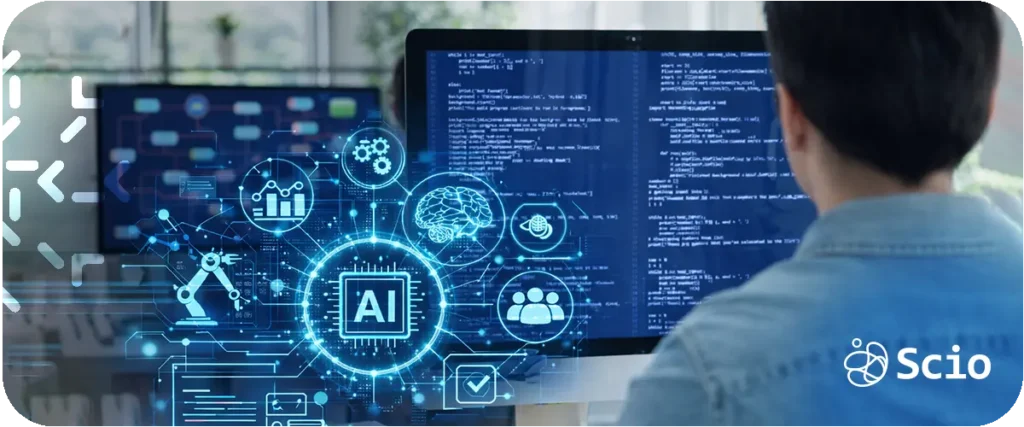
he idea that AI turns every developer into a productivity machine has spread fast. Scroll through any engineering forum and you will see promises of impossible acceleration: teams coding at ten times the speed, tools that eliminate entire steps of software development. Anyone leading an engineering team knows the truth is less spectacular and far more interesting. AI does not transform a developer into something they are not. It is an AI force multiplier, and what it multiplies depends entirely on what was already there.
AI helps good developers because they already understand context, reasoning, and tradeoffs. When they get syntax or boilerplate generated for them, they evaluate it, fix what is off, and reintegrate it confidently. For developers who struggle with fundamentals, AI becomes something else entirely. Someone who already fought to complete tasks or debug nuanced issues will not magically improve because an AI tool writes 200 lines for them. They simply ship those lines with even less understanding than before.
TABLE OF CONTENTS
What AI Actually Does Well, and Why It Matters
To understand why AI is a force multiplier and not a miracle accelerator, start with a grounded view of what AI actually does reliably today. AI is strong in the mechanical layers of development: syntax generation, repetitive scaffolding, small refactors, documentation drafts, predictable test patterns, and translating code between languages or frameworks.
Think about any task that requires typing more than thinking. Writing tests that follow a known structure, generating interfaces from JSON, migrating code across language versions, producing repetitive CRUD endpoints. AI is great at anything predictable, because predictability is pattern recognition, which is the foundation of how large language models operate. But AI does not generate understanding. It does not evaluate tradeoffs, align a solution with internal architecture, anticipate edge cases, or know which modules require extra care because of legacy constraints. The Stanford HAI AI Index Report reinforces this: AI delivers its strongest gains in repetitive or well-structured tasks, with little improvement in areas requiring deep reasoning or architectural judgment.
Why Good Developers Become More Efficient, Not Superhuman
There is a misconception that AI-assisted coding creates super developers. The real gain is in cognitive clarity, not raw speed. Great engineers have something AI cannot touch: a mental model of the system. They grasp how features behave under pressure, where hidden dependencies sit, and how each module fits into the larger purpose of the product. When they use AI, they let it handle scaffolding while they focus on reasoning, edge cases, and architecture.
This is why AI becomes a quiet amplifier for strong engineers. Tasks that used to drag momentum, generating mocks, rewriting test data, formatting documentation, no longer interrupt flow. Engineers stay focused on design decisions and quality. This increase in focus improves the whole team because fewer interruptions lead to tighter communication loops, and senior engineers get more bandwidth to support juniors. The effect looks like dramatically higher productivity on the surface, not because developers write more code, but because they make more meaningful progress.
Why Weak Developers Become a Risk When AI Enters the Workflow
AI does not fix weak fundamentals. It exposes them. When a developer lacks context, ownership, or architectural sense, AI does not fill the gaps. It widens them. The patterns leaders see when weak developers start using AI are consistent: bigger pull requests filled with inconsistencies, reliance on AI-generated logic they cannot explain, review load that grows dramatically as a senior who reviewed 200 lines now receives 800-line AI-assisted PRs, and a tendency to skip tests because AI makes generating code without them so easy.
AI does not make these developers worse. It makes the consequences of weak fundamentals impossible to ignore. This is why leaders need to rethink how juniors grow. Instead of relying blindly on AI, teams need pairing, explicit standards, review discipline, and coaching that reinforces understanding rather than shortcuts. The danger is not AI itself. The danger is AI used as a crutch by people who have not built the fundamentals yet.
How AI Affects Different Developer Types: A Comparison
| Developer Type | Impact with AI | Risks | Real Outcome |
| Senior with strong judgment | Uses AI to speed up repetitive work | Minimal friction, minor adjustments | More clarity, better focus, steady progress |
| Solid mid-level | Uses AI but reviews everything | Early overconfidence possible | Levels up faster with proper guidance |
| Disciplined junior | Learns through AI output | Risk of copying without understanding | Improves when paired with a mentor |
| Junior with weak fundamentals | Produces more without understanding | Regressions, noise, inconsistent code | Risk for the team, heavier review load |
The Organizational Impact Leaders Tend to Underestimate
The biggest surprise for engineering leaders is not the productivity shift. It is the behavioral shift. When AI tools enter a codebase, patterns in collaboration, review habits, and team alignment shift too, and many organizations underestimate these ripple effects.
Review load grows because AI-generated PRs tend to be larger even for simple tasks. Inconsistency increases because AI follows patterns it learned from the internet, not from your organization's architecture. QA feels pressure as teams produce more code faster, and onboarding gets harder because new hires join a codebase that does not reflect a unified voice. This entire ripple effect leads to a simple conclusion: AI changes productivity shape, not just productivity speed. You get more code, more noise, and more need for discipline.
How Teams Can Use AI Without Increasing Chaos
AI can help teams, but only when leaders set clear boundaries and expectations. Start with review guidelines: enforce small PRs, require explanations for AI-generated code, and ask developers to summarize intent and assumptions. Define patterns that AI must follow: naming conventions, folder structure, architectural rules, and testing patterns fed back into the prompts developers use daily.
Consider limiting AI for certain tasks. Allow AI to write tests, but require humans to design test cases. Allow AI to scaffold modules, but require developers to justify logic choices. At the organizational level, monitor patterns instead of individual mistakes. Are PRs getting larger? Is review load increasing? Are juniors progressing or plateauing? Context, correctness, and reasoning matter more than line count.
- I know who on my team uses AI effectively versus who relies on it too heavily
- Pull requests remain small and focused, not inflated with AI-generated noise
- AI is not creating technical debt faster than we can manage it
- Developers can explain what AI-generated code does and why
- Juniors are learning fundamentals, not skipping straight to output
What This Means for Engineering Leaders
Mid-market software companies
For mid-market software companies the AI force multiplier effect is most dangerous when adopted without review discipline already in place. Teams that rush AI adoption to compensate for limited headcount often discover the review load problem only after several sprints of inflated, inconsistent pull requests have already shipped to production.
Scio's dedicated nearshore engineering teams bring the senior judgment and review discipline that make AI adoption additive rather than risky, integrating directly into your existing standards rather than introducing a parallel set of practices.
PE-backed software portfolios
For PE-backed software portfolios inconsistent AI governance across PortCos creates technical debt that is harder to quantify than traditional debt because it accumulates through volume rather than obvious shortcuts. Standardizing AI usage guidelines and review discipline across the portfolio protects the platform value that AI adoption was supposed to accelerate, not erode.
If you want to discuss how to introduce AI tooling into your engineering team without losing the discipline that makes it valuable, our team at Scio would be glad to talk.
Frequently Asked Questions
Does AI make engineering teams faster automatically?
AI speeds up repetitive tasks like boilerplate generation and test scaffolding. Overall speed only improves meaningfully when developers already possess the system knowledge to guide and validate the AI's output, because AI accelerates execution without providing the judgment that prevents new bugs from entering the codebase.
Can junior developers rely on AI to learn faster?
AI can help juniors practice and see suggestions, but without strong fundamentals and senior guidance, they risk learning incorrect patterns or producing code they cannot explain. The risk is not that AI teaches bad habits directly. It is that AI removes the friction that used to force juniors to understand what they were writing.
How can leaders prevent AI from increasing chaos in a codebase?
By enforcing clear pull request size limits, maintaining rigorous code review discipline, defining architectural standards explicitly, and providing structured coaching for junior developers. These human processes are what keep AI-generated output manageable and aligned with the codebase's existing patterns rather than introducing new ones.
Does AI reduce the need for senior engineers?
No, it increases their importance. Senior engineers become more critical because they are responsible for guiding reasoning, shaping architecture, and maintaining the consistency that AI cannot enforce or comprehend on its own. Teams that reduce senior headcount while increasing AI adoption typically see review quality degrade rather than improve.
What is the single biggest risk of treating AI as a force multiplier without governance?
Review load growing faster than review capacity. AI-generated pull requests tend to be larger even for simple tasks, and without explicit limits on PR size and a requirement that developers explain their AI-assisted code, senior engineers end up reviewing volume rather than reasoning. That shift quietly erodes the quality bar a codebase depends on.
AI Does Not Change the Talent Equation, It Clarifies It
AI did not rewrite the rules of engineering. It made the existing rules impossible to ignore. Good developers get more room to focus on meaningful work. Weak developers now generate noise faster than they generate clarity. Leaders are left with a much sharper picture of who understands the system and who is simply navigating it from the surface.
AI force multiplier effects are real, but the question worth asking is what AI is multiplying in your specific team. If you want to talk through how to introduce AI tooling without losing the fundamentals that make it valuable, our team at Scio would be glad to discuss it.
References and Further Reading
- Stanford HAI, AI Index Report. Annual research tracking AI capability and adoption trends, including the finding that AI delivers its strongest gains in repetitive tasks with limited improvement in deep reasoning or architectural judgment. https://aiindex.stanford.edu/
- McKinsey and Company, Generative AI and Developer Productivity Research. Analysis of how generative AI tools affect software developer productivity, including the conditions under which gains are realized versus where output increases without quality improvement. https://www.mckinsey.com/
- GitHub, Octoverse and AI Developer Survey. Research on how developers actually use AI coding assistants in practice, including adoption patterns and the review behaviors that distinguish effective from risky usage. https://octoverse.github.com/
- DORA Research Program, State of DevOps Report. Research on how AI adoption interacts with existing engineering practices, including the finding that AI amplifies the underlying quality of an organization's development practices rather than replacing them. https://dora.dev/publications/
- IEEE, Software Engineering and AI-Assisted Development Standards. Technical research on the architectural and review practices needed to safely integrate AI-generated code into production systems. https://www.ieee.org/
- ACM, Code Review and AI-Generated Code Research. Academic research on how code review practices need to adapt when a growing share of code originates from AI assistance rather than direct human authorship. https://www.acm.org/
- Scio blog, AI Adoption for Engineering Teams: 5 Proven Practices. Complementary guidance on how engineering teams successfully integrate AI tooling while maintaining delivery quality and review discipline. https://sciodev.com/blog/ai-adoption-for-engineering-teams/
- Scio blog, Managing AI in Engineering Teams: How Leaders Balance Speed, Talent, and Risk. Direct extension of the governance themes in this article, focused on the leadership decisions that determine whether AI adoption helps or hurts a team. https://sciodev.com/blog/ai-driven-change-management/