
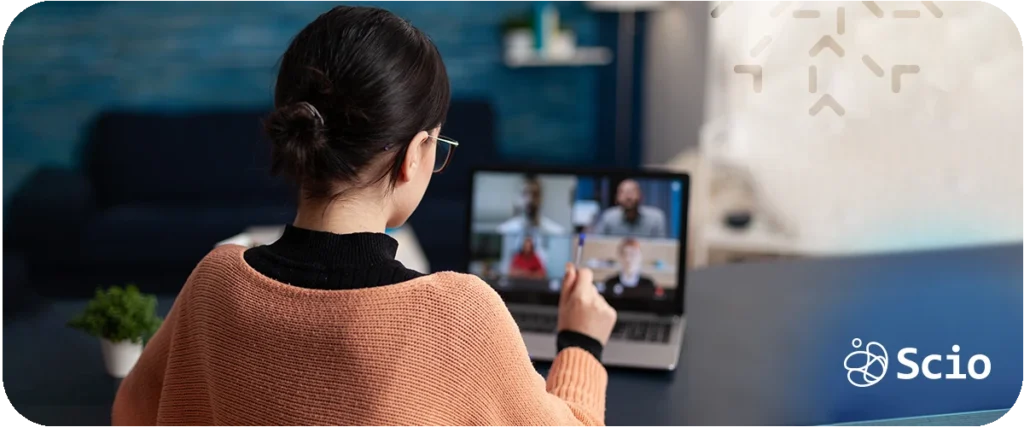
In my role overseeing human capital within the software sector, I have learned that trust is not built in a single meeting or through a well-written policy. It is built in the everyday interactions that happen across screens. In a nearshore model, where collaboration spans borders and time zones, trust becomes the invisible infrastructure that keeps projects moving and teams aligned.
At Scio, we have spent over 20 years creating distributed software teams for U.S. companies, and one truth stands out: culture and trust are inseparable. When culture is intentional, trust flows naturally, even when your team is hundreds of miles apart.
TABLE OF CONTENTS
Why Trust Matters in Nearshore Collaboration
Nearshore development offers clear advantages: similar time zones, cultural proximity, and strong technical talent. But these benefits only pay off when teams feel safe to communicate openly, share ideas, and take ownership without fear of micromanagement. Without it, even the best code cannot save a project.
Common challenges when trust is missing: misunderstandings due to different communication styles, delays caused by unclear expectations, and low morale and disengagement in remote settings. These are not engineering problems. They are cultural ones, and they respond to cultural solutions.
5 Practices That Build Distributed Team Trust
1. Make culture a system, not a perk
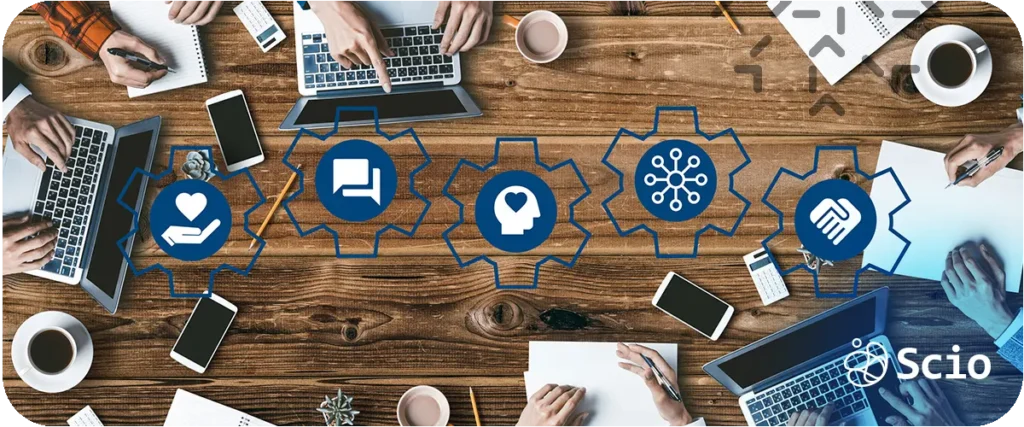
Trust does not come from virtual happy hours alone. It comes from consistent rituals and shared values. Daily stand-ups that prioritize transparency and psychological safety. Retrospectives that check in on people, not just metrics. Peer recognition that celebrates collaboration and effort. When rituals are consistent and predictable, people begin to invest in them rather than treat them as overhead.
2. Communicate beyond tools
Slack and Zoom are useful, but they cannot replace clarity. Document decisions so they survive across time zones. Use empathetic language, noting that what feels neutral in one culture may sound abrupt in another. Encourage questions before assumptions. The goal is to make the informal knowledge that would exist naturally in a co-located team explicit and accessible to a distributed one.
3. Prioritize soft skills alongside technical ones
Technical skills deliver features. Soft skills deliver trust. Encourage empathy by understanding the context behind every message. Build adaptability into how the team responds to shifting priorities. Reinforce accountability as ownership of results, not just hours online. These are not character traits you hire for once and forget. They are practices you build into the team's daily rhythms.
4. Create intentional spaces for human connection
Isolation erodes trust. Build intentional moments for human connection: virtual coffee breaks or social channels, monthly check-ins focused on wellbeing, and open forums for feedback and ideas. Connection is not a distraction from the work. It is the foundation that makes difficult conversations and honest feedback possible when the work demands them.
5. Align on values from the first day
From onboarding onward, reinforce the values that define how the team operates together: collaboration, meaning solving problems together rather than in silos; curiosity, meaning asking what if and exploring better ways to work; and ownership, meaning taking responsibility for results, not just tasks. Values that are named explicitly and modeled by leadership become the standard everyone can reference when a situation is ambiguous.
Common Challenges When Trust Is Missing
The challenges that emerge from trust deficits in distributed software teams are consistent and recognizable. They are worth naming precisely because they are often misattributed to technical or process problems when the root cause is cultural.
- Misunderstood feedback. A comment that would be received as constructive in one cultural context lands as criticism in another. When engineers are uncertain how feedback will land, they stop giving it, and quality gaps that could have been caught early accumulate silently.
- Delayed escalation. When trust is low, engineers wait too long to surface problems. A blocker that could be resolved in a conversation becomes a sprint disruption because the engineer was not certain it was safe to escalate.
- Parallel interpretations of requirements. Without a shared foundation of trust and direct communication, team members fill in ambiguous requirements based on their own assumptions rather than checking with each other. The divergence only becomes visible at review.
- Disengagement in ceremonies. Stand-ups and retrospectives become performative when trust is absent. Engineers report status rather than surface real concerns, and the ceremonies lose their diagnostic value entirely.
Practical Recommendations for Software Companies
Building this foundation requires deliberate investment at the organizational level, not just at the team level.
- Audit your communication norms. Ask whether they are clear and culturally sensitive, and whether they create equal safety for every team member to raise concerns.
- Invest in onboarding. Make cultural alignment part of the process from day one, not something that gets addressed reactively when friction surfaces.
- Measure trust indicators. Engagement surveys, direct feedback loops, and retention rates all serve as early warning signals for trust deficits before they become delivery problems.
- Lead by example. Managers who model transparency and empathy set the standard more effectively than any policy document.
What This Means for Engineering Leaders
Mid-market software companies
For building or extending a nearshore engineering team, trust is the factor most likely to determine whether the engagement delivers or disappoints, and yet it is the factor least likely to appear in a vendor evaluation checklist. Leaders who invest in trust-building practices from the first sprint, rather than waiting for friction to signal a problem, get measurably better delivery outcomes and significantly lower turnover in their extended team.mid-market software companies
Scio's dedicated nearshore engineering teams are built around the trust practices in this article as operating principles, not aspirational values.
PE-backed software portfolios
For PE-backed software portfolios trust deficits in engineering teams aggregate across PortCos as execution risk. Post-acquisition engineering integration in particular depends on the ability to build trust quickly between teams that did not choose to work together. Operating partners who invest in cultural alignment alongside technical integration accelerate the delivery stability that the value creation plan depends on.
If you want to discuss how Scio builds trust practices into distributed engineering partnerships from day one, our team would be glad to talk.
Frequently Asked Questions
Why is trust the invisible infrastructure of distributed software teams?
Because every high-stakes moment in software delivery depends on trust to function: a developer escalating a blocker before it derails a sprint, a tech lead giving honest feedback on an architectural decision, a team member asking a question instead of assuming. When trust is absent, each of those moments defaults to silence or avoidance, and the cost accumulates as missed signals, delayed escalation, and quality gaps that surface later when they are harder and more expensive to address.
What is the single most important trust-building practice for nearshore teams?
Consistency in the rituals that create safety. Stand-ups, retrospectives, and check-ins build trust not through any single conversation but through the reliable expectation that there will be another one. When engineers know that a space for honest communication exists and happens predictably, they invest in it. When rituals are inconsistent or feel performative, engineers disengage, and the diagnostic value of those ceremonies disappears precisely when the team needs it most.
How does cultural alignment affect distributed team trust?
Significantly. Cultural differences in how feedback is given, how hierarchy affects communication, and how disagreement is expressed all affect whether engineers feel safe to surface concerns directly. Teams with strong cultural alignment, particularly nearshore teams with close business culture proximity to their U.S. counterparts, require less explicit trust-building infrastructure to function well because the communication defaults are closer to begin with. This is one of the structural advantages nearshore collaboration offers over offshore alternatives.
How do you measure trust in a distributed engineering team?
Through a combination of behavioral signals and survey data. Behavioral signals include how quickly engineers escalate blockers, how often concerns are raised in retrospectives versus privately, and how directly feedback flows between team members. Survey data from regular pulse checks provides the quantitative layer. Retention rates are also a reliable lagging indicator: distributed teams with strong trust retain members significantly longer because engineers who feel seen and supported have less reason to leave.
What role do soft skills play in building distributed team trust?
A central one. Technical skills determine what a team can build. Soft skills determine whether the team can build it together. Empathy, adaptability, and ownership are not personality traits that exist or do not. They are practices that can be built into team rituals, reinforced through leadership modeling, and developed through structured coaching. Organizations that treat soft skills as the domain of HR rather than engineering leadership consistently underinvest in them, and consistently wonder why their distributed teams underperform.
Trust Across Screens Is Your Competitive Advantage
Building trust across screens is not about adding more meetings. It is about creating a culture where people feel safe, connected, and empowered to deliver their best work. In nearshore partnerships, that culture is the competitive advantage that separates a vendor relationship from a genuine engineering partnership.
At Scio, these are the habits that help us keep our teams engaged, balanced, and performing at their best without sacrificing the human side of the work. Because software gets better when people feel better, and great engineering comes from people who are supported, not just managed. If you want to explore what that looks like in practice, our team would be glad to talk.
References and Further Reading
- Google re:Work, Project Aristotle Team Effectiveness Research. Research identifying psychological safety as the top predictor of team effectiveness, directly relevant to this article's argument that trust is the foundation every other collaboration practice depends on. https://rework.withgoogle.com/
- Gallup, Employee Engagement and Team Performance Research. Annual research on how engagement, measured through trust indicators like safety to raise concerns and sense of belonging, affects team performance and retention. https://www.gallup.com/
- Hofstede Insights, Cultural Dimensions Research. Foundational framework for understanding how cultural differences in communication directness and hierarchy affect collaboration norms in distributed teams. https://www.hofstede-insights.com/
- Harvard Business Review, Psychological Safety and Team Performance. Research establishing the connection between psychological safety, the ability to speak up without fear of negative consequences, and team performance across distributed and co-located contexts. https://hbr.org/
- MIT Sloan Management Review, Organizational Culture and Remote Team Effectiveness. Research on how intentional culture-building practices affect the performance of distributed teams, supporting the five practices described in this article. https://sloanreview.mit.edu/
- Scio blog, Cross-Cultural Communication: How 3 Cultures Handle No. Complementary analysis of how cultural differences in communication style affect feedback and disagreement in distributed software teams. https://sciodev.com/blog/cross-cultural-communication-software-teams/
- Scio blog, Conflict Debt in Teams: 5 Signs Leaders Often Miss. How the absence of trust creates the conditions where conflict accumulates silently, connecting directly to the diagnostic practices described in this article. https://sciodev.com/blog/conflict-debt-in-teams/