


Modernization decisions are strongest when engineering leaders match the method to the business risk, system condition, delivery pressure, and capacity available to execute safely. The right modernization approach is not one method because legacy systems do not constrain the business in one way. Some systems need stabilization before they can be changed safely. Some need selective refactoring. Others need replatforming, modularization, API encapsulation, component replacement, or, in more limited cases, a full rewrite.
For CTOs and VP Engineering leaders, the challenge is not simply choosing a more modern technology stack. It is deciding which approach reduces the right risk without putting current delivery commitments at risk.
TABLE OF CONTENTS
Why Modernization Decisions Need a Framework
Technical debt and legacy systems are rarely solved by one universal approach. McKinsey has estimated that companies often pay an additional 10 to 20 percent on top of project costs to address technical debt, and that 30 percent of CIOs surveyed said more than 20 percent of the technical budget intended for new products is diverted to technical debt issues. The practical question for engineering leaders is not which technology is best in the abstract. It is which modernization method fits the problem they actually have.
What Problem Are Engineering Leaders Really Trying to Solve?
Most modernization conversations begin with visible symptoms. Roadmap commitments slip. Releases become fragile. Regression testing takes too long. Senior engineers spend too much time supporting old functionality. Small changes require too many people to coordinate. Business stakeholders begin to lose confidence in delivery dates.
The underlying issue is not always old technology. A legacy system may still run valuable workflows and contain years of business logic. The real problem is that the system has become harder, slower, riskier, or more expensive to change.
Modernization should not begin with the question "What should we move to?" It should begin with a more useful question: what business constraint is this system creating? That constraint may be roadmap drag, production instability, high support burden, poor integration, infrastructure cost, security exposure, or key-person dependency. Each constraint points to a different response.
Technical Debt, Legacy Systems, and Modernization: Definitions
Technical debt is the accumulated cost of past technical decisions that now make a system harder to maintain, change, test, secure, or scale. Not all technical debt is irresponsible. Some debt comes from reasonable tradeoffs made to meet a customer commitment, launch a product, or respond to urgent business needs. Debt becomes a serious issue when it consistently affects business outcomes.
A legacy system is a software system that remains important to the business but has become difficult to change, support, integrate, or operate using current practices. Legacy does not always mean obsolete. Many legacy systems are valuable precisely because they reflect how the business actually works.
Legacy system modernization is the process of improving a system's ability to support current and future business needs. It may involve code, architecture, infrastructure, testing, deployment, data, security, support processes, or team ownership. Modernization is broader than cloud migration, refactoring, or rewriting.
Why This Matters Operationally and Financially
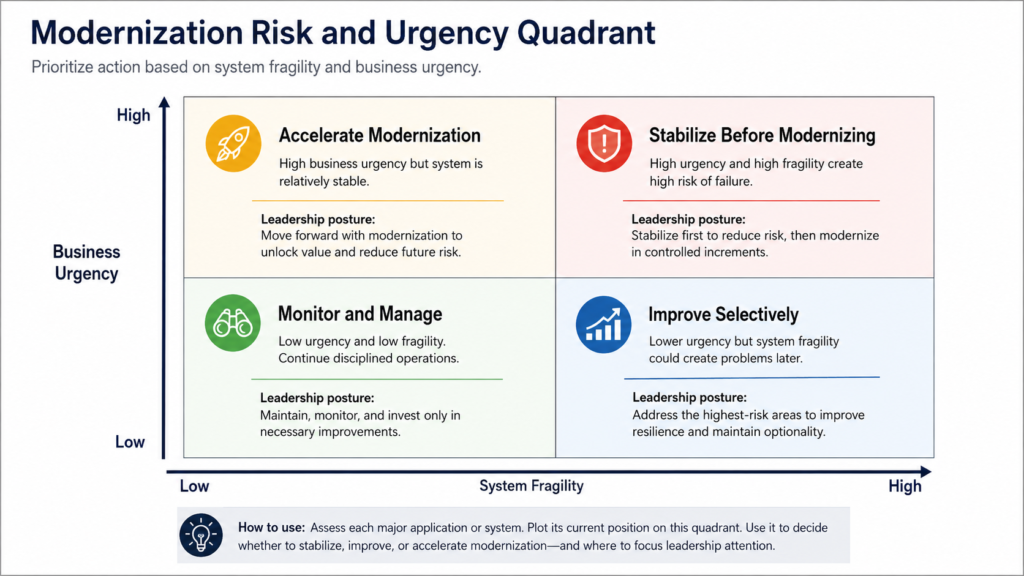
Technical debt changes the economics of engineering. A team may still be busy, but a larger share of its capacity goes into support, bug fixing, coordination, release cleanup, and working around brittle areas of the system. This shows up operationally as slower delivery cycles, less predictable roadmap execution, more production incidents, longer regression cycles, and higher dependency on a few senior engineers.
Financially, it means more engineering spend goes into maintaining the past instead of creating new value. The urgency of modernization varies by organization type:
| Urgency Level | System Fragility | Recommended Posture |
| Low urgency | Low fragility | Monitor and manage: track debt accumulation, no immediate action |
| Low urgency | High fragility | Improve selectively: address highest-risk areas before they become urgent |
| High urgency | Low fragility | Accelerate modernization: move quickly while the system is still stable |
| High urgency | High fragility | Stabilize before modernizing: fragility makes big changes too risky |
For independent mid-market software companies, technical debt often becomes a roadmap tax. For PE-backed software portfolios, platform risk can affect value creation plans, diligence readiness, and engineering leverage. For businesses running on proprietary software, brittle systems can threaten operational continuity, customer experience, and strategic initiatives.
The important point is that modernization is not only a technical improvement effort. It is a business decision about risk, capacity, cost, and timing.
The Most Common Root Causes
Many modernization problems start with short-term decisions that became permanent. A team ships a workaround to meet a deadline. A temporary integration becomes part of the core workflow. A manual release process keeps working, so no one fixes it. Over time, these choices compound.
Another common root cause is that the system grew beyond its original design. The product expanded, the business model changed, more integrations were added, and more teams began contributing. The architecture did not evolve at the same pace. Weak test coverage is a frequent constraint: if the team cannot confidently tell whether a change broke something, every release becomes more stressful, manual QA becomes the safety net, and engineers avoid changing risky parts of the system.
Maintenance burden then makes the problem worse. The same people responsible for roadmap delivery are pulled into support, incidents, and urgent fixes. Modernization work starts, stops, and loses momentum. Finally, organizations often choose a modernization method before diagnosing the real problem. Moving to the cloud may not fix code complexity. Breaking into microservices may create operational burden. Rewriting may recreate the same complexity in a new stack.
How to Compare Modernization Approaches: 5 Diagnostic Questions
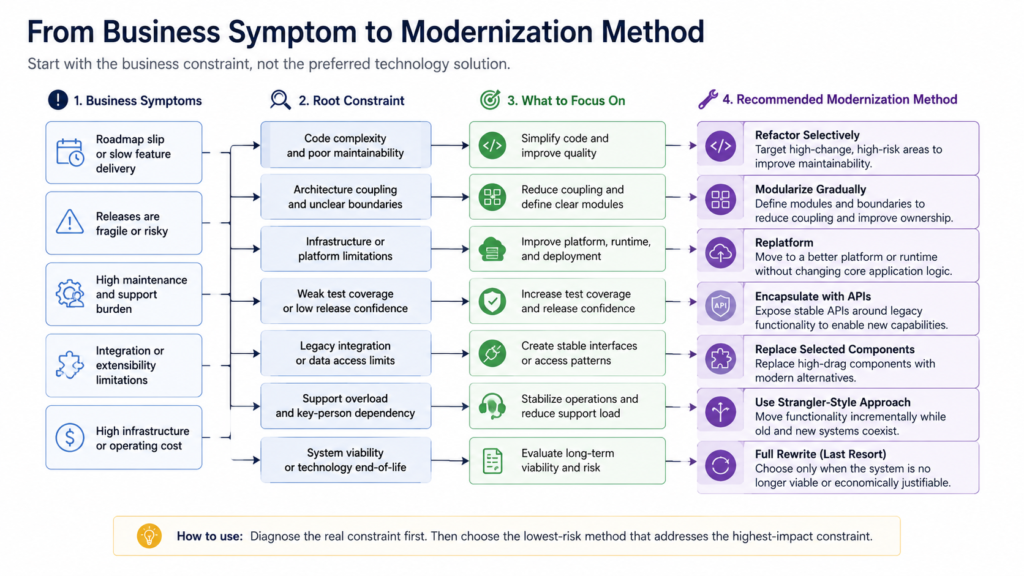
A practical modernization decision starts with five questions.
- What business outcome are we trying to protect or improve? The answer may be roadmap delivery, release reliability, operating cost, scalability, security, continuity, or customer experience.
- How fragile is the current system? A system with poor documentation, weak test coverage, frequent incidents, and unclear dependencies may need stabilization before deeper changes begin.
- Where is the real constraint? It may sit in the codebase, architecture, infrastructure, data model, integrations, test coverage, deployment process, team capacity, or ownership model.
- How much disruption can the business tolerate? A company with customer commitments, regulatory deadlines, or seasonal operating constraints may need a lower-risk modernization path.
- What capacity is available to execute? If the internal team is already consumed by roadmap delivery and support, modernization will likely require dedicated capacity or help from a partner that can integrate into the existing delivery model.
8 Modernization Methods and When to Use Each
1. Stabilize first
Stabilization is the right starting point when the system is too fragile to change safely. This may involve monitoring, incident cleanup, documentation, support process improvements, basic test coverage, environment stabilization, and ownership clarification.
Main benefit: Creates enough operational control to make future modernization safer.
Main risk: The organization may stay in support mode and never move into actual modernization.
2. Refactor selectively
Selective refactoring fits when specific parts of the codebase slow delivery or create recurring defects, but the overall architecture is still viable. The goal is not to clean up everything. It is to improve high-change, high-risk areas that affect delivery or reliability.
Main benefit: Improves maintainability without changing external behavior.
Main risk: Can become unfocused cleanup if disconnected from business value.
3. Replatform
Replatforming is useful when infrastructure, runtime, hosting, or deployment constraints are the main problem. Microsoft's Azure migration guidance describes multiple workload strategies including rehost, replatform, refactor, rearchitect, rebuild, replace, retire, and retain. The practical lesson is not the exact number of categories. It is that each workload should be evaluated based on its business driver, risk profile, and technical constraints.
Main benefit: Improves the operating environment without fully redesigning the system.
Main risk: May leave deeper architecture and code problems untouched.
4. Modularize gradually
Gradual modularization fits when the system is too tightly coupled. Teams cannot work independently, ownership is unclear, and small changes create unexpected effects elsewhere.
Main benefit: Makes change safer and more manageable over time.
Main risk: Can become over-architected if the team pursues structural purity rather than practical delivery improvement.
5. Encapsulate legacy functionality with APIs
API encapsulation works when a legacy system still performs valuable business functions but is hard to integrate or extend. Instead of replacing the system immediately, teams create controlled access points around key data or workflows.
Main benefit: New capabilities can move forward while the older system remains operational.
Main risk: Can add another layer that hides complexity without reducing it.
6. Replace selected components
Component replacement fits when a bounded subsystem is too expensive, risky, or difficult to maintain. Examples include replacing a billing module, reporting engine, integration layer, or unsupported dependency.
Main benefit: Removes a high-drag area without rewriting the full system.
Main risk: The team may discover that the component was not as isolated as expected.
7. Use a strangler-style modernization path
A strangler-style approach gradually moves functionality out of a legacy system while the business keeps running. Microsoft describes the Strangler Fig pattern as an incremental migration approach where specific pieces of legacy functionality are gradually replaced by new applications and services, allowing the old system to be decommissioned over time.
Main benefit: Reduces the risk of a large-scale replacement.
Main risk: Old and new systems may coexist for some time, creating data, routing, operations, and ownership complexity.
8. Full rewrite
A full rewrite may be justified when the current system is no longer economically or technically viable, the business model has changed materially, or incremental modernization would cost more than replacement. A rewrite should be treated as a business investment with explicit risk acceptance, not the default modernization strategy.
Main benefit: Can create a cleaner future-state foundation.
Main risk: High cost, long timelines, parallel-system complexity, and the possibility of rebuilding old business logic poorly.
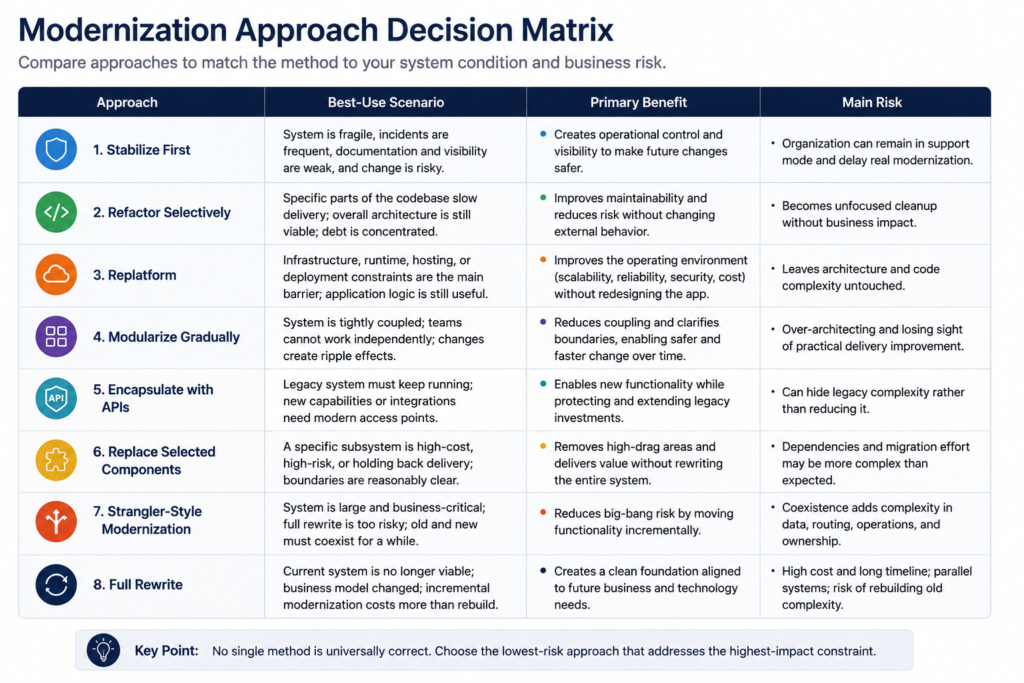
The 8-Method Decision Matrix
| Method | Best-Use Scenario | Primary Benefit | Main Risk |
| Stabilize first | System too fragile to change safely | Creates operational control before modernization | Organization stays in support mode permanently |
| Refactor selectively | Specific areas slow delivery, architecture viable | Improves maintainability, no behavior change | Becomes unfocused cleanup disconnected from value |
| Replatform | Infrastructure or deployment is the main constraint | Improves operating environment without redesign | Leaves architecture and code problems untouched |
| Modularize gradually | System too tightly coupled for parallel delivery | Makes change safer over time | Over-engineering in pursuit of structural purity |
| Encapsulate with APIs | Legacy does valuable work but cannot be extended | New capability moves forward, old system runs | Adds a layer that hides complexity without reducing it |
| Replace components | Bounded subsystem creates disproportionate drag | Removes high-drag area without full rewrite | Component less isolated than expected |
| Strangler-style | Cannot safely replace all at once | Reduces large-scale replacement risk | Old and new coexist; data and routing complexity |
| Full rewrite | System no longer economically viable | Clean future-state foundation | High cost, long timeline, business logic risk |
How This Works in Practice: 3 Scenarios
Scenario 1: Independent software company with roadmap slip and fragile releases
A mid-market SaaS company has a mature product, but roadmap items keep slipping because changes in a legacy module create regressions. QA is slow because automated coverage is thin, and senior engineers spend too much time reviewing risky changes.
The right approach is unlikely to be a full rewrite. The system still works. The better path is to stabilize the release process, add targeted test coverage, refactor the high-change module selectively, and modularize only the areas tied to roadmap friction.
Scenario 2: PE-backed PortCo with modernization pressure and maintenance drag
A PE-backed B2B software company has a product that supports the value creation plan, but its platform is aging. The engineering team is still delivering customer commitments, but every release requires extra regression testing because several core workflows depend on legacy modules with limited automated coverage. The PortCo CTO has been asked to improve delivery predictability without adding a large permanent team. The Operating Partner is concerned that support burden and platform fragility will surface during future diligence.
The right approach is not to move everything to the cloud or start a rewrite. A more practical path: assess the highest-risk modules against roadmap impact and support volume; separate recurring support work from modernization execution; stabilize release and regression practices around the most fragile workflows; replace one or two bounded components that create disproportionate drag; use a strangler-style approach where functionality cannot be replaced safely all at once. This keeps the modernization effort tied to delivery pressure, diligence readiness, capacity constraints, and the need to protect the value creation plan.
Scenario 3: Proprietary-software business with a critical legacy operating system
A business runs core operations on custom software built around its workflows. The system is old but deeply embedded in daily operations. Leaders want new digital capabilities, but the legacy system is hard to integrate.
A full replacement may create too much operational risk. A more practical path: stabilize and document the current system, encapsulate key legacy functions with APIs, build new workflows around the existing core, and gradually replace selected components over time.
What Risks and Constraints Leaders Should Watch
- Treating modernization as a technology project only. Business stakeholders need to understand tradeoffs. Product leaders need to help sequence priorities. Finance may need a business case.
- Modernizing without enough test coverage. If teams cannot detect regressions, technical improvement can temporarily increase release risk.
- Choosing a method that solves the wrong problem. Replatforming does not fix poor architecture. Refactoring does not reduce infrastructure cost. APIs do not eliminate legacy complexity. Rewriting does not guarantee that business logic will be preserved.
- Underestimating coexistence. Incremental modernization often means old and new systems run together. That requires clear ownership, data strategy, monitoring, and support procedures.
- Running modernization with no dedicated capacity. If the same team owns roadmap delivery, support, incidents, and modernization, strategic work will lose to urgent work.
Common Pitfalls to Avoid
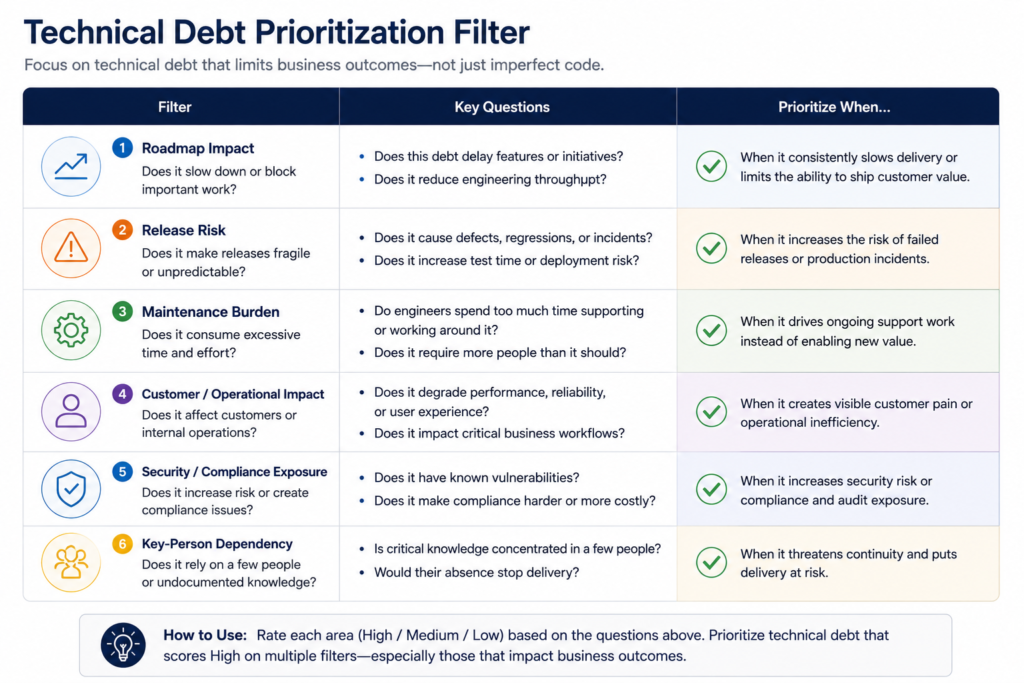
The most consistent mistakes in software modernization programs are predictable and preventable.
The first pitfall is calling everything technical debt. Leaders should distinguish between annoying debt, risky debt, and business-limiting debt. Debt deserves priority when it affects business outcomes, not simply because the code is imperfect. A useful prioritization filter applies six criteria: roadmap impact, release risk, maintenance burden, customer or operational impact, security or compliance exposure, and key-person dependency.
The second is choosing the method before diagnosing the constraint. A technical and business impact assessment should come first.
The third is treating modernization as separate from roadmap planning. Modernization work must be sequenced alongside product commitments, not hidden in the background.
The fourth is letting maintenance consume modernization capacity. If the same people own every urgent issue and every strategic improvement, the urgent work usually wins.
The fifth is measuring only technical activity. Better metrics include reduced support burden, faster regression cycles, fewer production incidents, improved deployment confidence, and better roadmap predictability. DORA's software delivery performance guidance identifies five useful measures for delivery outcomes: change lead time, deployment frequency, failed deployment recovery time, change fail rate, and deployment rework rate. These help modernization teams evaluate whether technical changes are improving delivery flow and release stability, not just producing technical activity.
What Implementation Path Should Companies Follow?
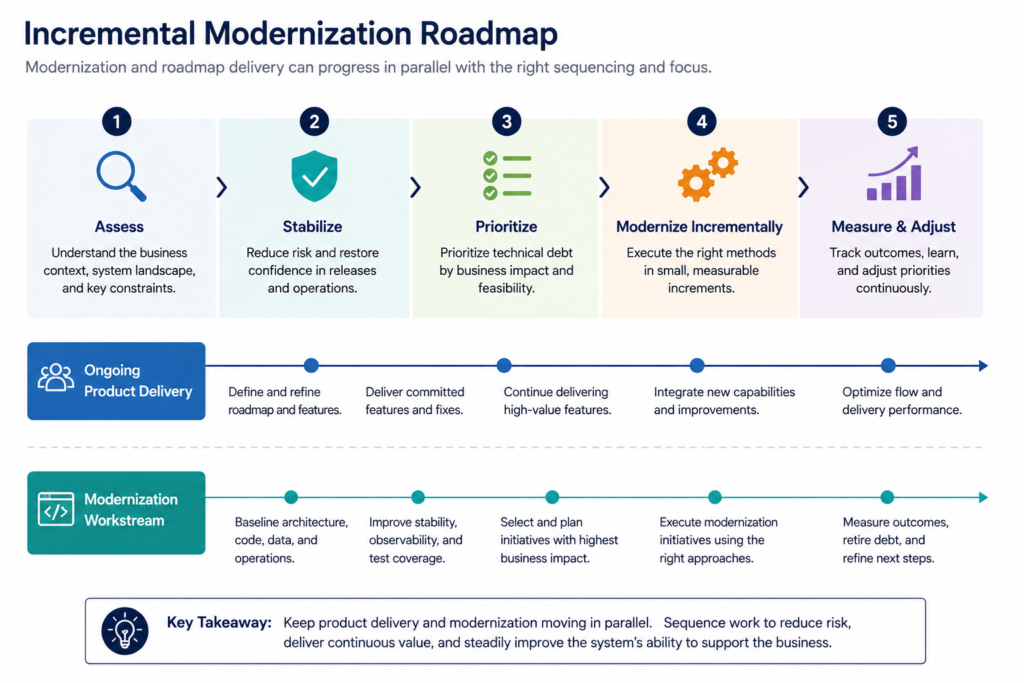
A practical modernization workflow follows five phases, which can run in parallel with ongoing product delivery when work is sequenced carefully.
- Assess: Start with business constraints, not technical preferences. What is the system preventing the company from doing? Create a baseline across architecture, codebase health, test coverage, infrastructure, security, integrations, data dependencies, release process, support burden, and team ownership.
- Stabilize: Before deeper changes, establish enough operational control to make modernization safe. Address the fragility, documentation, and process gaps that make changes unpredictable.
- Prioritize: Rank debt by business impact. The highest-priority debt is usually the debt that slows roadmap delivery, creates recurring defects, consumes senior engineering capacity, increases release risk, blocks strategic initiatives, or creates operational exposure.
- Modernize incrementally: Choose the appropriate method and sequence the work around delivery commitments. Avoid multi-quarter modernization efforts that produce no visible business value. Use incremental releases where possible. Make progress visible to product and business stakeholders.
- Measure and adjust: Track business outcomes, not technical activity. Revisit the prioritization as the system evolves and delivery conditions change.
AWS describes application modernization as an iterative process with three high-level phases: assess, modernize, and manage. It also emphasizes that understanding an application's details and its relationships with other systems is a critical step before modernization work begins.
When Each Approach Is Not Appropriate
Choosing the wrong method is one of the most common modernization mistakes. Knowing when an approach does not fit is as important as knowing when it does.
- Stabilization may not be enough when the system is no longer viable or has unsupported dependencies that must be removed.
- Refactoring may not be appropriate when the target area is poorly understood, lacks test coverage, or will soon be replaced.
- Replatforming may not help when the main problem is business logic complexity.
- API encapsulation may not help if the legacy system is unstable or the underlying data is unreliable.
- Component replacement may be too risky if boundaries are unclear.
- A full rewrite may be inappropriate when the current system still contains valuable business logic, the company cannot tolerate a long parallel-system period, or leadership expects the rewrite to be faster than incremental modernization without evidence.
What This Means for Engineering Leaders
Mid-market software companies
For mid-market software companies, the most common modernization failure mode is choosing a method before diagnosing the constraint. A team that is slipping roadmap commitments because of a fragile module does not need a full rewrite. It needs targeted stabilization, test coverage, and selective refactoring in the areas that directly affect delivery. Leaders who invest in the diagnostic step first avoid the cost of solving the wrong problem.
When the internal team is already consumed by roadmap delivery and support, this type of work requires dedicated capacity. A that integrates into the existing delivery model can provide the modernization execution capacity that frees the internal team to stay focused on roadmap work. The caveat is important: not every external partner reduces burden. The partner must integrate into the client's operating model, engineering standards, and communication rhythm.nearshore engineering team
PE-backed software portfolios
For PE-backed software portfolios, platform risk is a value creation and exit readiness issue, not just an engineering concern. Legacy systems that create delivery fragility, support burden, or diligence exposure affect the hold-period execution plan regardless of how well the business otherwise performs. Operating partners who incorporate modernization sequencing into the value creation plan from the start of a hold period avoid the more expensive scenario of addressing platform fragility under time pressure near exit.
The two practical scenarios most relevant to PE-backed portfolios are PortCos that need to improve delivery predictability without adding permanent headcount, and PortCos where platform risk surfaces during diligence and needs to be addressed before a transaction. Both benefit from the same framework: assess the real constraint first, choose the lowest-risk method that addresses it, execute incrementally with dedicated capacity, and measure business outcomes rather than technical activity. If you want to discuss how this framework applies to a specific acquisition or portfolio company, our team at Scio would be glad to talk.
Frequently Asked Questions
What is legacy system modernization?
Legacy system modernization is the process of improving a software system's ability to support current and future business needs when that system has become difficult to change, support, integrate, or operate using current practices. It may involve code, architecture, infrastructure, testing, deployment, data, security, support processes, or team ownership. Modernization is not one method. It includes refactoring, replatforming, modularization, API encapsulation, component replacement, strangler-style migration, and full rewrites, each suited to a different constraint.
What is the difference between a refactor and a rewrite?
Refactoring improves the internal structure of existing code without changing its external behavior. It targets specific high-risk or high-change areas and can be done incrementally without disrupting the running system. A rewrite replaces the existing system with a new one, which requires running old and new systems in parallel during the transition and carries the risk of rebuilding old business logic incorrectly. Refactoring is lower risk and lower cost. A rewrite is higher risk and appropriate only when the current system is no longer economically or technically viable.
What is the Strangler Fig pattern in software modernization?
The Strangler Fig pattern is an incremental migration approach where specific pieces of legacy functionality are gradually replaced by new applications and services, allowing the old system to be decommissioned over time rather than replaced in a single large-scale effort. Microsoft describes it as a technique for migrating a legacy system incrementally by building a new system alongside the old one and slowly moving features until the legacy system can be retired. The main benefit is reduced replacement risk. The main risk is the coexistence period, where old and new systems must share data, routing, and operational responsibility.
How do you decide which technical debt to address first?
Start with the debt that affects business outcomes, not the debt that is simply old or imperfect code. The highest-priority technical debt is debt that slows roadmap delivery, creates recurring production defects, consumes senior engineering capacity, increases release risk, blocks strategic initiatives, creates operational exposure, or creates key-person dependency. The lowest priority is debt that is imperfect but not affecting delivery quality, reliability, or capacity. DORA's metrics, including change lead time, deployment frequency, and change fail rate, can help teams evaluate whether their modernization choices are improving business outcomes rather than just reducing technical imperfection.
Can modernization happen while roadmap delivery continues?
Yes, but only with careful sequencing, clear ownership, realistic capacity planning, and incremental delivery. Modernization loses to urgent work when both compete for the same people. The most effective approach is to separate modernization capacity from roadmap and support capacity, sequence modernization work in small increments that each deliver a visible business outcome, and keep product stakeholders informed of progress at the same cadence as roadmap delivery. AWS recommends an assess, modernize, and manage framework that treats modernization as iterative rather than a single large-scale initiative.
What are the most common modernization mistakes engineering leaders make?
The most consistent mistakes are: choosing a modernization method before diagnosing the real constraint, which leads to solving the wrong problem; treating modernization as a technology project rather than a business decision, which disconnects it from the priorities that drive resource allocation; letting maintenance work consume the capacity set aside for modernization; and measuring technical activity rather than business outcomes. A team can complete significant refactoring or infrastructure work without improving roadmap delivery speed, support burden, or release reliability, which are the outcomes that actually matter.
When does a nearshore partner add value in a modernization program?
When the internal team's capacity is already fully committed to roadmap delivery and support, and the work requires steady execution capacity that internal engineers cannot absorb without disrupting current commitments. A nearshore partner is most effective in legacy system modernization when it integrates directly into the client's delivery model, engineering standards, and communication rhythm rather than operating as a separate workstream. The constraint to watch is that not every external partner reduces burden. If the partner requires significant coordination overhead, it can absorb more capacity than it provides.
Key Takeaways
- Modernization is a choice of method, not a single initiative.
- Technical debt should be prioritized by business impact, not engineering preference alone.
- Stabilization often needs to happen before deeper modernization.
- Replatforming, refactoring, modularization, API encapsulation, component replacement, and rewriting solve different problems.
- Full rewrites should be treated as high-risk business investments, not default modernization strategies.
- The right partner can create execution capacity, but only if they integrate well with the client's delivery model.
- Measure business outcomes, not technical activity: support burden, deployment frequency, change fail rate, and roadmap predictability.
References and Further Reading
- McKinsey and Company, Breaking Technical Debt's Vicious Cycle to Modernize Your Business. Research estimating that companies pay an additional 10 to 20 percent on project costs to address technical debt, with 30 percent of CIOs reporting that more than 20 percent of technical budget for new products is diverted to debt issues. https://www.mckinsey.com/capabilities/tech-and-ai/our-insights/breaking-technical-debts-vicious-cycle-to-modernize-your-business
- Microsoft, Select Cloud Migration Strategy (Azure Cloud Adoption Framework). Microsoft's guidance on evaluating each workload by business driver, risk profile, and technical constraint before choosing a migration or modernization approach. https://learn.microsoft.com/en-us/azure/cloud-adoption-framework/plan/select-cloud-migration-strategy
- Microsoft, Strangler Fig Pattern (Azure Architecture Center). Microsoft's definition and guidance for the Strangler Fig pattern as an incremental migration approach for this incremental migration pattern. https://learn.microsoft.com/en-us/azure/architecture/patterns/strangler-fig
- AWS, Strategy for Modernizing Applications (Prescriptive Guidance). AWS guidance on modernization as an iterative process with assess, modernize, and manage phases, emphasizing that understanding application dependencies is a critical prerequisite. https://docs.aws.amazon.com/prescriptive-guidance/latest/strategy-modernizing-applications/phases.html
- DORA, Software Delivery Performance Metrics Guide. DORA's current guidance on five useful delivery performance measures: change lead time, deployment frequency, failed deployment recovery time, change fail rate, and deployment rework rate, directly relevant to measuring whether modernization improves business outcomes. https://dora.dev/guides/dora-metrics/
- Scio blog, Legacy System Failure Risk: 5 Questions Every CTO Skips. Complementary analysis of how to evaluate legacy system risk using impact, probability, and recoverability dimensions, directly relevant to the diagnostic framework in this article. https://sciodev.com/blog/legacy-system-failure-risk/
- Scio blog, Platform Modernization Strategy: How to Reduce Risk Without Pausing the Roadmap. Practical guidance on sequencing platform modernization alongside roadmap delivery, complementing the implementation path described in this article. https://sciodev.com/blog/platform-modernization-strategy/
- Scio blog, Technical Debt Prioritization: 5 Proven Roadmap Fixes. Framework for prioritizing technical debt by business impact rather than engineering preference, directly relevant to the prioritization filter discussed in this article. https://sciodev.com/blog/technical-debt-prioritization/